Montana Land Board adopts revised land-exchange policy despite calls for more public review
May 18, 2026 | 2026 Legislature MT, Montana
This article was created by AI summarizing key points discussed. AI makes mistakes, so for full details and context, please refer to the video of the full meeting. Please report any errors so we can fix them. Report an error »
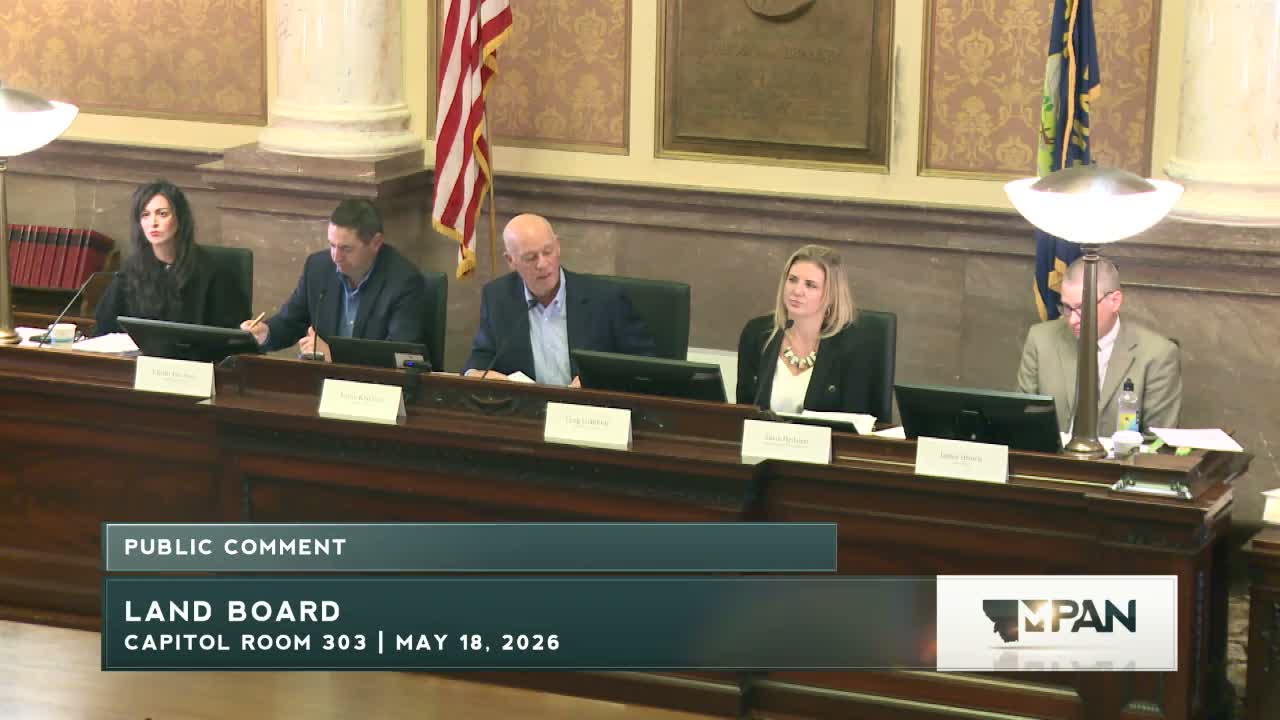
The Montana Land Board adopted a revised land-exchange policy on May [date] after extensive presentations and more than an hour of public comment from hunters, anglers, ranchers and conservation groups.
Commissioner Brown introduced the proposal and called Jack Connors, chief legal counsel to the Auditor, to describe the changes. Connors said the update brings earlier public notice into the application phase, clarifies the role and independence of consultants (including a financial-hardship exception), and preserves the constitutional duty of the five-member board to review and approve exchanges. "The revised policy does not permit the landlord to sell public land. Period," Connors said, and he framed the changes as efforts to consolidate checkerboard parcels, reduce bureaucracy and generate revenue for school beneficiaries.
DNRC deputy administrator Ryan Weiss walked through the department's historical use of scoping and stakeholder engagement for existing policies and said the department typically works with stakeholder groups to develop policy and provide public notice.
Public commenters were divided. Russell Fruits of Montana Backcountry Hunters and Anglers urged a 30-day extension, calling parts of the proposal "buried" in a long agenda and warning that a consultant-driven model could create conflicts of interest that disadvantage the public. Similar concerns came from the Montana Wildlife Federation and other conservation groups, which asked for clearer valuation criteria and a formal rulemaking process. By contrast, Trout Unlimited, Stock Growers and Farm Bureau speakers praised the increased early notice, argued the policy could improve access and consolidation of landlocked parcels, and said the consultant provisions include safeguards.
Commissioner Brown and other supporters said the policy restores decision-making authority to the board and addresses long-standing procedural delays. The governor proposed an amendment to send the policy to a 30-day public scoping period and place the item on the July agenda; that amendment failed in board votes. The board then adopted the underlying policy; one board member announced an abstention on the final vote.
What happens next: the adopted policy will be published and DNRC and the Auditor's Office will coordinate implementation and public outreach per the revised procedures. Several public commenters asked for additional rulemaking or redline comparisons; those items remain topics for ongoing implementation discussions.
Quotes and attributions in this article come from the May Land Board transcript and public comment.
Commissioner Brown introduced the proposal and called Jack Connors, chief legal counsel to the Auditor, to describe the changes. Connors said the update brings earlier public notice into the application phase, clarifies the role and independence of consultants (including a financial-hardship exception), and preserves the constitutional duty of the five-member board to review and approve exchanges. "The revised policy does not permit the landlord to sell public land. Period," Connors said, and he framed the changes as efforts to consolidate checkerboard parcels, reduce bureaucracy and generate revenue for school beneficiaries.
DNRC deputy administrator Ryan Weiss walked through the department's historical use of scoping and stakeholder engagement for existing policies and said the department typically works with stakeholder groups to develop policy and provide public notice.
Public commenters were divided. Russell Fruits of Montana Backcountry Hunters and Anglers urged a 30-day extension, calling parts of the proposal "buried" in a long agenda and warning that a consultant-driven model could create conflicts of interest that disadvantage the public. Similar concerns came from the Montana Wildlife Federation and other conservation groups, which asked for clearer valuation criteria and a formal rulemaking process. By contrast, Trout Unlimited, Stock Growers and Farm Bureau speakers praised the increased early notice, argued the policy could improve access and consolidation of landlocked parcels, and said the consultant provisions include safeguards.
Commissioner Brown and other supporters said the policy restores decision-making authority to the board and addresses long-standing procedural delays. The governor proposed an amendment to send the policy to a 30-day public scoping period and place the item on the July agenda; that amendment failed in board votes. The board then adopted the underlying policy; one board member announced an abstention on the final vote.
What happens next: the adopted policy will be published and DNRC and the Auditor's Office will coordinate implementation and public outreach per the revised procedures. Several public commenters asked for additional rulemaking or redline comparisons; those items remain topics for ongoing implementation discussions.
Quotes and attributions in this article come from the May Land Board transcript and public comment.
View the Full Meeting & All Its Details
This article offers just a summary. Unlock complete video, transcripts, and insights as a Founder Member.
✓
Watch full, unedited meeting videos
✓
Search every word spoken in unlimited transcripts
✓
AI summaries & real-time alerts (all government levels)
✓
Permanent access to expanding government content
30-day money-back guarantee
