Boise Independent District to adopt standards-based report cards for elementary students, officials say
May 18, 2026 | Boise Independent District, School Districts, Idaho
This article was created by AI summarizing key points discussed. AI makes mistakes, so for full details and context, please refer to the video of the full meeting. Please report any errors so we can fix them. Report an error »
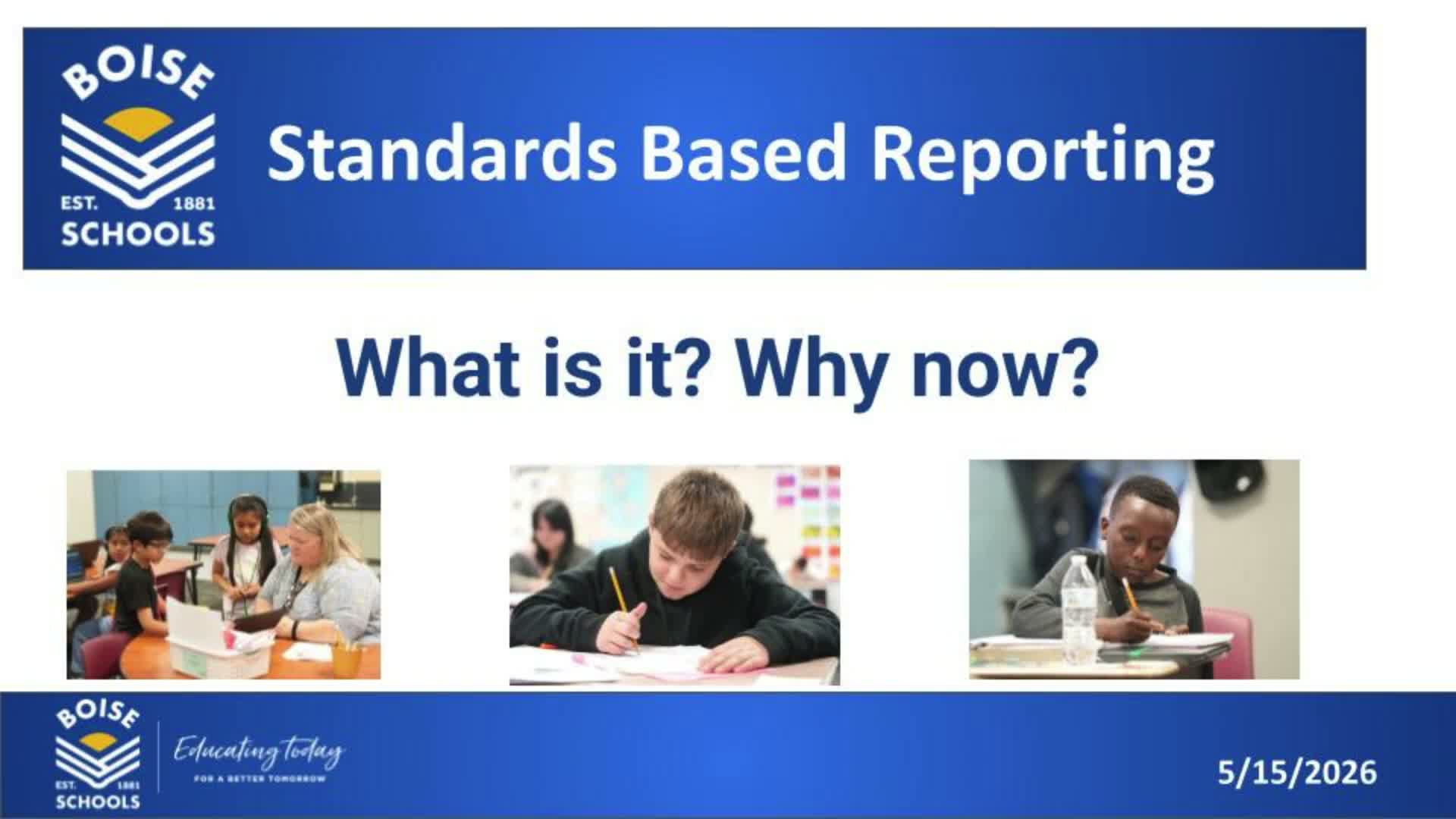
Rob Thompson, Administrator of Teaching and Learning for the Boise Independent District, said the district will roll out standards‑based reporting for kindergarten through sixth grade next school year and is sharing resources and meetings for parents.
"I'm Rob Thompson, administrator of teaching and learning for the Boise School District, and I wanna welcome you to our overview video for standards based reporting," Thompson said in the video introducing the change and the staff who will lead it.
Becca Anderson, director of teaching and learning, said the shift responds to shortcomings in traditional grading that mix completion, participation and effort into a single score. "A traditional grade tends to mix a lot of things together," Anderson said. "A 72 — we don't know much about what the student is able to do or what they need to do to improve." She said the new reports are intended to reflect a student's understanding and progress toward clearly defined learning intentions.
Anderson described the district’s four‑level scale tied to specific "learning intentions": insufficient evidence, beginning, progressing and achieving. She gave a classroom example: a learning intention might be that "a student can count forwards and backwards within a 120," and the scale will indicate whether the student is achieving that intention.
Rebecca Severson, an administrator of teaching and learning and former principal at Whitney Elementary, described school‑level work to make learning clearer for students. She recounted a student who initially could not explain what he was learning and later, in sixth grade, "was able to articulate everything that he's learning" and could say "I know that I have these 3 things to do to improve." Severson said that clarity allows students to "own their learning" and that the district will now report that progress to parents.
The district also will separate "traits of a successful learner" from academic scales. Anderson said those traits will be reported in three categories: ready to learn, works hard to learn, and works with others to learn. "We want students and families to see the work a student is doing," she said, noting that behaviors such as class discussion and work habits will be reported explicitly rather than blended into academic ratings.
Anderson said sample report cards for first grade — and a consistent format for kindergarten through sixth grade — will be available to parents and students, and that teachers and principals are the first points of contact for questions. She added that letter grades will continue in grades 7–12 to reflect secondary preparation for postsecondary and work.
The district said it has held several parent meetings in each quadrant to review the change and will provide a QR code and contact list for more information and follow‑up. Thompson closed the video by thanking viewers and encouraging parents to reach out with questions.
The rollout is framed as an initial step; district staff said they expect more conversations with families and encouraged parents to start with classroom teachers or their school principal for student‑specific concerns.
"I'm Rob Thompson, administrator of teaching and learning for the Boise School District, and I wanna welcome you to our overview video for standards based reporting," Thompson said in the video introducing the change and the staff who will lead it.
Becca Anderson, director of teaching and learning, said the shift responds to shortcomings in traditional grading that mix completion, participation and effort into a single score. "A traditional grade tends to mix a lot of things together," Anderson said. "A 72 — we don't know much about what the student is able to do or what they need to do to improve." She said the new reports are intended to reflect a student's understanding and progress toward clearly defined learning intentions.
Anderson described the district’s four‑level scale tied to specific "learning intentions": insufficient evidence, beginning, progressing and achieving. She gave a classroom example: a learning intention might be that "a student can count forwards and backwards within a 120," and the scale will indicate whether the student is achieving that intention.
Rebecca Severson, an administrator of teaching and learning and former principal at Whitney Elementary, described school‑level work to make learning clearer for students. She recounted a student who initially could not explain what he was learning and later, in sixth grade, "was able to articulate everything that he's learning" and could say "I know that I have these 3 things to do to improve." Severson said that clarity allows students to "own their learning" and that the district will now report that progress to parents.
The district also will separate "traits of a successful learner" from academic scales. Anderson said those traits will be reported in three categories: ready to learn, works hard to learn, and works with others to learn. "We want students and families to see the work a student is doing," she said, noting that behaviors such as class discussion and work habits will be reported explicitly rather than blended into academic ratings.
Anderson said sample report cards for first grade — and a consistent format for kindergarten through sixth grade — will be available to parents and students, and that teachers and principals are the first points of contact for questions. She added that letter grades will continue in grades 7–12 to reflect secondary preparation for postsecondary and work.
The district said it has held several parent meetings in each quadrant to review the change and will provide a QR code and contact list for more information and follow‑up. Thompson closed the video by thanking viewers and encouraging parents to reach out with questions.
The rollout is framed as an initial step; district staff said they expect more conversations with families and encouraged parents to start with classroom teachers or their school principal for student‑specific concerns.
View the Full Meeting & All Its Details
This article offers just a summary. Unlock complete video, transcripts, and insights as a Founder Member.
✓
Watch full, unedited meeting videos
✓
Search every word spoken in unlimited transcripts
✓
AI summaries & real-time alerts (all government levels)
✓
Permanent access to expanding government content
30-day money-back guarantee
