Interim committee trims 2026 work plan, prioritizes infrastructure workshops, disaster recovery and water planning
May 18, 2026 | House of Representatives, Committees, Legislative, New Mexico
This article was created by AI summarizing key points discussed. AI makes mistakes, so for full details and context, please refer to the video of the full meeting. Please report any errors so we can fix them. Report an error »
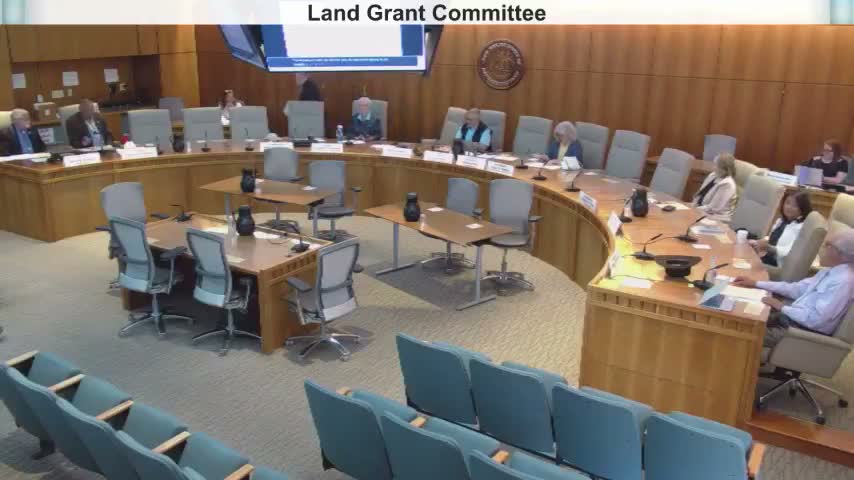
The Land Grants and Acequias interim committee reviewed and narrowed its 2026 work plan on May 18 in Santa Fe, centering the roster on infrastructure funding, disaster recovery capacity, governance statute updates and technical assistance to local boards. Chair Sen. Leo Jaramillo said the committee will use a June Roundhouse meeting to convene state agencies and try to craft a bill that can move next session.
"The very first item on the agenda on the proposed work plan is approaches to infrastructure investment," Mark Edwards, committee staff, told members, laying out a plan to bring agencies to a workshop so lawmakers can ‘‘flesh out what the issues are and see if the committee can craft a bill for the upcoming legislative session that will have some legs to it.’’
Why it matters: Land grants and acequias face repeated hurdles getting capital projects built, committee members said, in part because local boards often lack technical capacity and because prior bond- or severance-tax-based bills failed in recent sessions. Lawmakers said a focused interim process could surface options—including nonbond funding—before the next regular session.
Key elements of the work plan
- Infrastructure workshop: The committee will dedicate its June meeting in the Roundhouse to an infrastructure workshop, inviting agencies that have commented on past legislation in hopes of producing a draft bill. Edwards summarized past efforts to dedicate part of the state’s severance tax bond capacity to land-grant and acequia infrastructure and noted those efforts were ‘‘hung up in each of the last 2 years.’’
- Disaster-recovery capacity: Edwards urged the committee to study the state’s ability to support long-term reconstruction after floods and fires, saying immediate federal aid often stabilizes communities but does not fully rebuild them. He proposed examining whether a state construction capacity could respond to water-system and washed-out-road repairs that common transportation agencies do not cover.
- Governance and Attorney General treaty division review: The committee will review governance challenges for land-grant entities and whether the treaty division in the Attorney General’s office needs statutory updates to reflect its current responsibilities. Edwards referenced House Memorial 24 as prior committee work relevant to that review.
- Technical assistance and capital-outlay readiness: Members emphasized recurring problems with land-grant boards’ capacity to meet audit, planning and feasibility requirements needed to spend capital-outlay dollars. Edwards said the committee will examine whether state technical assistance is adequately resourced so long-stalled capital requests can be completed and funds spent.
- Water planning coordination: Several members asked the committee to make water a central theme of the interim work, pointing to a persistent Rio Grande Valley shortage. Representative Garcia urged the committee to incorporate the valley’s crisis—where he said some irrigators received only seven total deliveries last irrigation season, down from weekly deliveries years earlier—into the plan.
"On average, up to 2022 we were getting an irrigation once a week," Representative Garcia said. "Seven irrigations in the whole irrigation season … puts us at one irrigation per month. You can't grow forage crops or pasture crops on one irrigation a month."
Members asked staff to bring water-funding actors—such as programs that run the Water Trust Fund and the New Mexico Finance Authority—into planning discussions so land-grant communities better understand grant and loan processes.
- Education and youth programs: Representative Torres Velasquez urged adding school- and youth-focused curricula and outdoor-education projects tied to land-grant history and agriculture. Edwards said the committee has previously invited youth-program coordinators and will continue to include such presentations while seeking to avoid duplicating standing education committee work.
Questions and next steps
Sen. Stefanik asked that public-health planning tied to climate events be included alongside disaster response, and urged examination of recent Forest Service and BLM organizational changes and how those could affect land-grant interactions. Sen. Thoren asked the committee to consider the overlap between the Water Trust Fund and other funding paths and suggested inviting the New Mexico Finance Authority to co-present with the acequia commission.
Sen. Linda Lopez requested a briefing from the state engineer on implementation of a law that she said grants acequias a first right of refusal in certain water matters, citing concerns from a South Valley acequia about how that law is being applied.
Chair’s note on uranium mining and scheduling
Jaramillo flagged a Canadian company's application for uranium mining in northern New Mexico as an item likely to draw land-grant concern over downstream water and environmental impacts when the committee meets in Espanola. "A major issue happening in Northern New Mexico is uranium mining by the Canadian company that has put in their application," he said, and said the committee expects to hear land-grant testimony in Espanola.
The committee also approved travel for interim meetings in Espanola and Taos to hear local reports and invited the state ombudsman to present on services for rural communities. Members emphasized that funding remains the top issue for land grants and acequias and directed staff to assemble agency panels and follow-up briefings ahead of the June Roundhouse workshop.
The committee adjourned and will reconvene in July in Santa Fe; staff and members noted that public comment had not been taken and that the committee will include it at the next meeting.
Sources: Committee staff presentation by Mark Edwards; remarks and questions from Sen. Leo Jaramillo (chair), Representative Garcia, Representative Torres Velasquez, Sen. Stefanik, Sen. Thoren and Sen. Linda Lopez as recorded in the committee transcript.
"The very first item on the agenda on the proposed work plan is approaches to infrastructure investment," Mark Edwards, committee staff, told members, laying out a plan to bring agencies to a workshop so lawmakers can ‘‘flesh out what the issues are and see if the committee can craft a bill for the upcoming legislative session that will have some legs to it.’’
Why it matters: Land grants and acequias face repeated hurdles getting capital projects built, committee members said, in part because local boards often lack technical capacity and because prior bond- or severance-tax-based bills failed in recent sessions. Lawmakers said a focused interim process could surface options—including nonbond funding—before the next regular session.
Key elements of the work plan
- Infrastructure workshop: The committee will dedicate its June meeting in the Roundhouse to an infrastructure workshop, inviting agencies that have commented on past legislation in hopes of producing a draft bill. Edwards summarized past efforts to dedicate part of the state’s severance tax bond capacity to land-grant and acequia infrastructure and noted those efforts were ‘‘hung up in each of the last 2 years.’’
- Disaster-recovery capacity: Edwards urged the committee to study the state’s ability to support long-term reconstruction after floods and fires, saying immediate federal aid often stabilizes communities but does not fully rebuild them. He proposed examining whether a state construction capacity could respond to water-system and washed-out-road repairs that common transportation agencies do not cover.
- Governance and Attorney General treaty division review: The committee will review governance challenges for land-grant entities and whether the treaty division in the Attorney General’s office needs statutory updates to reflect its current responsibilities. Edwards referenced House Memorial 24 as prior committee work relevant to that review.
- Technical assistance and capital-outlay readiness: Members emphasized recurring problems with land-grant boards’ capacity to meet audit, planning and feasibility requirements needed to spend capital-outlay dollars. Edwards said the committee will examine whether state technical assistance is adequately resourced so long-stalled capital requests can be completed and funds spent.
- Water planning coordination: Several members asked the committee to make water a central theme of the interim work, pointing to a persistent Rio Grande Valley shortage. Representative Garcia urged the committee to incorporate the valley’s crisis—where he said some irrigators received only seven total deliveries last irrigation season, down from weekly deliveries years earlier—into the plan.
"On average, up to 2022 we were getting an irrigation once a week," Representative Garcia said. "Seven irrigations in the whole irrigation season … puts us at one irrigation per month. You can't grow forage crops or pasture crops on one irrigation a month."
Members asked staff to bring water-funding actors—such as programs that run the Water Trust Fund and the New Mexico Finance Authority—into planning discussions so land-grant communities better understand grant and loan processes.
- Education and youth programs: Representative Torres Velasquez urged adding school- and youth-focused curricula and outdoor-education projects tied to land-grant history and agriculture. Edwards said the committee has previously invited youth-program coordinators and will continue to include such presentations while seeking to avoid duplicating standing education committee work.
Questions and next steps
Sen. Stefanik asked that public-health planning tied to climate events be included alongside disaster response, and urged examination of recent Forest Service and BLM organizational changes and how those could affect land-grant interactions. Sen. Thoren asked the committee to consider the overlap between the Water Trust Fund and other funding paths and suggested inviting the New Mexico Finance Authority to co-present with the acequia commission.
Sen. Linda Lopez requested a briefing from the state engineer on implementation of a law that she said grants acequias a first right of refusal in certain water matters, citing concerns from a South Valley acequia about how that law is being applied.
Chair’s note on uranium mining and scheduling
Jaramillo flagged a Canadian company's application for uranium mining in northern New Mexico as an item likely to draw land-grant concern over downstream water and environmental impacts when the committee meets in Espanola. "A major issue happening in Northern New Mexico is uranium mining by the Canadian company that has put in their application," he said, and said the committee expects to hear land-grant testimony in Espanola.
The committee also approved travel for interim meetings in Espanola and Taos to hear local reports and invited the state ombudsman to present on services for rural communities. Members emphasized that funding remains the top issue for land grants and acequias and directed staff to assemble agency panels and follow-up briefings ahead of the June Roundhouse workshop.
The committee adjourned and will reconvene in July in Santa Fe; staff and members noted that public comment had not been taken and that the committee will include it at the next meeting.
Sources: Committee staff presentation by Mark Edwards; remarks and questions from Sen. Leo Jaramillo (chair), Representative Garcia, Representative Torres Velasquez, Sen. Stefanik, Sen. Thoren and Sen. Linda Lopez as recorded in the committee transcript.
View the Full Meeting & All Its Details
This article offers just a summary. Unlock complete video, transcripts, and insights as a Founder Member.
✓
Watch full, unedited meeting videos
✓
Search every word spoken in unlimited transcripts
✓
AI summaries & real-time alerts (all government levels)
✓
Permanent access to expanding government content
30-day money-back guarantee
