Conference committee adopts higher-education package with funding swaps for fraud prevention, trees and workforce development
May 16, 2026 | 2026 Legislature MN, Minnesota
This article was created by AI summarizing key points discussed. AI makes mistakes, so for full details and context, please refer to the video of the full meeting. Please report any errors so we can fix them. Report an error »
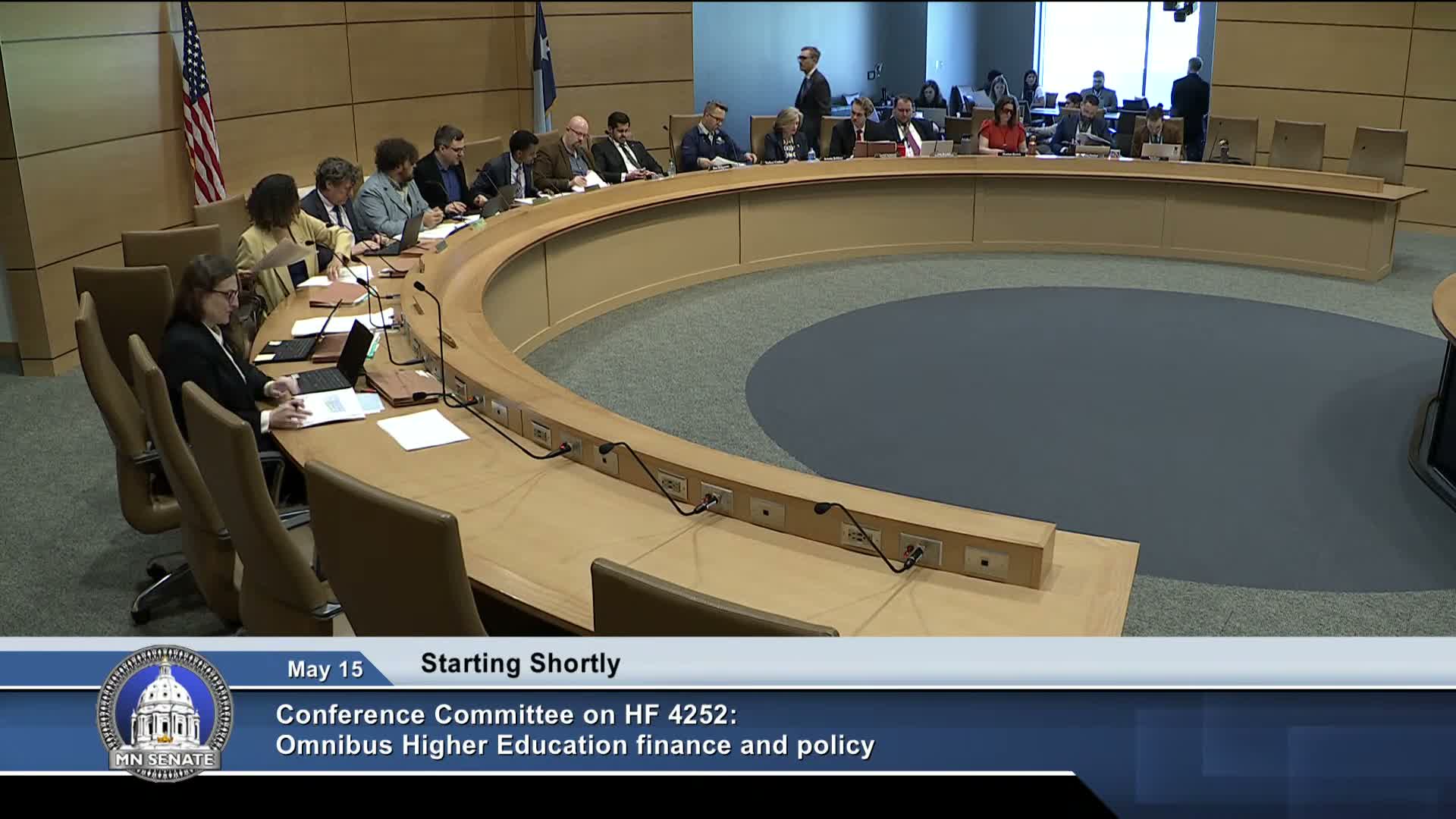
The conference committee on higher education approved a conference report after a daylong session that included negotiated funding shifts and a string of amendment votes.
Clerk summarized the interchamber agreement that the A17 amendment would fund fraud-prevention software for Minnesota State and dedicate $5,000 for trees, while the A19 amendment contains $570,000 directed to workforce development. The committee also noted a $1,500,000 general-fund contribution to cover a fixed shortfall and discussed drawing roughly $1,000,001 from the fraud-prevention line to balance the package.
Senator Eric Rehrig, chair, told the committee he expects lawmakers to restore Minnesota State funding in the next biennium, saying "we should absolutely make them whole when we come back into the next biennium." Representative Robbins and others voiced support for immediate fraud-prevention spending while warning it will be an ongoing expense: "it is very important that we deal with this ghost fraud problem," Robbins said.
Committee members moved and adopted the A17 amendment by voice vote and later adopted A19 after debate over jurisdiction of workforce development funds and assurances from leadership that the transfer is permitted. Members also adopted the A12 amendment clarifying leave policies for pregnant and parenting students and several other technical changes after brief discussion and stakeholder confirmation.
The committee heard guidance from the Minnesota Office of Higher Education on several technical provisions and accepted the office's recommendation not to adopt redundant language in R27, R31 and R32 because the matters are already covered in statute or by actions taken earlier in the process.
The chair moved to adopt the full conference report and directed staff to make technical and conforming changes; the committee approved the report by voice vote and concluded its business before the 4 p.m. deadline.
The conference report now proceeds to the next steps in the legislative process; committee members said the package reflects compromise language negotiated with House counterparts and includes provisions they intend to revisit in the next biennium if needed.
Clerk summarized the interchamber agreement that the A17 amendment would fund fraud-prevention software for Minnesota State and dedicate $5,000 for trees, while the A19 amendment contains $570,000 directed to workforce development. The committee also noted a $1,500,000 general-fund contribution to cover a fixed shortfall and discussed drawing roughly $1,000,001 from the fraud-prevention line to balance the package.
Senator Eric Rehrig, chair, told the committee he expects lawmakers to restore Minnesota State funding in the next biennium, saying "we should absolutely make them whole when we come back into the next biennium." Representative Robbins and others voiced support for immediate fraud-prevention spending while warning it will be an ongoing expense: "it is very important that we deal with this ghost fraud problem," Robbins said.
Committee members moved and adopted the A17 amendment by voice vote and later adopted A19 after debate over jurisdiction of workforce development funds and assurances from leadership that the transfer is permitted. Members also adopted the A12 amendment clarifying leave policies for pregnant and parenting students and several other technical changes after brief discussion and stakeholder confirmation.
The committee heard guidance from the Minnesota Office of Higher Education on several technical provisions and accepted the office's recommendation not to adopt redundant language in R27, R31 and R32 because the matters are already covered in statute or by actions taken earlier in the process.
The chair moved to adopt the full conference report and directed staff to make technical and conforming changes; the committee approved the report by voice vote and concluded its business before the 4 p.m. deadline.
The conference report now proceeds to the next steps in the legislative process; committee members said the package reflects compromise language negotiated with House counterparts and includes provisions they intend to revisit in the next biennium if needed.
Don't Miss a Word: See the Full Meeting!
Go beyond summaries. Unlock every video, transcript, and key insight with a Founder Membership.
✓
Get instant access to full meeting videos
✓
Search and clip any phrase from complete transcripts
✓
Receive AI-powered summaries & custom alerts
✓
Enjoy lifetime, unrestricted access to government data
30-day money-back guarantee
