Committee debates lowering statewide attainment goal and whether to involve Children, Youth and Families in reporting
May 16, 2026 | 2026 Legislature MN, Minnesota
This article was created by AI summarizing key points discussed. AI makes mistakes, so for full details and context, please refer to the video of the full meeting. Please report any errors so we can fix them. Report an error »
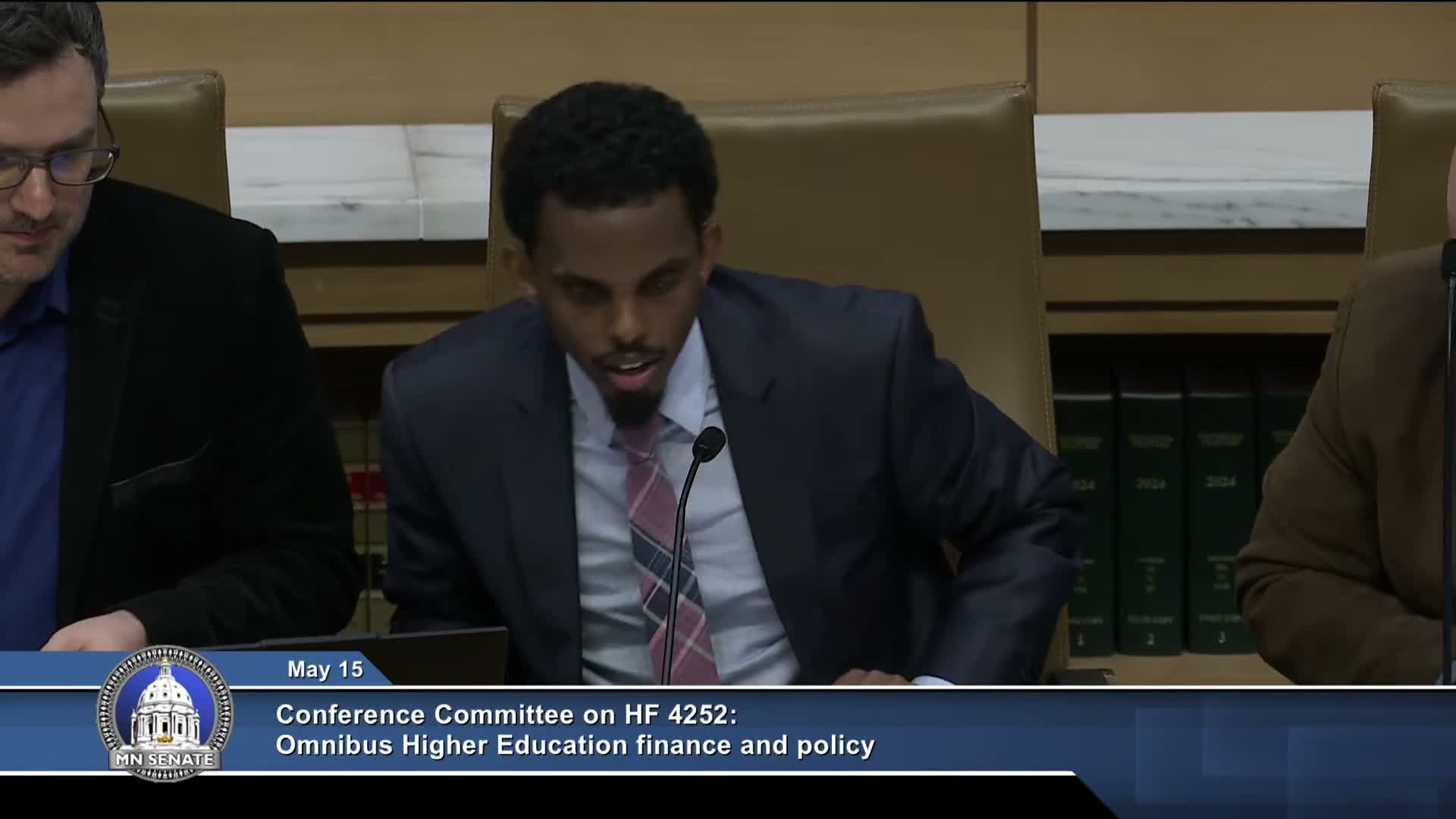
Senators and representatives spent substantial time on A15, a provision to change the statewide higher-education attainment goal and the statutory language that defines reporting and interagency roles.
Senator Umu Ruben said he proposed lowering the attainment target to 70% to align with House discussions. Committee counsel and members reviewed the senate language and the fiscal impacts described in fiscal notes. Representative Eric (speaking in committee) raised concern about expanding work beyond the Office of Higher Education’s usual duties and about imposing costs on other agencies without agreements.
Dennis Olsen, commissioner of the Minnesota Office of Higher Education, testified that OHE and the P-20 partnership indicated no cost for participation, but the fiscal note for the Department of Children, Youth and Families (DCYF) included assumptions about reporting-program updates: an initial $15,000 programming cost to update early-childhood reporting and an assumption of up to 1.5 FTE for ongoing reporting duties.
Members debated options: some proposed striking DCYF from lines 3.2–3.3 to avoid statutorily imposing costs on an agency not under the committee’s jurisdiction; others argued DCYF’s participation reflects existing partnerships and would be best retained for data and subgoal development. Senator Mulvavey and others moved an oral amendment that included striking DCYF in the reporting lines and directing the reviser to change instances of '75' to '70' through the relevant sections.
The record shows the committee gave direction to the reviser to ensure every instance of '75' between the cited lines is adjusted to '70.' The chair announced adoption of the amended language by voice vote, though the transcript contains a short procedural confusion immediately afterward. Committee members agreed to continue work next year on remaining definitional or jurisdictional details as needed.
The committee did not adopt language that would expand reporting duties without clarifying fiscal responsibility; in several places members preferred retaining early-childhood and K–12 engagement on a partnership basis rather than as a statutory obligation.
Senator Umu Ruben said he proposed lowering the attainment target to 70% to align with House discussions. Committee counsel and members reviewed the senate language and the fiscal impacts described in fiscal notes. Representative Eric (speaking in committee) raised concern about expanding work beyond the Office of Higher Education’s usual duties and about imposing costs on other agencies without agreements.
Dennis Olsen, commissioner of the Minnesota Office of Higher Education, testified that OHE and the P-20 partnership indicated no cost for participation, but the fiscal note for the Department of Children, Youth and Families (DCYF) included assumptions about reporting-program updates: an initial $15,000 programming cost to update early-childhood reporting and an assumption of up to 1.5 FTE for ongoing reporting duties.
Members debated options: some proposed striking DCYF from lines 3.2–3.3 to avoid statutorily imposing costs on an agency not under the committee’s jurisdiction; others argued DCYF’s participation reflects existing partnerships and would be best retained for data and subgoal development. Senator Mulvavey and others moved an oral amendment that included striking DCYF in the reporting lines and directing the reviser to change instances of '75' to '70' through the relevant sections.
The record shows the committee gave direction to the reviser to ensure every instance of '75' between the cited lines is adjusted to '70.' The chair announced adoption of the amended language by voice vote, though the transcript contains a short procedural confusion immediately afterward. Committee members agreed to continue work next year on remaining definitional or jurisdictional details as needed.
The committee did not adopt language that would expand reporting duties without clarifying fiscal responsibility; in several places members preferred retaining early-childhood and K–12 engagement on a partnership basis rather than as a statutory obligation.
Don't Miss a Word: See the Full Meeting!
Go beyond summaries. Unlock every video, transcript, and key insight with a Founder Membership.
✓
Get instant access to full meeting videos
✓
Search and clip any phrase from complete transcripts
✓
Receive AI-powered summaries & custom alerts
✓
Enjoy lifetime, unrestricted access to government data
30-day money-back guarantee
