Consultant outlines student-centered, measurable approach to Northshore strategic-plan refresh
May 17, 2026 | Northshore School District, School Districts, Washington
This article was created by AI summarizing key points discussed. AI makes mistakes, so for full details and context, please refer to the video of the full meeting. Please report any errors so we can fix them. Report an error »
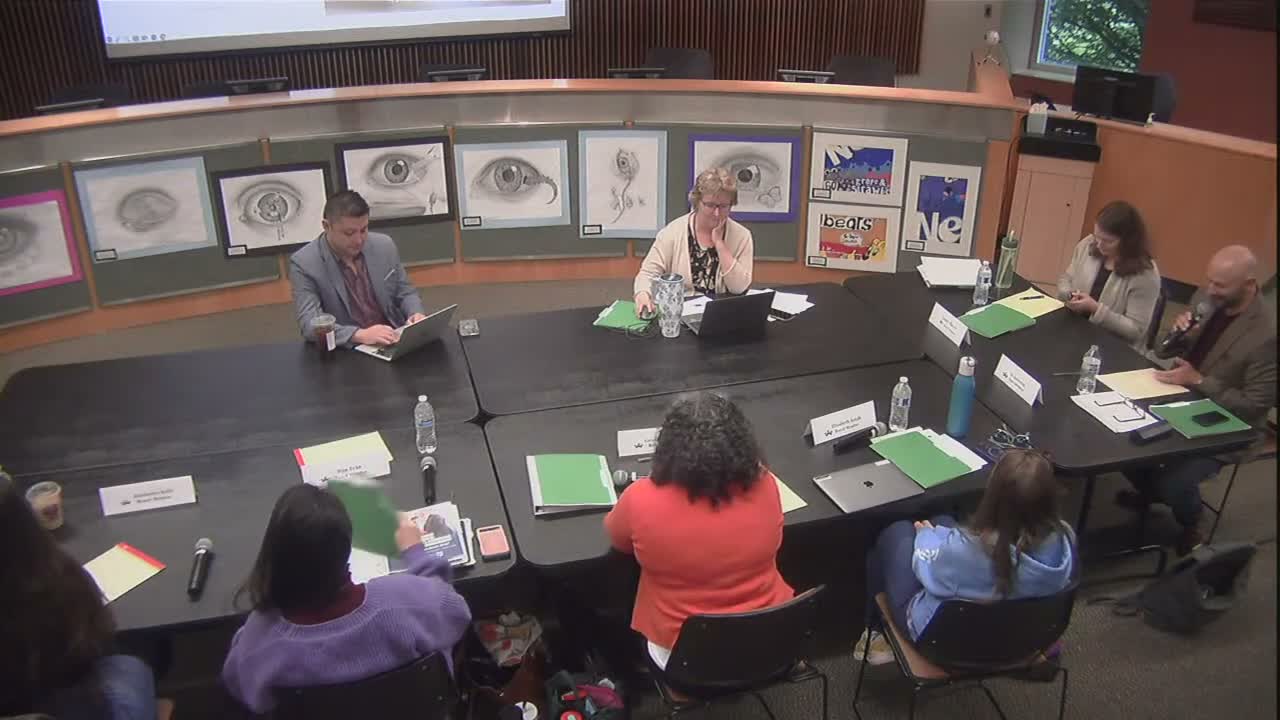
Superintendent Irish introduced Dr. Tammy Campbell of Scholar First to the Northshore School District board at a Saturday retreat and framed the work as a "refresh," not a complete rewrite, of the district’s strategic plan.
Campbell, a former superintendent who said she founded Scholar First four years ago, described a process grounded in student voice, co-construction with staff and community and a clear theory of action that backward-maps classroom practices to district goals. "The process is the product, not the actual plan," Campbell said, arguing that involving teachers, instructional coaches and students produces ownership and increases the likelihood of sustained implementation.
Campbell proposed a structure of committees: a core planning team (the district leadership team), a graduate-profile committee that includes students and a larger instructional planning team (she suggested roughly 90–150 participants for different groups depending on task). She described four goal areas: a whole-child social-emotional goal plus three academic goals aligned to elementary, middle and high school levels. Each school would keep goal area 1 and then adopt the grade-level goal(s) appropriate to its level.
Board members repeatedly pressed on measurability and the risk of losing qualitative priorities such as creativity and critical thinking. "I do not want us to stop the understanding of the importance that our students are critical thinkers, creative thinkers, innovative thinkers," President Sandy Hayes said, adding she would "be a dog with a bone" to preserve those priorities. Campbell and the superintendent responded that the process emphasizes performance targets, success criteria and observable classroom practices so qualitative aims can be translated into measurable outcomes and monitored over time.
Equity and racial-educational-justice (REJ) concerns were raised as a through-line to the entire plan. Campbell said equity should be operationalized in classroom practices and in how student voices and community perspectives are included in committee work, rather than siloed as a separate column.
Campbell provided examples from other districts (Mount Vernon, Portland, Battle Creek and Quincy) to show how districts set a limited number of initiatives and use balanced implementation so schools are not overwhelmed. She also described deliverables Scholar First would provide, including internal and external plan documents, a short video of the process, and artifacts to help socialize the plan with the community.
Superintendent Irish outlined next steps: administrators and principals will collect student input on the "vision of the student experience," core planning teams and committees will be formed in the fall, and the board will receive governance check-ins in fall, winter and spring. The revised plan will be brought back to the board for a vote; no formal action was taken at the retreat.
Campbell, a former superintendent who said she founded Scholar First four years ago, described a process grounded in student voice, co-construction with staff and community and a clear theory of action that backward-maps classroom practices to district goals. "The process is the product, not the actual plan," Campbell said, arguing that involving teachers, instructional coaches and students produces ownership and increases the likelihood of sustained implementation.
Campbell proposed a structure of committees: a core planning team (the district leadership team), a graduate-profile committee that includes students and a larger instructional planning team (she suggested roughly 90–150 participants for different groups depending on task). She described four goal areas: a whole-child social-emotional goal plus three academic goals aligned to elementary, middle and high school levels. Each school would keep goal area 1 and then adopt the grade-level goal(s) appropriate to its level.
Board members repeatedly pressed on measurability and the risk of losing qualitative priorities such as creativity and critical thinking. "I do not want us to stop the understanding of the importance that our students are critical thinkers, creative thinkers, innovative thinkers," President Sandy Hayes said, adding she would "be a dog with a bone" to preserve those priorities. Campbell and the superintendent responded that the process emphasizes performance targets, success criteria and observable classroom practices so qualitative aims can be translated into measurable outcomes and monitored over time.
Equity and racial-educational-justice (REJ) concerns were raised as a through-line to the entire plan. Campbell said equity should be operationalized in classroom practices and in how student voices and community perspectives are included in committee work, rather than siloed as a separate column.
Campbell provided examples from other districts (Mount Vernon, Portland, Battle Creek and Quincy) to show how districts set a limited number of initiatives and use balanced implementation so schools are not overwhelmed. She also described deliverables Scholar First would provide, including internal and external plan documents, a short video of the process, and artifacts to help socialize the plan with the community.
Superintendent Irish outlined next steps: administrators and principals will collect student input on the "vision of the student experience," core planning teams and committees will be formed in the fall, and the board will receive governance check-ins in fall, winter and spring. The revised plan will be brought back to the board for a vote; no formal action was taken at the retreat.
Don't Miss a Word: See the Full Meeting!
Go beyond summaries. Unlock every video, transcript, and key insight with a Founder Membership.
✓
Get instant access to full meeting videos
✓
Search and clip any phrase from complete transcripts
✓
Receive AI-powered summaries & custom alerts
✓
Enjoy lifetime, unrestricted access to government data
30-day money-back guarantee
