Conference committee pauses changes to home-care nursing coverage, directs agency review
May 16, 2026 | 2026 Legislature MN, Minnesota
This article was created by AI summarizing key points discussed. AI makes mistakes, so for full details and context, please refer to the video of the full meeting. Please report any errors so we can fix them. Report an error »
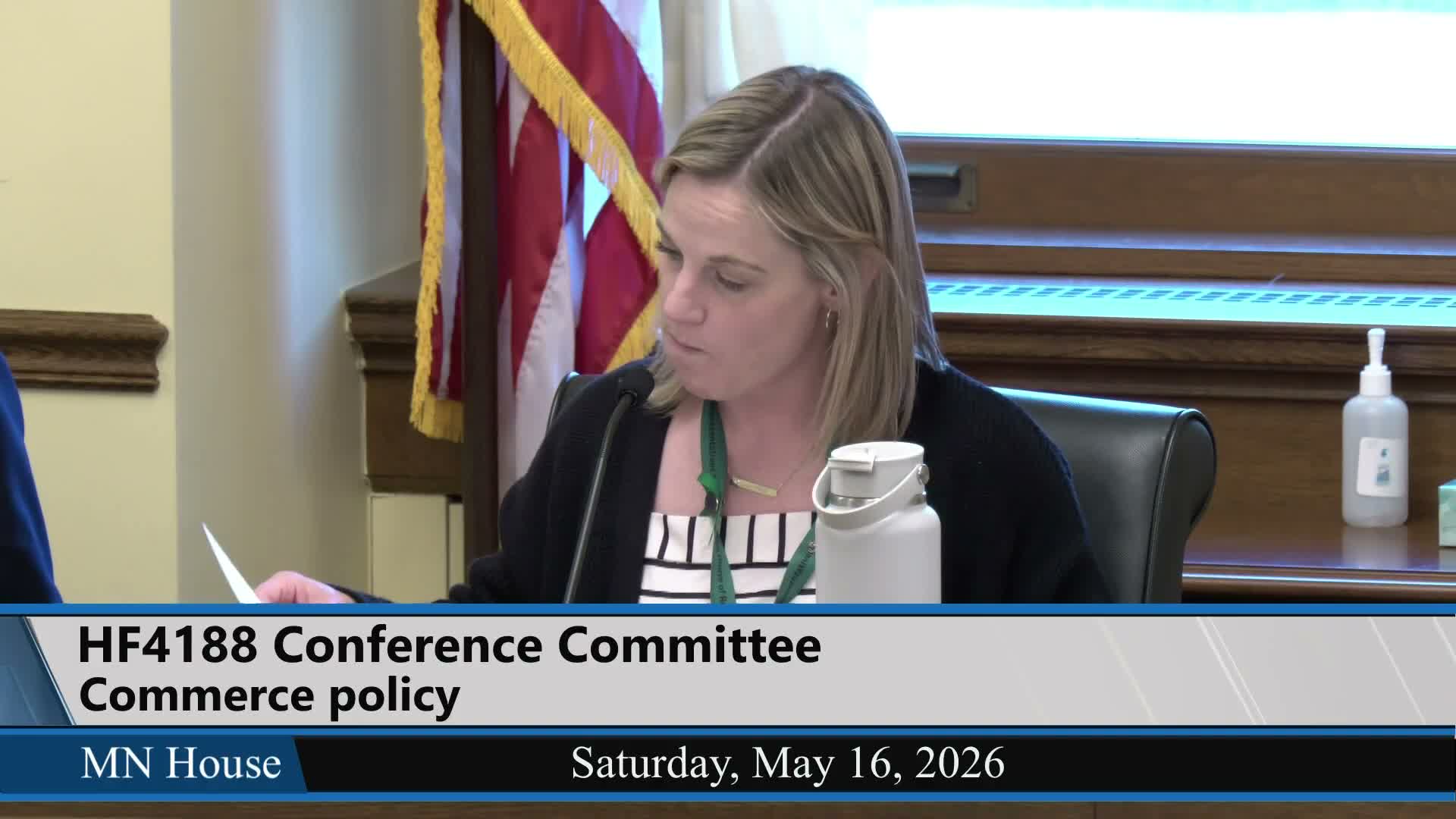
The conference committee on House File 4188 adopted an amendment May 16 directing the Department of Commerce and the Department of Health and Human Services to review state requirements and the fiscal and family impacts of private duty/home care nursing coverage before lawmakers take further action.
The amendment (A30) — described by a committee sponsor as a temporary pause — was framed as a way to avoid rushed fixes after insurers recently notified some families that home nursing hours would be limited. Sen. Bolden, who was invited to testify, told the committee the change could affect about 200 to 250 families in Minnesota, most of them children with complex medical needs who require hospital-level nursing care at home. “We were surprised by letters from two insurance companies that the care they rely on to keep their children alive and in their homes was going to be capped arbitrarily,” Sen. Bolden said.
Committee members and the chair relayed concerns from clinicians. The chair cited an email from a Children’s Hospital clinician and quoted Dr. Michael Shreeves saying limits on home nursing could force children into hospitals and reduce capacity for other critical-care patients. Committee members said shifting those costs to state waivers would strain waiver budgets and could increase the state human services budget.
Grace Arnold, commissioner of the Minnesota Department of Commerce, answered committee questions about plan contract language and statutory mandates. Arnold said plan documents commonly group a range of services under a ‘‘home care services’’ banner and acknowledged there is a statutory mandate covering aspects of this care. She told the committee that enforcement actions are case-specific and noted the consent order with HealthPartners addressed a particular set of circumstances for a subgroup of enrollees. When asked how many families were affected by HealthPartners’ rescinded prior authorizations, Arnold said the number was ‘‘in the teens’’ and that she would confirm the exact figure.
Committee members also referenced a Council of Health Plans letter that shows HealthPartners’ benchmark plan lists private duty nursing separately from home health services. Members pressed whether state mandates that exceed the federal essential health benefits benchmark require plans to cover the services and whether the state must pick up costs beyond the benchmark; Arnold said state mandates can be placed and the state generally covers costs above the federal benchmark.
A committee participant also cited an estimate from health plans of roughly $187 million (as stated in the hearing record) as a potential increase to human services costs tied to coverage shifts; the estimate was presented during discussion and characterized in the record as approximate.
The A30 amendment passed by voice vote; no roll-call tally was recorded in the transcript. The amendment instructs agencies to review the ‘‘62j’’ mandate language (as referenced in the record), consider fiscal impacts on the state and families, prioritize affordability for complex medical needs, and identify potential legislation for 2027. Committee members described the adoption as a bipartisan commitment to avoid creating new hardships for affected families while agencies examine the technical and budgetary issues.
The committee also heard members express regret that a fuller statutory fix did not clear the conference report; several members said they intend to pursue additional work next session, including consideration of a state innovation ("1332") waiver and reinsurance measures to address premium volatility. The committee then directed nonpartisan staff to prepare the conference committee report and empowered staff to make technical, conforming changes to reflect the committee’s intent; that motion also passed by voice vote.
The conference committee adjourned after finalizing the report.
The amendment (A30) — described by a committee sponsor as a temporary pause — was framed as a way to avoid rushed fixes after insurers recently notified some families that home nursing hours would be limited. Sen. Bolden, who was invited to testify, told the committee the change could affect about 200 to 250 families in Minnesota, most of them children with complex medical needs who require hospital-level nursing care at home. “We were surprised by letters from two insurance companies that the care they rely on to keep their children alive and in their homes was going to be capped arbitrarily,” Sen. Bolden said.
Committee members and the chair relayed concerns from clinicians. The chair cited an email from a Children’s Hospital clinician and quoted Dr. Michael Shreeves saying limits on home nursing could force children into hospitals and reduce capacity for other critical-care patients. Committee members said shifting those costs to state waivers would strain waiver budgets and could increase the state human services budget.
Grace Arnold, commissioner of the Minnesota Department of Commerce, answered committee questions about plan contract language and statutory mandates. Arnold said plan documents commonly group a range of services under a ‘‘home care services’’ banner and acknowledged there is a statutory mandate covering aspects of this care. She told the committee that enforcement actions are case-specific and noted the consent order with HealthPartners addressed a particular set of circumstances for a subgroup of enrollees. When asked how many families were affected by HealthPartners’ rescinded prior authorizations, Arnold said the number was ‘‘in the teens’’ and that she would confirm the exact figure.
Committee members also referenced a Council of Health Plans letter that shows HealthPartners’ benchmark plan lists private duty nursing separately from home health services. Members pressed whether state mandates that exceed the federal essential health benefits benchmark require plans to cover the services and whether the state must pick up costs beyond the benchmark; Arnold said state mandates can be placed and the state generally covers costs above the federal benchmark.
A committee participant also cited an estimate from health plans of roughly $187 million (as stated in the hearing record) as a potential increase to human services costs tied to coverage shifts; the estimate was presented during discussion and characterized in the record as approximate.
The A30 amendment passed by voice vote; no roll-call tally was recorded in the transcript. The amendment instructs agencies to review the ‘‘62j’’ mandate language (as referenced in the record), consider fiscal impacts on the state and families, prioritize affordability for complex medical needs, and identify potential legislation for 2027. Committee members described the adoption as a bipartisan commitment to avoid creating new hardships for affected families while agencies examine the technical and budgetary issues.
The committee also heard members express regret that a fuller statutory fix did not clear the conference report; several members said they intend to pursue additional work next session, including consideration of a state innovation ("1332") waiver and reinsurance measures to address premium volatility. The committee then directed nonpartisan staff to prepare the conference committee report and empowered staff to make technical, conforming changes to reflect the committee’s intent; that motion also passed by voice vote.
The conference committee adjourned after finalizing the report.
Don't Miss a Word: See the Full Meeting!
Go beyond summaries. Unlock every video, transcript, and key insight with a Founder Membership.
✓
Get instant access to full meeting videos
✓
Search and clip any phrase from complete transcripts
✓
Receive AI-powered summaries & custom alerts
✓
Enjoy lifetime, unrestricted access to government data
30-day money-back guarantee
