Brentwood subcommittee reviews resident survey on recycling, explores pilots as vendor contract limits options
May 16, 2026 | Brentwood Town, Rockingham County, New Hampshire
This article was created by AI summarizing key points discussed. AI makes mistakes, so for full details and context, please refer to the video of the full meeting. Please report any errors so we can fix them. Report an error »
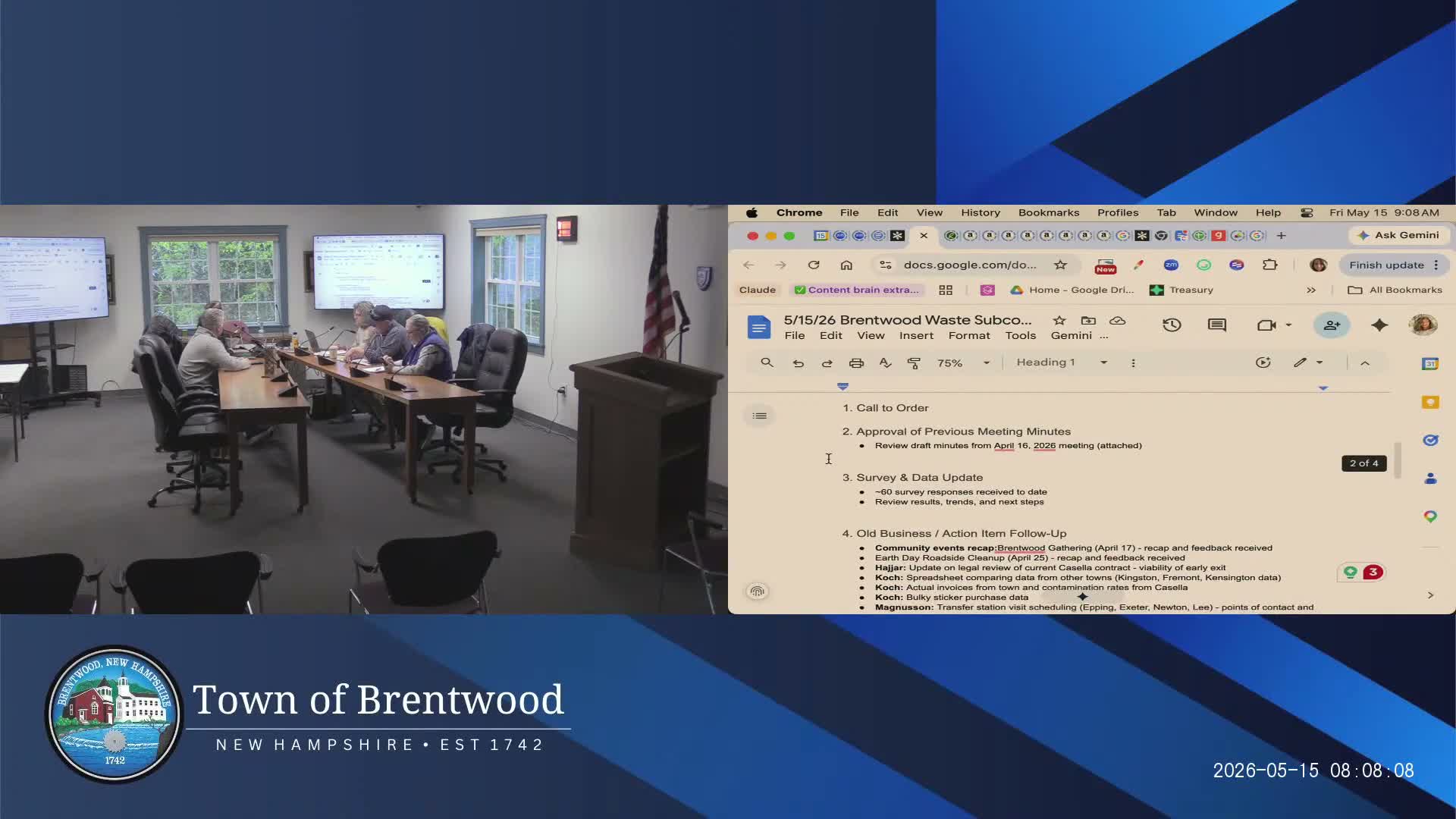
The Brentwood Town Solid Waste & Recycling Subcommittee met to review early results from a resident survey and to discuss options for reducing waste and managing recycling costs.
Chair (speaker S1) said the committee has "about 63 respondents to the survey," collected at the Brentwood Gathering, Earth Day and by newsletter postings, and described preliminary themes: broad use of recycling for cardboard, plastic and glass, some household composting, and barriers including convenience and uncertainty about what is recyclable. "Most people recycle every other week," the Chair said, while noting a small number reported recycling rarely or never.
The group spent much of the meeting weighing tradeoffs between convenience and costs. A member with years of industry experience (Presenter, S5) warned that single‑stream recycling and longer transport distances raise processing and transport costs and that diversion strategies can create unexpected expenses. "When you look at our cost per ton, regardless of the material, we are paying more," the Presenter said, adding that markets have shifted and material is now transported farther.
Legal and contract constraints shaped the discussion. A committee member (S2) summarized advice from counsel: "there's really nothing we can do about the contract getting out of the contract. It'd be very, very difficult to get out of the contract." Members said the town appears to be in the early years of a multi‑year contract with Casella and noted the contract may include provisions for roll‑offs or town‑placed bins but limits unilateral changes to curbside service.
Given those limits, the subcommittee prioritized practical pilots and outreach. Members agreed to investigate drop‑off bins for cardboard, textiles and other materials; to explore private compost pickup options (one vendor quoted $10 per pickup, with potential discounts at scale); and to schedule visits to nearby transfer stations to learn operational models. The Presenter reported contacts with New Hampshire Recycles (formerly the Northeast Resource Recycling Alliance) and suggested that organization could offer education and technical assistance via Zoom.
Committee members emphasized the importance of data and clear cost estimates before proposing policy changes. "We need to look at cost per household," a committee member said, noting total waste and recycling costs discussed in the meeting. The Chair said the subcommittee will aggregate survey responses, prepare pivot‑table analysis and return with scenario planning on what changes would mean for households' costs and for town contracts.
Procedural items: the committee moved and approved minutes from the prior meeting (motion by Committee member, S2; second by the Chair). One member abstained, citing inability to open the minutes document. The group set a follow‑up meeting for June 25 at 10:00 a.m., agreed to organize visits to regional facilities, and to invite a representative from New Hampshire Recycles to the next meeting by Zoom.
The meeting closed after a final motion to adjourn, which passed by voice vote.
Chair (speaker S1) said the committee has "about 63 respondents to the survey," collected at the Brentwood Gathering, Earth Day and by newsletter postings, and described preliminary themes: broad use of recycling for cardboard, plastic and glass, some household composting, and barriers including convenience and uncertainty about what is recyclable. "Most people recycle every other week," the Chair said, while noting a small number reported recycling rarely or never.
The group spent much of the meeting weighing tradeoffs between convenience and costs. A member with years of industry experience (Presenter, S5) warned that single‑stream recycling and longer transport distances raise processing and transport costs and that diversion strategies can create unexpected expenses. "When you look at our cost per ton, regardless of the material, we are paying more," the Presenter said, adding that markets have shifted and material is now transported farther.
Legal and contract constraints shaped the discussion. A committee member (S2) summarized advice from counsel: "there's really nothing we can do about the contract getting out of the contract. It'd be very, very difficult to get out of the contract." Members said the town appears to be in the early years of a multi‑year contract with Casella and noted the contract may include provisions for roll‑offs or town‑placed bins but limits unilateral changes to curbside service.
Given those limits, the subcommittee prioritized practical pilots and outreach. Members agreed to investigate drop‑off bins for cardboard, textiles and other materials; to explore private compost pickup options (one vendor quoted $10 per pickup, with potential discounts at scale); and to schedule visits to nearby transfer stations to learn operational models. The Presenter reported contacts with New Hampshire Recycles (formerly the Northeast Resource Recycling Alliance) and suggested that organization could offer education and technical assistance via Zoom.
Committee members emphasized the importance of data and clear cost estimates before proposing policy changes. "We need to look at cost per household," a committee member said, noting total waste and recycling costs discussed in the meeting. The Chair said the subcommittee will aggregate survey responses, prepare pivot‑table analysis and return with scenario planning on what changes would mean for households' costs and for town contracts.
Procedural items: the committee moved and approved minutes from the prior meeting (motion by Committee member, S2; second by the Chair). One member abstained, citing inability to open the minutes document. The group set a follow‑up meeting for June 25 at 10:00 a.m., agreed to organize visits to regional facilities, and to invite a representative from New Hampshire Recycles to the next meeting by Zoom.
The meeting closed after a final motion to adjourn, which passed by voice vote.
Don't Miss a Word: See the Full Meeting!
Go beyond summaries. Unlock every video, transcript, and key insight with a Founder Membership.
✓
Get instant access to full meeting videos
✓
Search and clip any phrase from complete transcripts
✓
Receive AI-powered summaries & custom alerts
✓
Enjoy lifetime, unrestricted access to government data
30-day money-back guarantee
