Broward housing council chair: County has invested about $1 billion in affordable housing as state pushes development
May 16, 2026 | Broward County, Florida
This article was created by AI summarizing key points discussed. AI makes mistakes, so for full details and context, please refer to the video of the full meeting. Please report any errors so we can fix them. Report an error »
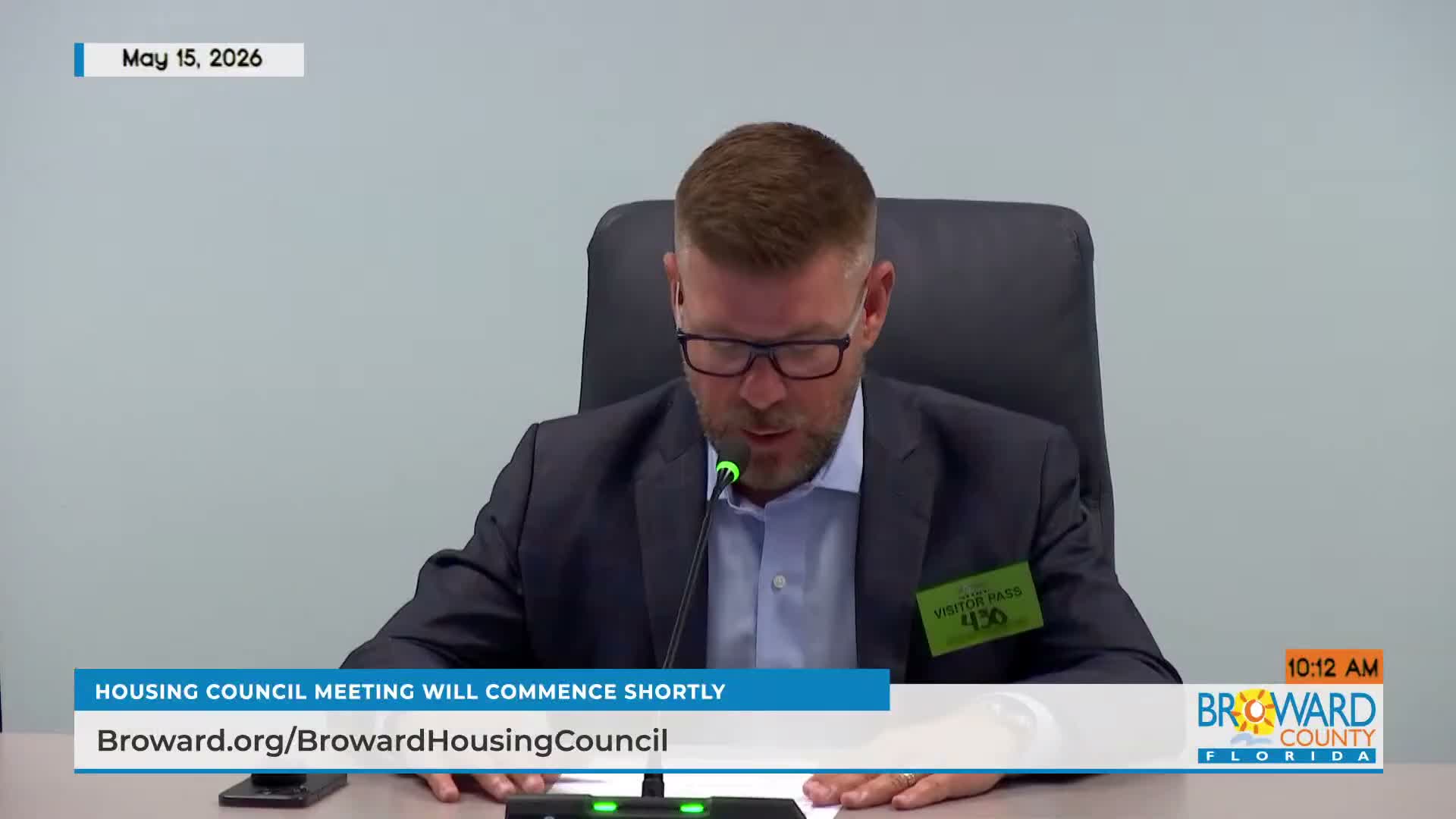
Chair Sue opened the meeting with a county- and state-level update on affordable housing.
"Broward County has now invested roughly $1,000,000,000 into affordable housing initiatives, helping create over 4,500 units to date," Sue said, and described county work to redirect expiring CRA dollars into the county’s affordable housing trust fund.
She said about 90% of those redirected CRA dollars will go to the trust fund to support families, seniors and workers, and that, to date, the trust fund has provided gap financing for thousands of homes and rentals.
Sue also described rising demand and persistent shortfalls: "we're still well behind where we need to be," she said, noting a countywide shortage she summarized as approximately 75,000 affordable units and that only one in four families can currently afford housing in Broward.
On state policy, Sue said lawmakers have advanced the fourth iteration of what participants called the Live Local effort—referred to in the meeting as 'Florida Live Local 4' or House Bill 13 89—and that the legislation increases developer protections, promotes tax incentives and fast-track approvals, and limits some local zoning or height restrictions. "The state is basically doubling down on supply side solutions, and increasingly preempting local control to make that happen," she said.
Council members and staff framed this shift as a practical tension: Broward will continue funding and facilitating development, they said, but execution, coordination and safeguards will determine whether those state-level policies translate into units that serve the county’s workforce and most at-risk residents.
The chair closed this portion by asking the council to focus on whether county policies and funding will translate into homes on the ground and to use upcoming meetings and the June workshop to refine priorities and responses to state changes.
"Broward County has now invested roughly $1,000,000,000 into affordable housing initiatives, helping create over 4,500 units to date," Sue said, and described county work to redirect expiring CRA dollars into the county’s affordable housing trust fund.
She said about 90% of those redirected CRA dollars will go to the trust fund to support families, seniors and workers, and that, to date, the trust fund has provided gap financing for thousands of homes and rentals.
Sue also described rising demand and persistent shortfalls: "we're still well behind where we need to be," she said, noting a countywide shortage she summarized as approximately 75,000 affordable units and that only one in four families can currently afford housing in Broward.
On state policy, Sue said lawmakers have advanced the fourth iteration of what participants called the Live Local effort—referred to in the meeting as 'Florida Live Local 4' or House Bill 13 89—and that the legislation increases developer protections, promotes tax incentives and fast-track approvals, and limits some local zoning or height restrictions. "The state is basically doubling down on supply side solutions, and increasingly preempting local control to make that happen," she said.
Council members and staff framed this shift as a practical tension: Broward will continue funding and facilitating development, they said, but execution, coordination and safeguards will determine whether those state-level policies translate into units that serve the county’s workforce and most at-risk residents.
The chair closed this portion by asking the council to focus on whether county policies and funding will translate into homes on the ground and to use upcoming meetings and the June workshop to refine priorities and responses to state changes.
Don't Miss a Word: See the Full Meeting!
Go beyond summaries. Unlock every video, transcript, and key insight with a Founder Membership.
✓
Get instant access to full meeting videos
✓
Search and clip any phrase from complete transcripts
✓
Receive AI-powered summaries & custom alerts
✓
Enjoy lifetime, unrestricted access to government data
30-day money-back guarantee
