Philadelphia City Council finance committee hears testimony on economy for Black women
May 15, 2026 | Philadelphia City, Pennsylvania
This article was created by AI summarizing key points discussed. AI makes mistakes, so for full details and context, please refer to the video of the full meeting. Please report any errors so we can fix them. Report an error »
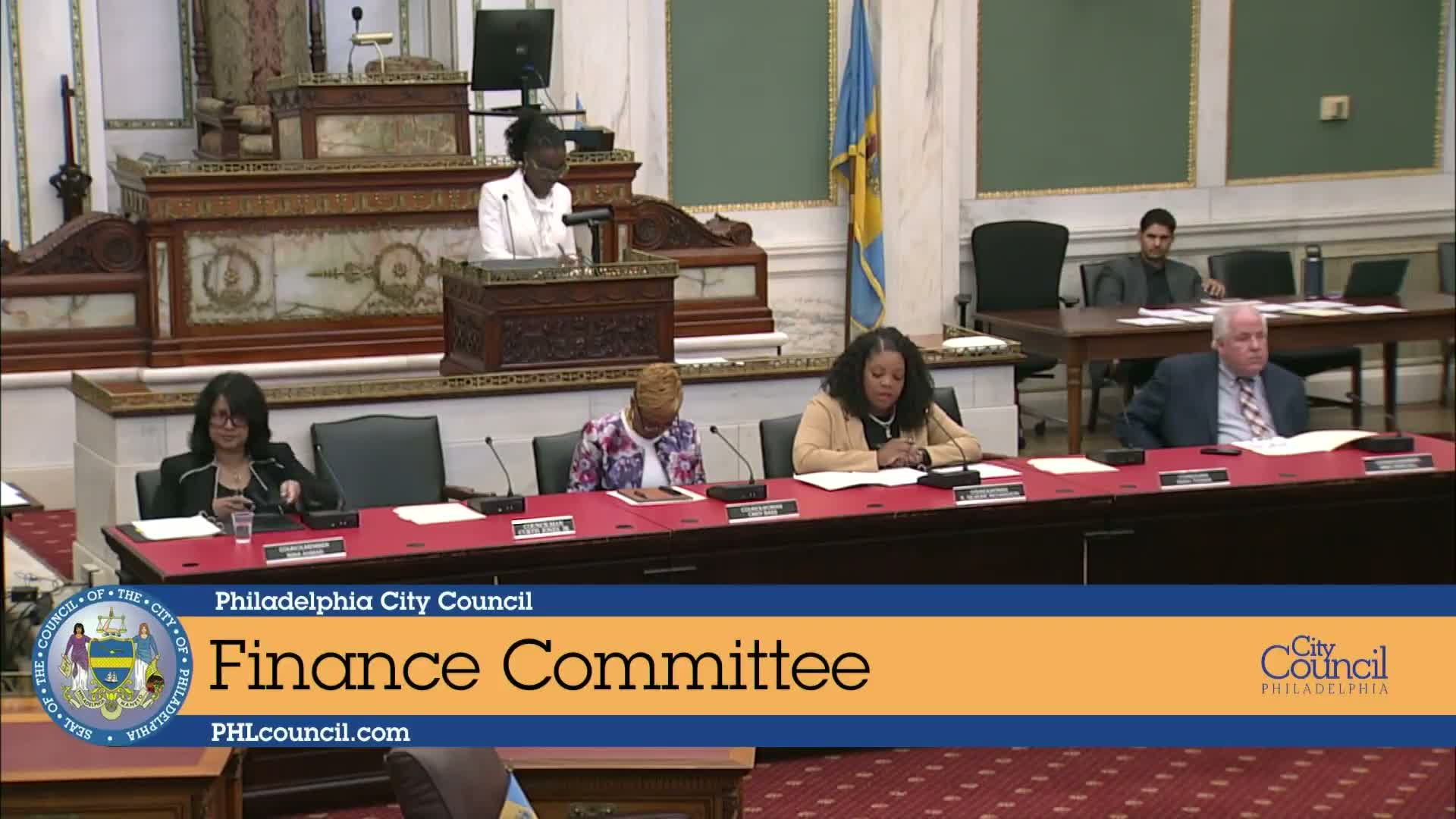
The Philadelphia City Council Committee on Finance held a public hearing on resolution 251034 examining the state of the economy for Black women in Philadelphia, hearing testimony from state legislators, nonprofit leaders and dozens of local entrepreneurs.
State Representative Morgan Cephas, chair of the Philadelphia House delegation, told the committee, "Black women are not failing the economy. The economy is failing Black women," and urged policymakers to treat childcare, paid leave, maternal health and transportation as core economic infrastructure rather than optional programs. Cephas framed three next steps: align economic policy with care infrastructure, invest directly in Black women’s economic mobility (citing guaranteed income pilots and baby bonds), and embed accountability across systems.
The hearing mixed high-level policy proposals with personal testimony. Jasmine Sessoms, president of Center 1968, urged the council to require contracting and procurement data be disaggregated by race and gender and to set public targets for contracting dollars to Black-women-owned businesses. "We cannot fix what we refuse to see," Sessoms said, citing large revenue gaps between typical woman‑owned firms and Black-woman‑owned firms.
State Representative Daresha Parker warned that recent federal layoffs and attacks on diversity, equity and inclusion have disproportionately affected Black women in public employment; she cited claims that roughly 30% of Black women federal employees lost jobs during recent federal reductions. Panelists from the National Coalition of 100 Black Women asked the council to establish a targeted micro‑business relief fund for firms with under $50,000 in annual revenue, to direct Commerce Department outreach into Black business communities, and to commission a disparity study focused on Black‑women business owners.
Multiple entrepreneurs described structural barriers in existing city and philanthropic programs: eligibility rules that require five years of audited financial statements, minimum employee counts, or revenue thresholds that exclude microbusinesses and online service firms. Chelsea Cox, who runs a data and strategy consultancy, urged the city to modernize supports for non‑storefront, digital and service‑based firms.
Health and caregiving concerns threaded through testimony. Witnesses connected maternal health, unpaid caregiving and chronic stress to both workplace exits and higher medical costs; doulas and maternal health advocates asked the city to consider policy and funding priorities that reduce those burdens.
The committee took no formal votes at the hearing. Members asked for written testimony and indicated follow‑up: the chair said staff would collect written statements for the record and the council will coordinate with the Commerce and Revenue departments to address technical assistance and access issues raised by witnesses.
What happens next: the committee will incorporate testimony into a report tied to resolution 251034 and pursue follow‑up meetings with Commerce, Revenue and the Pennsylvania Human Relations Commission to explore procurement targets, technical assistance programs for microbusinesses and potential legislative remedies to strengthen workplace protections and accountability.
Attribution: Quotes and assertions in this story come directly from witnesses at the April public hearing of the Philadelphia City Council Committee on Finance on resolution 251034. Primary speakers quoted include State Representative Morgan Cephas; Jasmine Sessoms, president of Center 1968; State Representative Daresha Parker; and multiple named entrepreneurs and advocates who testified for the record.
State Representative Morgan Cephas, chair of the Philadelphia House delegation, told the committee, "Black women are not failing the economy. The economy is failing Black women," and urged policymakers to treat childcare, paid leave, maternal health and transportation as core economic infrastructure rather than optional programs. Cephas framed three next steps: align economic policy with care infrastructure, invest directly in Black women’s economic mobility (citing guaranteed income pilots and baby bonds), and embed accountability across systems.
The hearing mixed high-level policy proposals with personal testimony. Jasmine Sessoms, president of Center 1968, urged the council to require contracting and procurement data be disaggregated by race and gender and to set public targets for contracting dollars to Black-women-owned businesses. "We cannot fix what we refuse to see," Sessoms said, citing large revenue gaps between typical woman‑owned firms and Black-woman‑owned firms.
State Representative Daresha Parker warned that recent federal layoffs and attacks on diversity, equity and inclusion have disproportionately affected Black women in public employment; she cited claims that roughly 30% of Black women federal employees lost jobs during recent federal reductions. Panelists from the National Coalition of 100 Black Women asked the council to establish a targeted micro‑business relief fund for firms with under $50,000 in annual revenue, to direct Commerce Department outreach into Black business communities, and to commission a disparity study focused on Black‑women business owners.
Multiple entrepreneurs described structural barriers in existing city and philanthropic programs: eligibility rules that require five years of audited financial statements, minimum employee counts, or revenue thresholds that exclude microbusinesses and online service firms. Chelsea Cox, who runs a data and strategy consultancy, urged the city to modernize supports for non‑storefront, digital and service‑based firms.
Health and caregiving concerns threaded through testimony. Witnesses connected maternal health, unpaid caregiving and chronic stress to both workplace exits and higher medical costs; doulas and maternal health advocates asked the city to consider policy and funding priorities that reduce those burdens.
The committee took no formal votes at the hearing. Members asked for written testimony and indicated follow‑up: the chair said staff would collect written statements for the record and the council will coordinate with the Commerce and Revenue departments to address technical assistance and access issues raised by witnesses.
What happens next: the committee will incorporate testimony into a report tied to resolution 251034 and pursue follow‑up meetings with Commerce, Revenue and the Pennsylvania Human Relations Commission to explore procurement targets, technical assistance programs for microbusinesses and potential legislative remedies to strengthen workplace protections and accountability.
Attribution: Quotes and assertions in this story come directly from witnesses at the April public hearing of the Philadelphia City Council Committee on Finance on resolution 251034. Primary speakers quoted include State Representative Morgan Cephas; Jasmine Sessoms, president of Center 1968; State Representative Daresha Parker; and multiple named entrepreneurs and advocates who testified for the record.
View the Full Meeting & All Its Details
This article offers just a summary. Unlock complete video, transcripts, and insights as a Founder Member.
✓
Watch full, unedited meeting videos
✓
Search every word spoken in unlimited transcripts
✓
AI summaries & real-time alerts (all government levels)
✓
Permanent access to expanding government content
30-day money-back guarantee
