Newton County adopts new UDO rules limiting convenience‑store size, pumps and adding site‑maintenance requirements
May 15, 2026 | Newton County, Georgia
This article was created by AI summarizing key points discussed. AI makes mistakes, so for full details and context, please refer to the video of the full meeting. Please report any errors so we can fix them. Report an error »
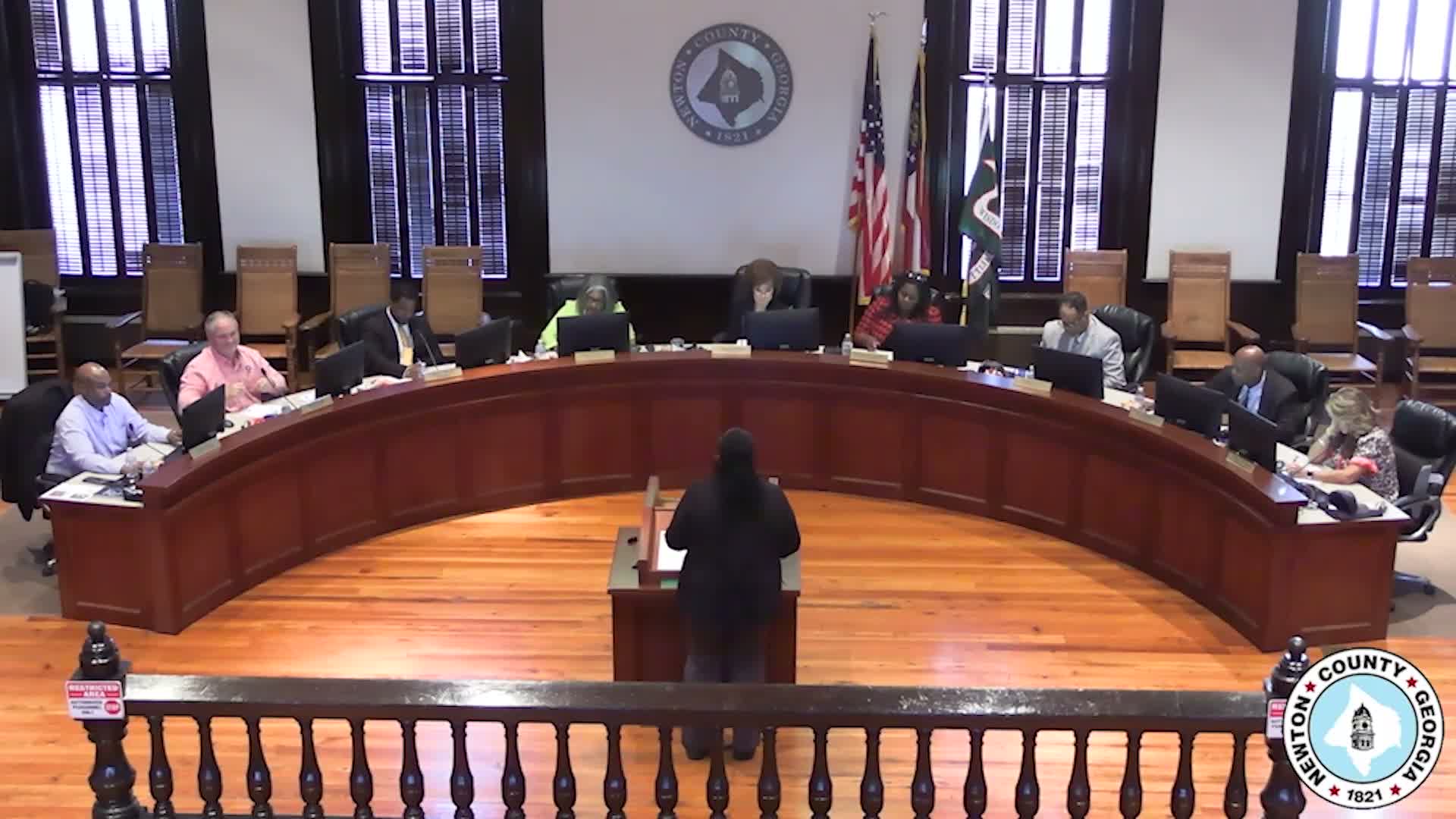
The Newton County Board of Commissioners on May 5 unanimously approved UDOAMD26‑001, a text amendment to Chapter 1, Article 5 of the county Unified Development Ordinance that places new limits on convenience stores and requires ongoing site maintenance of nonresidential properties.
Development Services planner Shana Applewhite told the board the amendment addresses growing demand for convenience‑store uses and aims to protect nearby residential areas. The ordinance revision limits gross leasable floor area for a convenience store to 5,000 square feet, caps canopy height at 18 feet, and limits fuel operations to no more than 12 pump stations without a conditional‑use permit. The draft also bars outdoor storage, prohibits loitering on store premises, and requires opaque 8‑foot screening where a convenience store adjoins residential zoning.
The amendment establishes separation rules intended to reduce clustering of gas stations: gas‑station uses must be at least 2 miles apart in a straight line from property line to property line, and only two convenience stores are permitted at a single four‑way intersection (on opposite sides). Lighting for canopies must be designed to prevent glare and spillover onto adjacent properties, and the planning commission recommended increasing required video‑surveillance retention from 30 to 60 days; staff incorporated that recommendation.
A new Section 500.015 creates site‑maintenance standards that apply to CN, CH and CG commercial properties, including cleanliness (removal of trash and debris), replacement of dead or damaged landscaping, and repair or replacement of damaged site elements such as curbing, dumpster screening, pavement and signage. The amendment preserves existing timely‑development provisions (site plans and land‑disturbance activity must begin within specified timeframes) and gives code enforcement the authority to notify the board and initiate rezoning if owners fail to comply.
Commissioner Mason asked whether the maintenance standard could be made more prescriptive — for example, requiring edging and weed control — and Applewhite said staff would review those suggestions as the county finalizes the full UDO update. “I definitely like to see if we can potentially add that piece,” Mason said, asking staff to consider a clearer definition of “maintained.” Commissioner Long said he wanted the amendment in place quickly but supported revisiting and strengthening the landscaping language in the final UDO.
The planning commission recommended the video‑retention change on April 28. The board voted to adopt the amendment as presented; staff said code enforcement can begin enforcing the new provisions on adoption. The amendment will apply to projects submitted after the effective date and will not apply retroactively to projects already in the pipeline.
Development Services planner Shana Applewhite told the board the amendment addresses growing demand for convenience‑store uses and aims to protect nearby residential areas. The ordinance revision limits gross leasable floor area for a convenience store to 5,000 square feet, caps canopy height at 18 feet, and limits fuel operations to no more than 12 pump stations without a conditional‑use permit. The draft also bars outdoor storage, prohibits loitering on store premises, and requires opaque 8‑foot screening where a convenience store adjoins residential zoning.
The amendment establishes separation rules intended to reduce clustering of gas stations: gas‑station uses must be at least 2 miles apart in a straight line from property line to property line, and only two convenience stores are permitted at a single four‑way intersection (on opposite sides). Lighting for canopies must be designed to prevent glare and spillover onto adjacent properties, and the planning commission recommended increasing required video‑surveillance retention from 30 to 60 days; staff incorporated that recommendation.
A new Section 500.015 creates site‑maintenance standards that apply to CN, CH and CG commercial properties, including cleanliness (removal of trash and debris), replacement of dead or damaged landscaping, and repair or replacement of damaged site elements such as curbing, dumpster screening, pavement and signage. The amendment preserves existing timely‑development provisions (site plans and land‑disturbance activity must begin within specified timeframes) and gives code enforcement the authority to notify the board and initiate rezoning if owners fail to comply.
Commissioner Mason asked whether the maintenance standard could be made more prescriptive — for example, requiring edging and weed control — and Applewhite said staff would review those suggestions as the county finalizes the full UDO update. “I definitely like to see if we can potentially add that piece,” Mason said, asking staff to consider a clearer definition of “maintained.” Commissioner Long said he wanted the amendment in place quickly but supported revisiting and strengthening the landscaping language in the final UDO.
The planning commission recommended the video‑retention change on April 28. The board voted to adopt the amendment as presented; staff said code enforcement can begin enforcing the new provisions on adoption. The amendment will apply to projects submitted after the effective date and will not apply retroactively to projects already in the pipeline.
View the Full Meeting & All Its Details
This article offers just a summary. Unlock complete video, transcripts, and insights as a Founder Member.
✓
Watch full, unedited meeting videos
✓
Search every word spoken in unlimited transcripts
✓
AI summaries & real-time alerts (all government levels)
✓
Permanent access to expanding government content
30-day money-back guarantee
