Baker County planners preview mobile‑food‑vendor rules as owners press for enforcement and flexible permits
May 15, 2026 | Baker County, Florida
This article was created by AI summarizing key points discussed. AI makes mistakes, so for full details and context, please refer to the video of the full meeting. Please report any errors so we can fix them. Report an error »
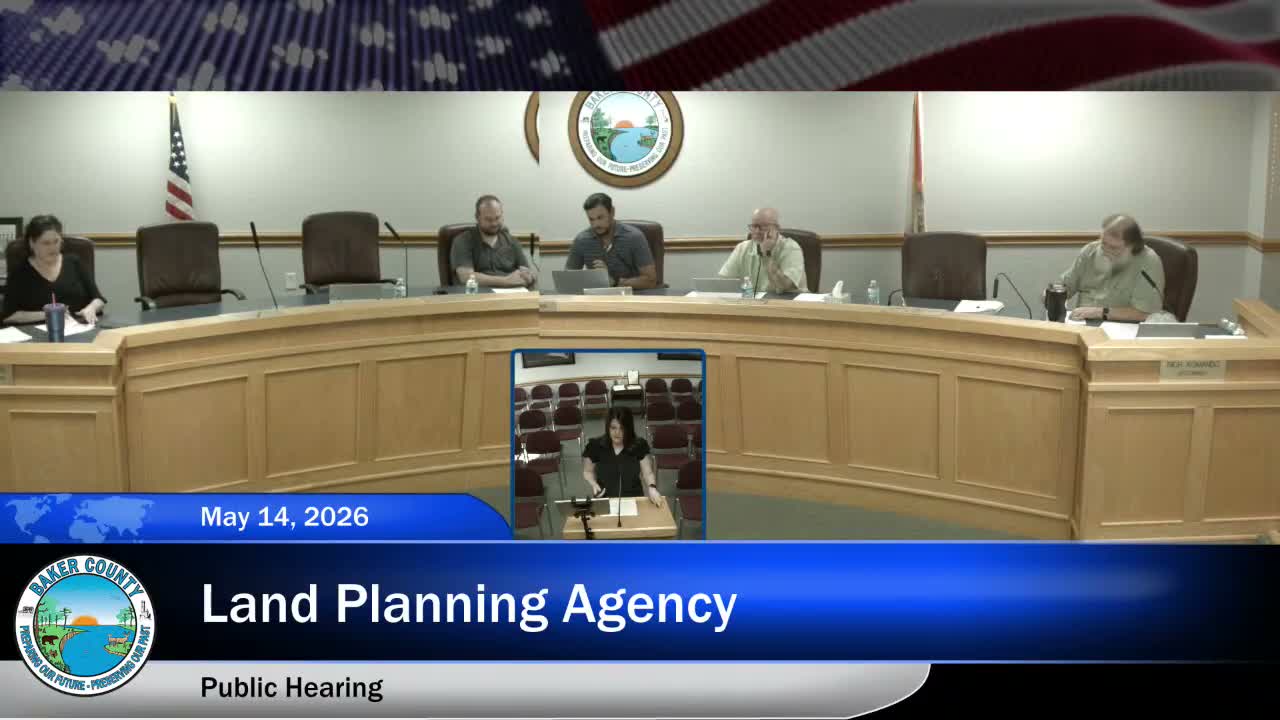
Planning staff introduced a draft ordinance May 14 to regulate mobile food vendors in unincorporated Baker County that would create three permit tiers (short temporary events, monthly/quarterly, and annual), require insurance and a displayed license, and exempt county‑approved festivals and certain agricultural and cottage‑food operations.
Director (speaker 3) summarized the draft and said the proposed default hours of operation are “7AM to 9PM,” but noted that commissioners and board members raised alternatives including 7AM–10PM or later weekend hours and a possible seasonal adjustment tied to daylight hours. The draft would also include buffers from brick‑and‑mortar food businesses and limits on operations in residential zones; staff flagged insurance, waste‑disposal, and health‑permit compliance as core requirements.
Food‑truck owner Brian Walstead (speaker 8) gave detailed public comment, saying he operates a licensed trailer and that enforcement gaps permit unlicensed vendors to undercut compliant businesses. He recounted being fined: “I got 1000 dollar fine because I was operating under my old food truck license …” and urged the county to include a DBPR (Florida Department of Business and Professional Regulation) enforcement component in the ordinance so complaints trigger inspections and penalties.
Staff responded that recent statutory changes limit code‑enforcement action without a formal complaint: “we are not allowed to investigate any sort of… unless we have a complaint,” Director said, explaining counties have constrained authority unless an explicit complaint is filed with the proper agency. Staff also noted jurisdictional limits—vendors inside municipal limits fall under city or town authority.
Board members discussed practical edits: adding a quarterly permit option (30–90 days), capping fees and offering discounts for Baker County businesses, mapping approved locations, and issuing a visible county permit sticker to make field enforcement easier. Several members emphasized striking a balance that supports entrepreneurship without harming established restaurants.
No motion was taken; the item was informational. Staff said the commissioners will hold first and second readings on May 19 and June 2, and invited interested vendors and residents to submit consolidated comments to staff ahead of those hearings.
Director (speaker 3) summarized the draft and said the proposed default hours of operation are “7AM to 9PM,” but noted that commissioners and board members raised alternatives including 7AM–10PM or later weekend hours and a possible seasonal adjustment tied to daylight hours. The draft would also include buffers from brick‑and‑mortar food businesses and limits on operations in residential zones; staff flagged insurance, waste‑disposal, and health‑permit compliance as core requirements.
Food‑truck owner Brian Walstead (speaker 8) gave detailed public comment, saying he operates a licensed trailer and that enforcement gaps permit unlicensed vendors to undercut compliant businesses. He recounted being fined: “I got 1000 dollar fine because I was operating under my old food truck license …” and urged the county to include a DBPR (Florida Department of Business and Professional Regulation) enforcement component in the ordinance so complaints trigger inspections and penalties.
Staff responded that recent statutory changes limit code‑enforcement action without a formal complaint: “we are not allowed to investigate any sort of… unless we have a complaint,” Director said, explaining counties have constrained authority unless an explicit complaint is filed with the proper agency. Staff also noted jurisdictional limits—vendors inside municipal limits fall under city or town authority.
Board members discussed practical edits: adding a quarterly permit option (30–90 days), capping fees and offering discounts for Baker County businesses, mapping approved locations, and issuing a visible county permit sticker to make field enforcement easier. Several members emphasized striking a balance that supports entrepreneurship without harming established restaurants.
No motion was taken; the item was informational. Staff said the commissioners will hold first and second readings on May 19 and June 2, and invited interested vendors and residents to submit consolidated comments to staff ahead of those hearings.
Don't Miss a Word: See the Full Meeting!
Go beyond summaries. Unlock every video, transcript, and key insight with a Founder Membership.
✓
Get instant access to full meeting videos
✓
Search and clip any phrase from complete transcripts
✓
Receive AI-powered summaries & custom alerts
✓
Enjoy lifetime, unrestricted access to government data
30-day money-back guarantee
