Senate approves committee amendments and orders third reading of bill setting rules for large data centers
May 16, 2026 | SENATE, Committees, Legislative , Vermont
This article was created by AI summarizing key points discussed. AI makes mistakes, so for full details and context, please refer to the video of the full meeting. Please report any errors so we can fix them. Report an error »
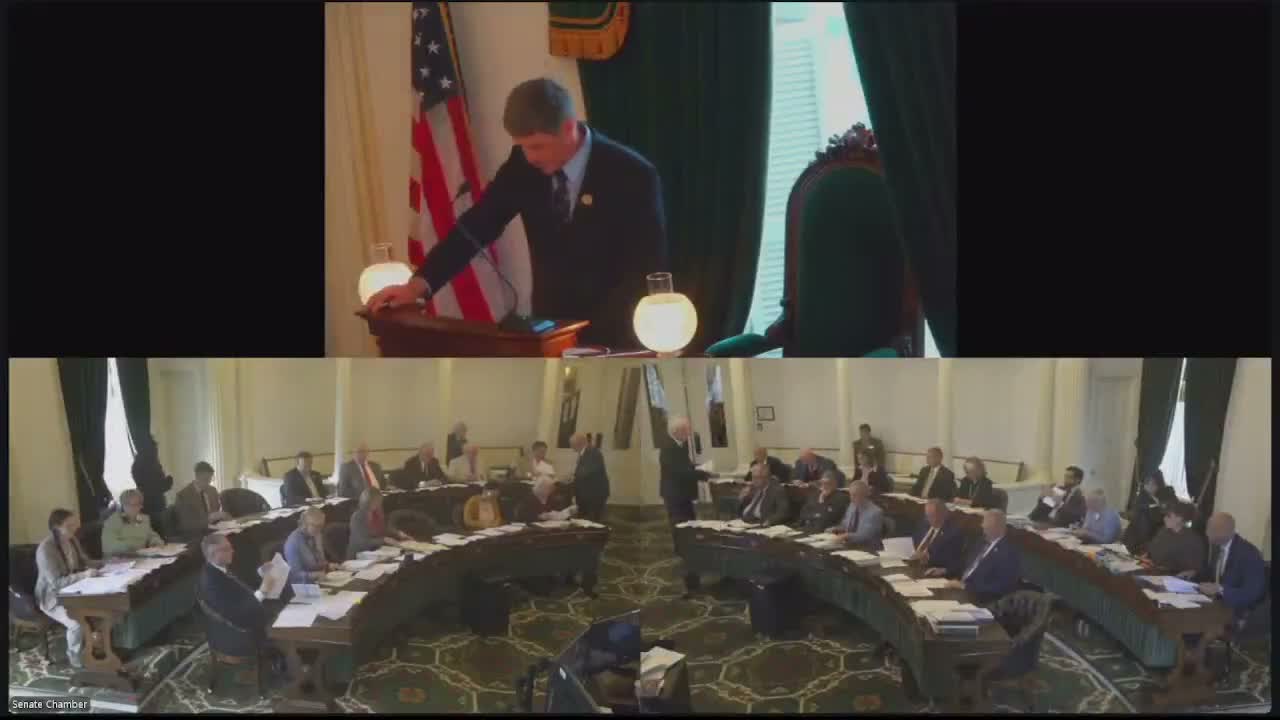
The Vermont Senate on May 18 voted to propose committee amendments to H727 and ordered the bill for third reading after extended debate and a 26‑3 roll‑call in favor of the committee recommendations.
Senator Watson, speaking for the Natural Resources and Energy Committee, described H727 as a readiness and oversight framework rather than a ban: ‘‘This bill is intended to be that fence,’’ he said, arguing that well‑crafted rules can protect communities, ratepayers and the grid while preserving the possibility that data centers could bring benefits if properly sited and regulated.
Key definitions and thresholds: the bill defines a data center as a facility that ‘‘uses, or is able to use, 20 megawatts of power,’’ and treats multiple co‑owned or integrated sites as a single facility for threshold purposes. The committee included large‑load service equity contract requirements to protect other ratepayer classes, including PUC approval, minimum contract lengths, periodic checks with the Department of Public Service, and obligations to pay a percentage of projected electricity use to avoid stranded cost exposure.
Grid and emissions guardrails: H727 requires sites to maximize on‑site renewable generation, prioritize battery storage and waste‑heat recovery, and restrict combustion backup to emergency use. The bill also obliges data centers to participate in a virtual power plant if one exists or create a self‑managed alternative.
Water, PFAS and Act 250: The bill favors closed‑loop cooling systems, requires applicants to disclose water sources, and sets withdrawal/permitting triggers (5,700 gallons/day for groundwater withdrawal permitting and a 150 gpd surface‑water threshold for impact assessment). It also requires PFAS monitoring for discharges and preserves Act 250 jurisdiction so development can be reviewed for environmental impacts.
Economic and community concerns dominated floor debate. Several senators warned that data centers often deliver few long‑term local jobs while using large amounts of electricity and water; others warned small towns could be overwhelmed. Supporters said clear rules and payment mechanisms (including an ‘‘energy transformation payment’’ equal to a statutory rate adjusted by the PUC) would help ensure benefits and avoid stranded costs.
After questions about whether manufacturers or hospitals could be captured, whether Vermont has sufficient grid headroom, and how the energy transformation payment would be calculated, the Senate voted 26‑3 to propose the committee amendments and ordered H727 for third reading. Sponsors said further technical work and rule details would follow.
Senator Watson, speaking for the Natural Resources and Energy Committee, described H727 as a readiness and oversight framework rather than a ban: ‘‘This bill is intended to be that fence,’’ he said, arguing that well‑crafted rules can protect communities, ratepayers and the grid while preserving the possibility that data centers could bring benefits if properly sited and regulated.
Key definitions and thresholds: the bill defines a data center as a facility that ‘‘uses, or is able to use, 20 megawatts of power,’’ and treats multiple co‑owned or integrated sites as a single facility for threshold purposes. The committee included large‑load service equity contract requirements to protect other ratepayer classes, including PUC approval, minimum contract lengths, periodic checks with the Department of Public Service, and obligations to pay a percentage of projected electricity use to avoid stranded cost exposure.
Grid and emissions guardrails: H727 requires sites to maximize on‑site renewable generation, prioritize battery storage and waste‑heat recovery, and restrict combustion backup to emergency use. The bill also obliges data centers to participate in a virtual power plant if one exists or create a self‑managed alternative.
Water, PFAS and Act 250: The bill favors closed‑loop cooling systems, requires applicants to disclose water sources, and sets withdrawal/permitting triggers (5,700 gallons/day for groundwater withdrawal permitting and a 150 gpd surface‑water threshold for impact assessment). It also requires PFAS monitoring for discharges and preserves Act 250 jurisdiction so development can be reviewed for environmental impacts.
Economic and community concerns dominated floor debate. Several senators warned that data centers often deliver few long‑term local jobs while using large amounts of electricity and water; others warned small towns could be overwhelmed. Supporters said clear rules and payment mechanisms (including an ‘‘energy transformation payment’’ equal to a statutory rate adjusted by the PUC) would help ensure benefits and avoid stranded costs.
After questions about whether manufacturers or hospitals could be captured, whether Vermont has sufficient grid headroom, and how the energy transformation payment would be calculated, the Senate voted 26‑3 to propose the committee amendments and ordered H727 for third reading. Sponsors said further technical work and rule details would follow.
Don't Miss a Word: See the Full Meeting!
Go beyond summaries. Unlock every video, transcript, and key insight with a Founder Membership.
✓
Get instant access to full meeting videos
✓
Search and clip any phrase from complete transcripts
✓
Receive AI-powered summaries & custom alerts
✓
Enjoy lifetime, unrestricted access to government data
30-day money-back guarantee
