House passes MilCon–VA appropriations after votes on PTSD treatment access and NATO funding
May 16, 2026 | House Office of the Clerk, House, Legislative, Federal
This article was created by AI summarizing key points discussed. AI makes mistakes, so for full details and context, please refer to the video of the full meeting. Please report any errors so we can fix them. Report an error »
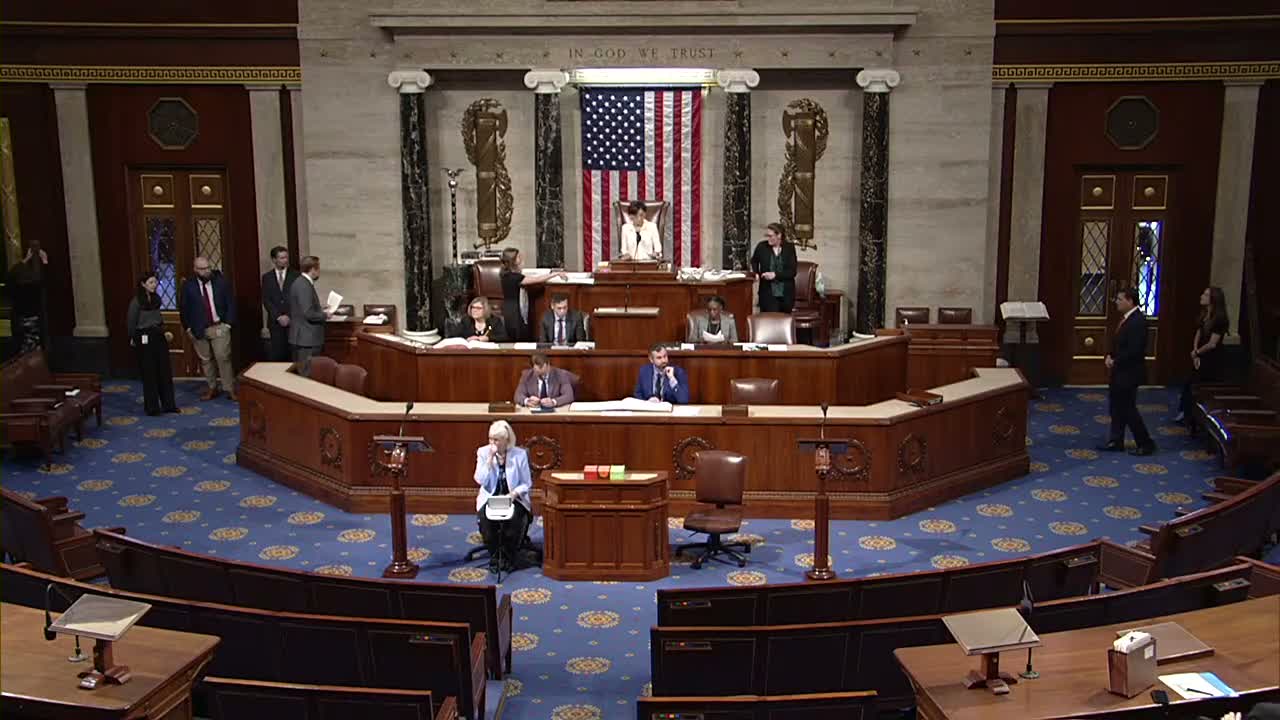
The House passed H.R. 8469, a fiscal 2027 appropriations bill for military construction and the Department of Veterans Affairs, on May 14, 2026, by a recorded vote of 400 to 15. Members in the Committee of the Whole adopted several amendments during floor consideration, including one to expand access to stellate ganglion block therapy for veterans and a separate provision protecting the Port Charlotte VA clinic; a proposed cut to the NATO Security Investment Program failed on a recorded vote.
The amendment offered by Representative Perry (R., Pa.) — designated Amendment No. 29 — directs money within the medical services account to furnish stellate ganglion block (SGB) therapy in every VA facility and directs the VA secretary to expand access upon PTSD diagnosis. "This amendment increases and decreases the amount appropriated ... to furnish stellate ganglion block or SGB in every VA facility," Perry said, arguing the outpatient procedure is "safe, effective, affordable" and noting that, as of 2018, SGB was reported in 11 VA facilities out of roughly 170. Perry characterized SGB as providing near‑immediate relief for some veterans and cited what he called an "anecdotal" 85 percent effectiveness rate. He framed the measure as urgent given the frequency of veteran suicides.
Representative Wasserman Schultz (D., Fla.) opposed the Perry amendment on institutional and scientific grounds. She said the VA and NIH are conducting a multiyear clinical trial and that preliminary data do not clearly establish a causal link between SGB and durable relief from PTSD symptoms. "If this treatment is safe, effective, and appropriate for expanded use, then the health care experts at the VA should be the ones to expand the treatment for wider use," Wasserman Schultz said, urging colleagues to let the deliberative medical process play out. The Committee resolved the dispute by voice vote; the chair announced "the ayes have it," and Amendment No. 29 was adopted.
During the same consideration, the House agreed by voice vote to Amendment No. 49, offered by Representative Stubbe (R., Fla.), which prohibits funds in the bill from being used to close the Port Charlotte VA clinic. Stubbe said the amendment "would not delay construction on a new clinic in North Port" and would preserve local access for veterans.
A separate and more contentious amendment, No. 50, proposed by Representative Stuby/Stubbe (R., Fla.), sought to redirect approximately $480,000,000 from the NATO Security Investment Program toward U.S. base infrastructure. Sponsors argued the reallocation would prioritize American readiness and installations; opponents, including Judge Carter, chair of the Military Construction and Veterans Affairs Subcommittee, said the NATO program underpins allied infrastructure and directly supports U.S. troops overseas. After extended debate a recorded vote was ordered. The amendment failed by recorded vote: yeas 80, nays 333.
Following the Committee of the Whole proceedings, the House proceeded to final consideration under the rule. The final passage vote on H.R. 8469 was recorded as 400 yeas and 15 nays. The House then laid a motion to consider on the table without objection and completed its business for the day.
What it means: The adopted changes will direct specific language and funding priorities within the MilCon–VA bill when it proceeds to conference or to the Senate, including a statutory direction to expand access to SGB therapy in the VA system and a prohibition on closing a local VA clinic in Florida. The failed amendment to eliminate NATO Security Investment Program funding leaves the program's authorization and the bill's base funding levels in place.
The House's action now sends the amended measure forward in the appropriations process; the bill's next formal step is typically further consideration consistent with the House rule and any coordination with the Senate or conference process.
The amendment offered by Representative Perry (R., Pa.) — designated Amendment No. 29 — directs money within the medical services account to furnish stellate ganglion block (SGB) therapy in every VA facility and directs the VA secretary to expand access upon PTSD diagnosis. "This amendment increases and decreases the amount appropriated ... to furnish stellate ganglion block or SGB in every VA facility," Perry said, arguing the outpatient procedure is "safe, effective, affordable" and noting that, as of 2018, SGB was reported in 11 VA facilities out of roughly 170. Perry characterized SGB as providing near‑immediate relief for some veterans and cited what he called an "anecdotal" 85 percent effectiveness rate. He framed the measure as urgent given the frequency of veteran suicides.
Representative Wasserman Schultz (D., Fla.) opposed the Perry amendment on institutional and scientific grounds. She said the VA and NIH are conducting a multiyear clinical trial and that preliminary data do not clearly establish a causal link between SGB and durable relief from PTSD symptoms. "If this treatment is safe, effective, and appropriate for expanded use, then the health care experts at the VA should be the ones to expand the treatment for wider use," Wasserman Schultz said, urging colleagues to let the deliberative medical process play out. The Committee resolved the dispute by voice vote; the chair announced "the ayes have it," and Amendment No. 29 was adopted.
During the same consideration, the House agreed by voice vote to Amendment No. 49, offered by Representative Stubbe (R., Fla.), which prohibits funds in the bill from being used to close the Port Charlotte VA clinic. Stubbe said the amendment "would not delay construction on a new clinic in North Port" and would preserve local access for veterans.
A separate and more contentious amendment, No. 50, proposed by Representative Stuby/Stubbe (R., Fla.), sought to redirect approximately $480,000,000 from the NATO Security Investment Program toward U.S. base infrastructure. Sponsors argued the reallocation would prioritize American readiness and installations; opponents, including Judge Carter, chair of the Military Construction and Veterans Affairs Subcommittee, said the NATO program underpins allied infrastructure and directly supports U.S. troops overseas. After extended debate a recorded vote was ordered. The amendment failed by recorded vote: yeas 80, nays 333.
Following the Committee of the Whole proceedings, the House proceeded to final consideration under the rule. The final passage vote on H.R. 8469 was recorded as 400 yeas and 15 nays. The House then laid a motion to consider on the table without objection and completed its business for the day.
What it means: The adopted changes will direct specific language and funding priorities within the MilCon–VA bill when it proceeds to conference or to the Senate, including a statutory direction to expand access to SGB therapy in the VA system and a prohibition on closing a local VA clinic in Florida. The failed amendment to eliminate NATO Security Investment Program funding leaves the program's authorization and the bill's base funding levels in place.
The House's action now sends the amended measure forward in the appropriations process; the bill's next formal step is typically further consideration consistent with the House rule and any coordination with the Senate or conference process.
Don't Miss a Word: See the Full Meeting!
Go beyond summaries. Unlock every video, transcript, and key insight with a Founder Membership.
✓
Get instant access to full meeting videos
✓
Search and clip any phrase from complete transcripts
✓
Receive AI-powered summaries & custom alerts
✓
Enjoy lifetime, unrestricted access to government data
30-day money-back guarantee
