Prince George supervisors push rural‑first changes to 2045 plan, back 10‑ and 20‑acre minimums by consensus
May 15, 2026 | Prince George County, Virginia
This article was created by AI summarizing key points discussed. AI makes mistakes, so for full details and context, please refer to the video of the full meeting. Please report any errors so we can fix them. Report an error »
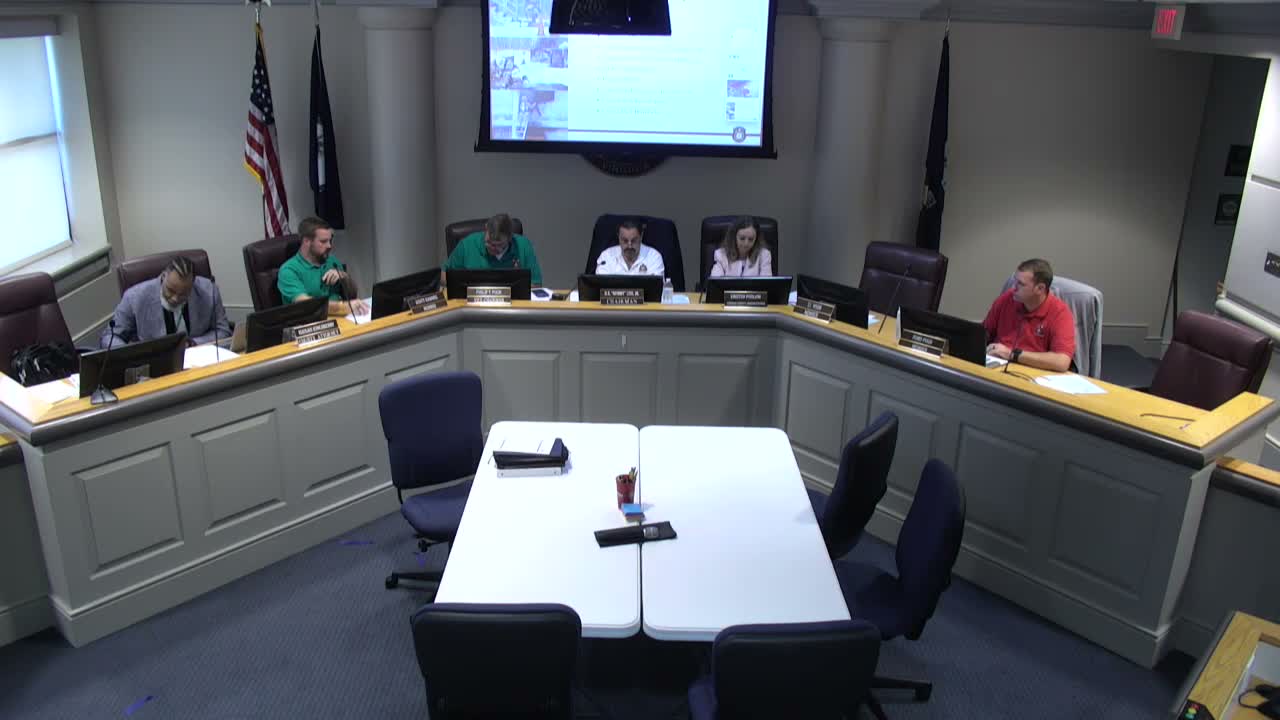
Planning staff briefed the Board of Supervisors on a work plan to incorporate board feedback into the draft Prince George 2045 comprehensive plan and to return with changes, maps and public‑comment options. Mr. Baldwin (planning staff) framed the session as a series of targeted amendments the board could approve for staff to implement and bring back for formal adoption steps.
Supervisor Hamill urged that the plan adopt a "rural preservation first" policy and reweight suitability metrics so that ecological cores, prime farmland and protected landscapes receive stronger protection on the future land‑use map. Staff showed maps and explained how adjusting weights (for example, raising ecological core scores) would change the automated suitability map used to generate future land‑use categories.
On specific land‑use rules, the board reached consensus to pursue a 10‑acre minimum for the general rural category and a 20‑acre minimum for the rural‑preservation category. The transcript records an abstention on the 10‑acre consensus (Supervisor Webb) and unanimous agreement on the 20‑acre minimums. The board also supported removing a proposed "utility transition" zone and reassigning that area into a rural designation to avoid mandatory public‑utility connection requirements for affected parcels.
Members discussed removing the "market residential" future‑land‑use category and stripping residential uses from "neighborhood commercial" so that mixed‑use or denser residential projects would proceed through discretionary rezoning tools such as proffers or planned unit developments (PUDs) rather than by right. Staff and board agreed that the zoning ordinance will need follow‑up work to implement changes and to ensure existing property owners are not forced into nonconforming status.
On conservation tools, the board asked staff to add language on TDR/PDR and other options in a toolkit and to prepare a follow‑up workshop explaining pros/cons and administrative responsibilities. County counsel warned that recent state law changes may affect how strictly the county can regulate industrial‑scale solar and battery storage; the board parked further solar policy action pending a legal memo from counsel.
Staff committed to producing revised maps that show how changes to the suitability weighting affect the future land‑use map, to draft ordinance language where needed (for zoning or conservation easements), and to return with a work plan and schedule for public outreach and next board actions.
Supervisor Hamill urged that the plan adopt a "rural preservation first" policy and reweight suitability metrics so that ecological cores, prime farmland and protected landscapes receive stronger protection on the future land‑use map. Staff showed maps and explained how adjusting weights (for example, raising ecological core scores) would change the automated suitability map used to generate future land‑use categories.
On specific land‑use rules, the board reached consensus to pursue a 10‑acre minimum for the general rural category and a 20‑acre minimum for the rural‑preservation category. The transcript records an abstention on the 10‑acre consensus (Supervisor Webb) and unanimous agreement on the 20‑acre minimums. The board also supported removing a proposed "utility transition" zone and reassigning that area into a rural designation to avoid mandatory public‑utility connection requirements for affected parcels.
Members discussed removing the "market residential" future‑land‑use category and stripping residential uses from "neighborhood commercial" so that mixed‑use or denser residential projects would proceed through discretionary rezoning tools such as proffers or planned unit developments (PUDs) rather than by right. Staff and board agreed that the zoning ordinance will need follow‑up work to implement changes and to ensure existing property owners are not forced into nonconforming status.
On conservation tools, the board asked staff to add language on TDR/PDR and other options in a toolkit and to prepare a follow‑up workshop explaining pros/cons and administrative responsibilities. County counsel warned that recent state law changes may affect how strictly the county can regulate industrial‑scale solar and battery storage; the board parked further solar policy action pending a legal memo from counsel.
Staff committed to producing revised maps that show how changes to the suitability weighting affect the future land‑use map, to draft ordinance language where needed (for zoning or conservation easements), and to return with a work plan and schedule for public outreach and next board actions.
View the Full Meeting & All Its Details
This article offers just a summary. Unlock complete video, transcripts, and insights as a Founder Member.
✓
Watch full, unedited meeting videos
✓
Search every word spoken in unlimited transcripts
✓
AI summaries & real-time alerts (all government levels)
✓
Permanent access to expanding government content
30-day money-back guarantee
