Austin Police Chief Lisa Davis tells CPRC she supports transparency, outlines training and discipline timelines
May 15, 2026 | Austin, Travis County, Texas
This article was created by AI summarizing key points discussed. AI makes mistakes, so for full details and context, please refer to the video of the full meeting. Please report any errors so we can fix them. Report an error »
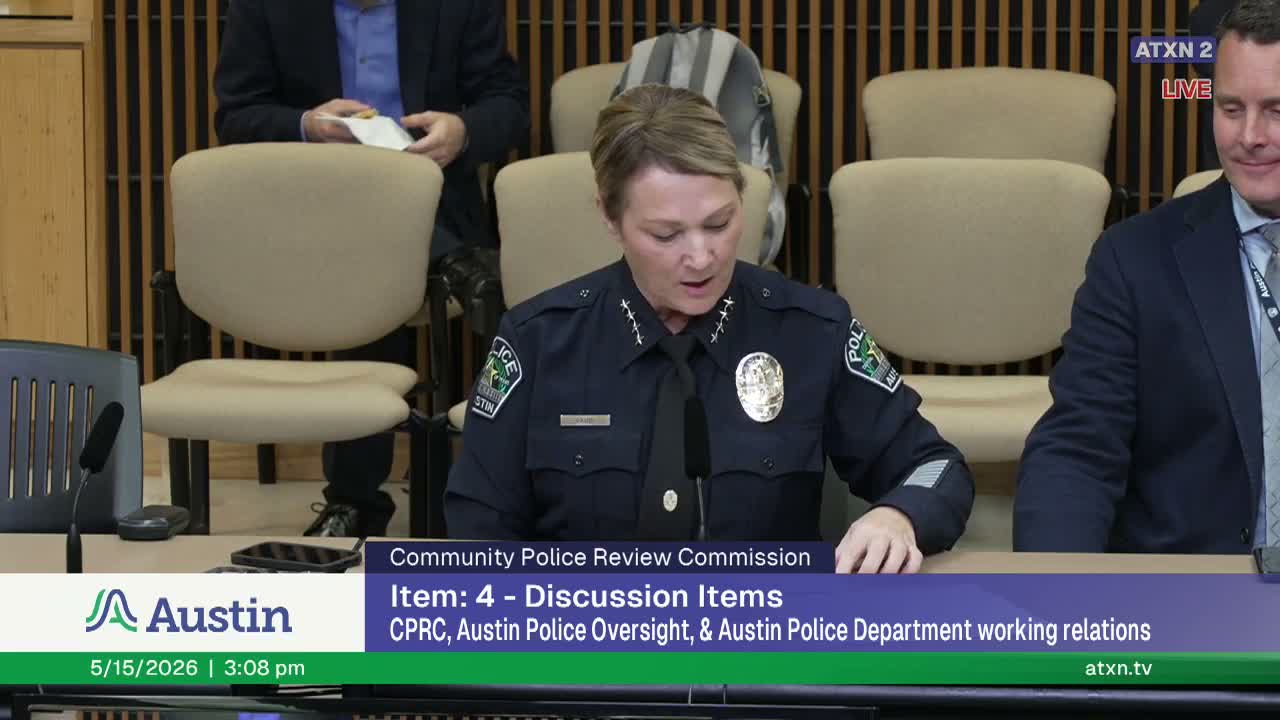
Austin Police Chief Lisa Davis told the Community Police Review Commission on May 15 that she supports greater transparency and accountability and is open to closer coordination with the commission on disciplinary reviews.
Davis, who spoke after the commission moved her presentation up on the agenda, said the CPRC assists with oversight and that she welcomes the group's recommendations. She described the department's disciplinary framework as progressive: informal measures such as oral counseling and supervisor mentoring can escalate to written reprimands, education-based discipline (1'to'5 days of training), suspensions (up to 15 days before arbitration), agreed suspensions (16'to'90 days), demotion or termination, and last-chance agreements in select cases. Davis and APD's internal-investigations commander, Mike Bergerson, said disciplinary decisions take into account the incident, the officer's history and training, and the totality of circumstances.
Davis acknowledged the commission's concern that APD sometimes finalizes discipline before the CPRC can issue a recommendation. She said the ordinance gives CPRC the right to recommend prior to the chief's decision and that APD staff will work with the oversight office to improve timing without unduly delaying discipline for officers and their families.
On training, Davis outlined several review mechanisms: a Professional Advisory Committee that reviews curriculum line-by-line, a Community Advisory Committee of community reviewers, and a TCO advisory board mandated by the state. She said APD has implemented most Crowell Report recommendations, with two exceptions still in progress (longer cadet lunches and a video-library resource for cadets), and invited CPRC/APO participation in curriculum review and advisory processes.
Davis described the Mobile Crisis Outreach Team (called MCAT/MCOT in the meeting) as a 24/7 resource APD can call when officers encounter people in mental-health crisis. She said the city's No Wrong Door initiative coordinates multiple agencies and nonprofit partners to target high utilizers (about 600 identified in Austin), and that pairing MCOT clinicians with officers has yielded positive outcomes in some cases.
Commissioners asked about APD's relationship with the district attorney and with Immigration and Customs Enforcement. Davis said she meets monthly with the DA and that the offices do not always agree but maintain a respectful working relationship. On immigration, she described the operational challenge after DHS added roughly 700,000 administrative warrants into systems in 2025 and said APD follows state law (SB 4) and department general orders: officers call ICE as required but ICE responses remain rare. She repeated a commitment to work with APO and the CPRC on clearer communication and training for officers as policies change.
Davis closed by saying she looks forward to working with the CPRC and APO, including meetings to align on timelines and processes that balance the commission's review role with the department's need to conclude investigations.
The commission did not take formal action on APD disciplinary policy at the meeting; commissioners asked staff to coordinate follow-up briefings and process improvements and requested opportunities to review training materials and the officer-involved-shooting dashboard planned for a June demonstration.
Davis, who spoke after the commission moved her presentation up on the agenda, said the CPRC assists with oversight and that she welcomes the group's recommendations. She described the department's disciplinary framework as progressive: informal measures such as oral counseling and supervisor mentoring can escalate to written reprimands, education-based discipline (1'to'5 days of training), suspensions (up to 15 days before arbitration), agreed suspensions (16'to'90 days), demotion or termination, and last-chance agreements in select cases. Davis and APD's internal-investigations commander, Mike Bergerson, said disciplinary decisions take into account the incident, the officer's history and training, and the totality of circumstances.
Davis acknowledged the commission's concern that APD sometimes finalizes discipline before the CPRC can issue a recommendation. She said the ordinance gives CPRC the right to recommend prior to the chief's decision and that APD staff will work with the oversight office to improve timing without unduly delaying discipline for officers and their families.
On training, Davis outlined several review mechanisms: a Professional Advisory Committee that reviews curriculum line-by-line, a Community Advisory Committee of community reviewers, and a TCO advisory board mandated by the state. She said APD has implemented most Crowell Report recommendations, with two exceptions still in progress (longer cadet lunches and a video-library resource for cadets), and invited CPRC/APO participation in curriculum review and advisory processes.
Davis described the Mobile Crisis Outreach Team (called MCAT/MCOT in the meeting) as a 24/7 resource APD can call when officers encounter people in mental-health crisis. She said the city's No Wrong Door initiative coordinates multiple agencies and nonprofit partners to target high utilizers (about 600 identified in Austin), and that pairing MCOT clinicians with officers has yielded positive outcomes in some cases.
Commissioners asked about APD's relationship with the district attorney and with Immigration and Customs Enforcement. Davis said she meets monthly with the DA and that the offices do not always agree but maintain a respectful working relationship. On immigration, she described the operational challenge after DHS added roughly 700,000 administrative warrants into systems in 2025 and said APD follows state law (SB 4) and department general orders: officers call ICE as required but ICE responses remain rare. She repeated a commitment to work with APO and the CPRC on clearer communication and training for officers as policies change.
Davis closed by saying she looks forward to working with the CPRC and APO, including meetings to align on timelines and processes that balance the commission's review role with the department's need to conclude investigations.
The commission did not take formal action on APD disciplinary policy at the meeting; commissioners asked staff to coordinate follow-up briefings and process improvements and requested opportunities to review training materials and the officer-involved-shooting dashboard planned for a June demonstration.
Don't Miss a Word: See the Full Meeting!
Go beyond summaries. Unlock every video, transcript, and key insight with a Founder Membership.
✓
Get instant access to full meeting videos
✓
Search and clip any phrase from complete transcripts
✓
Receive AI-powered summaries & custom alerts
✓
Enjoy lifetime, unrestricted access to government data
30-day money-back guarantee
