Joint subcommittee outlines plan for a mental health diversion center to reduce jail cycling
May 15, 2026 | Austin, Travis County, Texas
This article was created by AI summarizing key points discussed. AI makes mistakes, so for full details and context, please refer to the video of the full meeting. Please report any errors so we can fix them. Report an error »
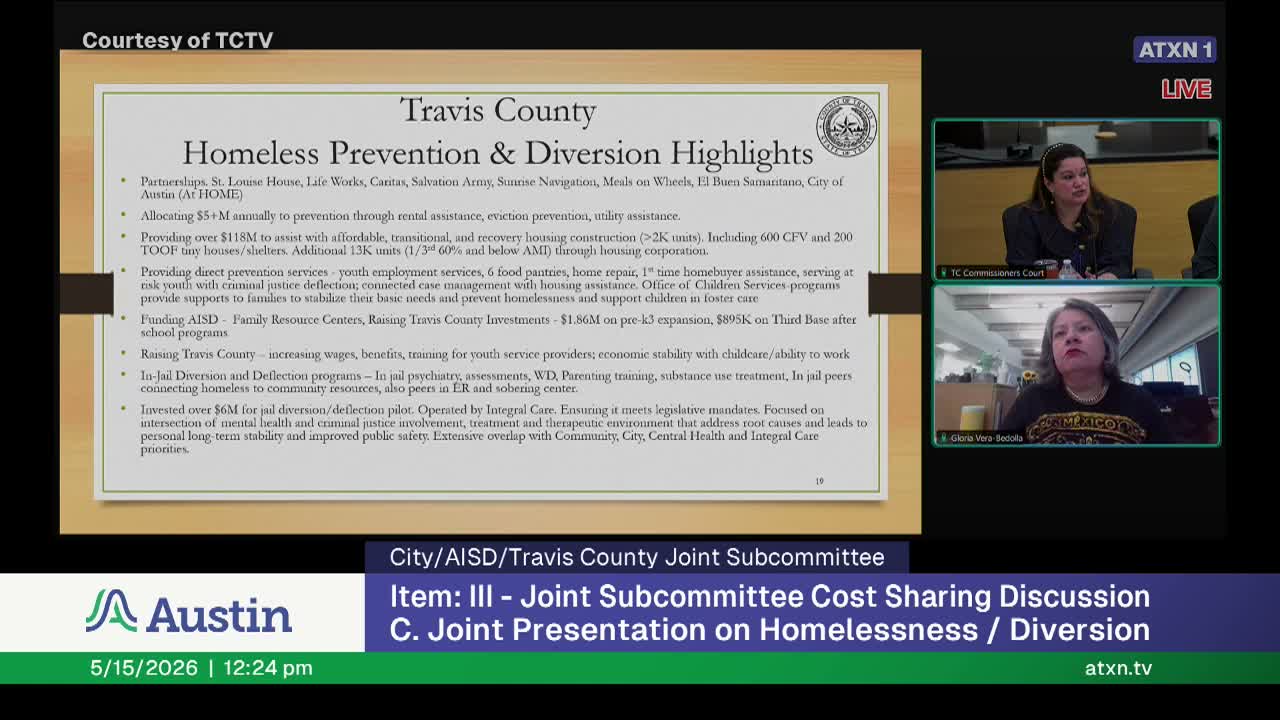
A Travis County–City of Austin–AISD joint subcommittee heard a detailed briefing on mental‑health jail diversion efforts aimed at reducing repeated jail entries by people with behavioral health needs.
Tyrone Jolley, identified in the meeting as the county’s senior strategic advisor leading diversion planning, said about "40 percent of the jail population — that's 900 to 1,000 folks — are experiencing mental health challenges," and described a two‑part pilot that uses expanded psychiatric emergency services and a therapeutic respite to stabilize people and connect them to community care. "We're seeing some good things," Jolley said, noting early data that clients served through the pilot were not being rearrested within 30 days and that an outcomes evaluation is planned in the coming year.
Jolley described the "Scribe Care Diversion Pilot," which leverages two Integral Care‑run sites: a psychiatric emergency services facility on Airport Road and a therapeutic respite on 15th Street. He said the diversion concept is intended to act as a front door to a larger crisis‑care continuum that could include crisis receiving, sobering, inpatient psychiatric care and step‑down supports. "We really need an integrated continuum to meet a varied range of needs for a complex population," Jolley said.
Committee members and staff focused on distinctions between levels of care: psychiatric emergency services as an entry point for anyone in crisis, and therapeutic respite as a longer‑term setting for those who can manage self‑care but need ongoing counseling, case management and housing referrals. County presenters emphasized the importance of connecting people to housing partners and peer supports as part of discharge planning.
Members also discussed how state capacity and funding intersect with local diversion plans, including competency restoration beds for people found incompetent to stand trial. Jolley said the county is pursuing strategic collaborations and working with an executive steering committee chaired by Judge Andy Brown and Sheriff Sally Hernandez to develop the diversion center concept.
The subcommittee did not vote on a project authorization; staff were directed to continue interagency coordination and to return with more detailed recommendations and prioritized options at a future meeting. The subcommittee tentatively scheduled its next meeting for October.
Tyrone Jolley, identified in the meeting as the county’s senior strategic advisor leading diversion planning, said about "40 percent of the jail population — that's 900 to 1,000 folks — are experiencing mental health challenges," and described a two‑part pilot that uses expanded psychiatric emergency services and a therapeutic respite to stabilize people and connect them to community care. "We're seeing some good things," Jolley said, noting early data that clients served through the pilot were not being rearrested within 30 days and that an outcomes evaluation is planned in the coming year.
Jolley described the "Scribe Care Diversion Pilot," which leverages two Integral Care‑run sites: a psychiatric emergency services facility on Airport Road and a therapeutic respite on 15th Street. He said the diversion concept is intended to act as a front door to a larger crisis‑care continuum that could include crisis receiving, sobering, inpatient psychiatric care and step‑down supports. "We really need an integrated continuum to meet a varied range of needs for a complex population," Jolley said.
Committee members and staff focused on distinctions between levels of care: psychiatric emergency services as an entry point for anyone in crisis, and therapeutic respite as a longer‑term setting for those who can manage self‑care but need ongoing counseling, case management and housing referrals. County presenters emphasized the importance of connecting people to housing partners and peer supports as part of discharge planning.
Members also discussed how state capacity and funding intersect with local diversion plans, including competency restoration beds for people found incompetent to stand trial. Jolley said the county is pursuing strategic collaborations and working with an executive steering committee chaired by Judge Andy Brown and Sheriff Sally Hernandez to develop the diversion center concept.
The subcommittee did not vote on a project authorization; staff were directed to continue interagency coordination and to return with more detailed recommendations and prioritized options at a future meeting. The subcommittee tentatively scheduled its next meeting for October.
View the Full Meeting & All Its Details
This article offers just a summary. Unlock complete video, transcripts, and insights as a Founder Member.
✓
Watch full, unedited meeting videos
✓
Search every word spoken in unlimited transcripts
✓
AI summaries & real-time alerts (all government levels)
✓
Permanent access to expanding government content
30-day money-back guarantee
