Subcommittee highlights family homelessness prevention, Wayfinder rapid rehousing and calls for coordinated staff work
May 15, 2026 | Austin, Travis County, Texas
This article was created by AI summarizing key points discussed. AI makes mistakes, so for full details and context, please refer to the video of the full meeting. Please report any errors so we can fix them. Report an error »
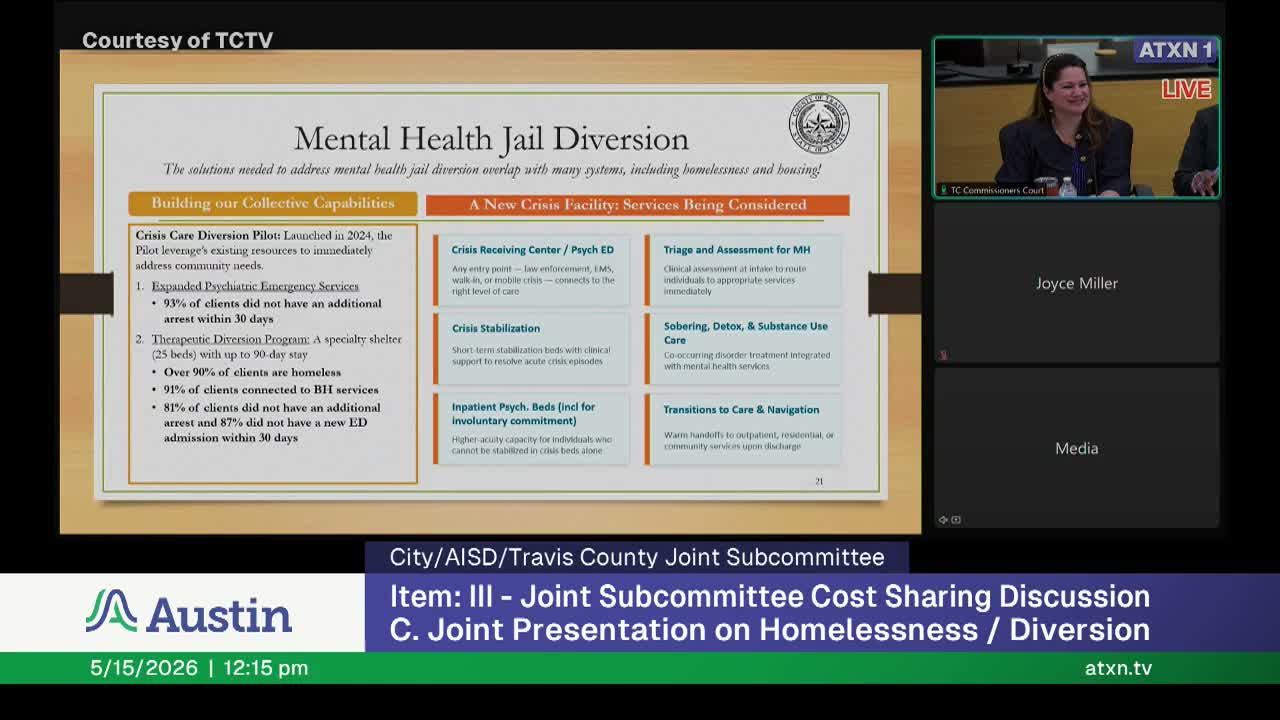
Members of the joint subcommittee reviewed a menu of collaborative homelessness‑prevention options and asked staff to convene partner agencies to prioritize concrete next steps.
Carla Scott, administrative supervisor of AISD’s Project HELP, told the subcommittee that AISD is serving 1,178 students classified as homeless this school year and has identified 162 unaccompanied students. "Our mission and our goal is to serve students with the protections and the rights that have been established under the McKinney‑Vento Homeless Assistance Act," Scott said, and she described school‑based family resource centers and district programs that connect students and families to services.
A City of Austin official described the Wayfinder program, operated by the Sunrise Homeless Navigation Center, and said the city provides $500,000 annually for the program. The official said Wayfinder served "281 households, totaling close to 700 people" between November 2024 and December 2025, averaging about 20 households per month, and that the average cost per household was under $1,200; staff said roughly four out of five households either retained or moved into housing within a month of enrollment.
Committee members discussed strategies to prevent family separation and keep children housed, including drawing down Family Unification Program (FUP) vouchers, expanding emergency family shelter capacity, strengthening eviction prevention (including lessons from Dallas programs), and coordinating with JP courts and family resource centers to identify households at imminent risk earlier.
Speakers highlighted landlord engagement efforts (Housing Connector) to increase landlords’ willingness to accept voucher holders and noted limited remaining Home ARP dollars that could seed non‑congregate family shelter as part of a broader capital stack. The subcommittee directed staff to convene stakeholders and return with prioritized recommendations; members tentatively agreed on an October follow‑up meeting to align next steps with upcoming budget cycles.
Carla Scott, administrative supervisor of AISD’s Project HELP, told the subcommittee that AISD is serving 1,178 students classified as homeless this school year and has identified 162 unaccompanied students. "Our mission and our goal is to serve students with the protections and the rights that have been established under the McKinney‑Vento Homeless Assistance Act," Scott said, and she described school‑based family resource centers and district programs that connect students and families to services.
A City of Austin official described the Wayfinder program, operated by the Sunrise Homeless Navigation Center, and said the city provides $500,000 annually for the program. The official said Wayfinder served "281 households, totaling close to 700 people" between November 2024 and December 2025, averaging about 20 households per month, and that the average cost per household was under $1,200; staff said roughly four out of five households either retained or moved into housing within a month of enrollment.
Committee members discussed strategies to prevent family separation and keep children housed, including drawing down Family Unification Program (FUP) vouchers, expanding emergency family shelter capacity, strengthening eviction prevention (including lessons from Dallas programs), and coordinating with JP courts and family resource centers to identify households at imminent risk earlier.
Speakers highlighted landlord engagement efforts (Housing Connector) to increase landlords’ willingness to accept voucher holders and noted limited remaining Home ARP dollars that could seed non‑congregate family shelter as part of a broader capital stack. The subcommittee directed staff to convene stakeholders and return with prioritized recommendations; members tentatively agreed on an October follow‑up meeting to align next steps with upcoming budget cycles.
View the Full Meeting & All Its Details
This article offers just a summary. Unlock complete video, transcripts, and insights as a Founder Member.
✓
Watch full, unedited meeting videos
✓
Search every word spoken in unlimited transcripts
✓
AI summaries & real-time alerts (all government levels)
✓
Permanent access to expanding government content
30-day money-back guarantee
