Experts divided in Vermont House Judiciary hearing over constitutionality of S.208 masking and ID provisions
May 15, 2026 | Judiciary, HOUSE OF REPRESENTATIVES, Committees, Legislative , Vermont
This article was created by AI summarizing key points discussed. AI makes mistakes, so for full details and context, please refer to the video of the full meeting. Please report any errors so we can fix them. Report an error »
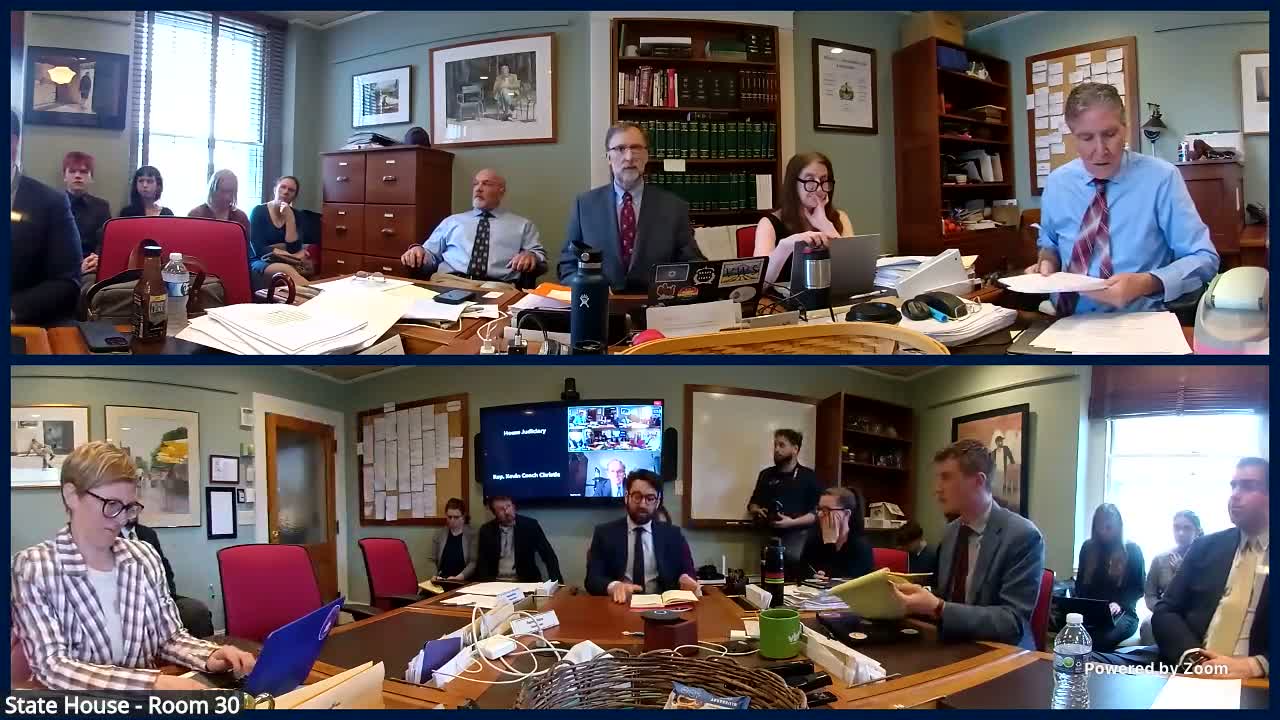
Harrison Stark, senior counsel and director of special projects at the State Democracy Research Initiative at the University of Wisconsin Law School, told the House Judiciary Committee on May 15 that mask bans and identification requirements like those in S.208 occupy a legally uncertain space: "mask bans and ID laws like this are not clearly permissible, nor are they clearly prohibited," he said. Stark urged the committee to consider how courts apply the Supremacy Clause and distinguish state laws that "incidentally" affect federal officers from those that "directly" regulate federal functions.
Stark described the familiar line of cases that begins with Johnson v. Maryland (1920), in which the Supreme Court drew a distinction between laws that control whether a federal function may occur and laws that merely affect the mode of operation, like traffic rules. He said courts evaluate the "degree of control" a state law would impose on federally authorized duties and that, because there is no clear federal statute requiring masking or a uniform identification rule for immigration enforcement, states can plausibly argue such measures are analogous to neutral public-safety rules.
"There is no federal law on point," Stark said, noting federal agencies have in public statements treated masking and identification in some contexts as a matter of officer discretion. He acknowledged the risk that a statute like S.208 could be invalidated but said some district-court reasoning (and a functional, effects-based approach adopted by certain circuits) supports a state-level regulation that does not literally dictate federal operational choices.
Testifying next, Rodney Smola, a professor at the Vermont Law and Graduate School, said he was sympathetic to the policy concerns but sharply disagreed on the legal outcome. "I'm afraid I can't," Smola told the committee. "I think that, it's almost certain that if the bill were passed, it would fail in any judicial challenge." He emphasized two doctrines: the Supremacy Clause immunity that can shield federal actors from state penalties when the conduct is "necessary and proper" to their duties, and an inquiry that, in his view, should not permit courts to "go beneath the hood" and second-guess federal determinations about operational necessity.
Smola warned that a statute that names or targets federal agents risks being read as a direct regulation of federal operations and that courts are unlikely to accept an inquiry that balances the policy merits against federal prerogatives. He cited historical doctrines and illustrative cases to argue the likely outcome of litigation would favor federal immunity.
Committee members pressed each witness on whether applying the rule to all arresting officers (state, local and federal) would change the legal analysis. Stark said making the law facially general could shift the inquiry toward incidental effects on federal operations; Smola said including local officers does not resolve the constitutional problem if the law reaches federal agents.
Chair Alon told the panel the committee will wait for language of a pending amendment before convening a vote and that members should weigh the litigation risk. The hearing recorded competing expert assessments without a committee decision; the committee will reconvene when the amendment is filed.
Stark described the familiar line of cases that begins with Johnson v. Maryland (1920), in which the Supreme Court drew a distinction between laws that control whether a federal function may occur and laws that merely affect the mode of operation, like traffic rules. He said courts evaluate the "degree of control" a state law would impose on federally authorized duties and that, because there is no clear federal statute requiring masking or a uniform identification rule for immigration enforcement, states can plausibly argue such measures are analogous to neutral public-safety rules.
"There is no federal law on point," Stark said, noting federal agencies have in public statements treated masking and identification in some contexts as a matter of officer discretion. He acknowledged the risk that a statute like S.208 could be invalidated but said some district-court reasoning (and a functional, effects-based approach adopted by certain circuits) supports a state-level regulation that does not literally dictate federal operational choices.
Testifying next, Rodney Smola, a professor at the Vermont Law and Graduate School, said he was sympathetic to the policy concerns but sharply disagreed on the legal outcome. "I'm afraid I can't," Smola told the committee. "I think that, it's almost certain that if the bill were passed, it would fail in any judicial challenge." He emphasized two doctrines: the Supremacy Clause immunity that can shield federal actors from state penalties when the conduct is "necessary and proper" to their duties, and an inquiry that, in his view, should not permit courts to "go beneath the hood" and second-guess federal determinations about operational necessity.
Smola warned that a statute that names or targets federal agents risks being read as a direct regulation of federal operations and that courts are unlikely to accept an inquiry that balances the policy merits against federal prerogatives. He cited historical doctrines and illustrative cases to argue the likely outcome of litigation would favor federal immunity.
Committee members pressed each witness on whether applying the rule to all arresting officers (state, local and federal) would change the legal analysis. Stark said making the law facially general could shift the inquiry toward incidental effects on federal operations; Smola said including local officers does not resolve the constitutional problem if the law reaches federal agents.
Chair Alon told the panel the committee will wait for language of a pending amendment before convening a vote and that members should weigh the litigation risk. The hearing recorded competing expert assessments without a committee decision; the committee will reconvene when the amendment is filed.
View the Full Meeting & All Its Details
This article offers just a summary. Unlock complete video, transcripts, and insights as a Founder Member.
✓
Watch full, unedited meeting videos
✓
Search every word spoken in unlimited transcripts
✓
AI summaries & real-time alerts (all government levels)
✓
Permanent access to expanding government content
30-day money-back guarantee
