Committee pauses proposed disability bar on evictions, agrees to tighten written termination notices
May 15, 2026 | Economic Development, Housing & General Affairs, SENATE, Committees, Legislative , Vermont
This article was created by AI summarizing key points discussed. AI makes mistakes, so for full details and context, please refer to the video of the full meeting. Please report any errors so we can fix them. Report an error »
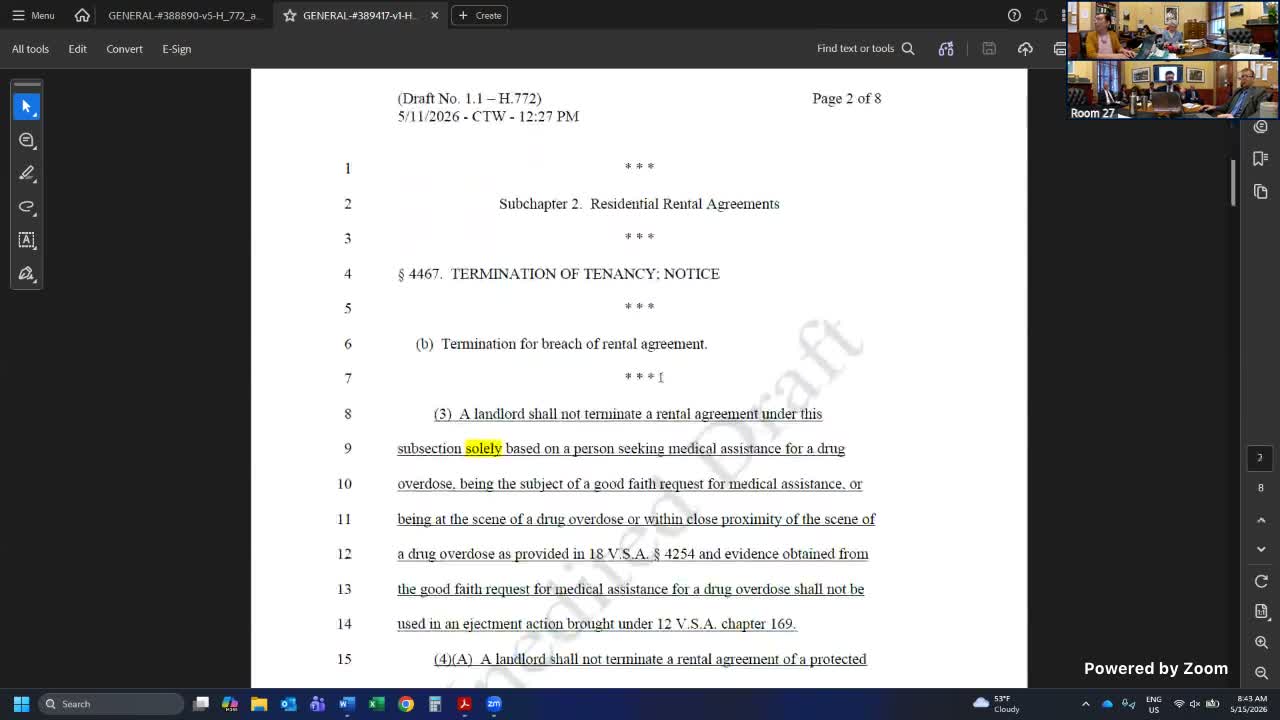
The Economic Development, Housing & General Affairs committee met May 15 and debated changes to the landlord‑tenant bill (H 775), focusing on whether landlords should be barred from terminating tenancies when a tenant's conduct is related to a disability and on what showing, if any, a tenant must make.
Committee members and staff debated two linked questions: should protections depend on a tenant having a documented disability or on a ‘‘knowing’’ standard for the landlord, and must termination notices include detailed reasons that a tenant can take to legal counsel? Staff counsel described draft language that would prevent termination under specified subsections when the conduct is directly related to a disability while preserving exceptions for criminal activity and acts of violence.
Staff said the proposed language sought to protect tenants from being evicted for conduct resulting from disabilities, but warned there are tradeoffs in requiring disclosure. "You can't terminate someone's rental agreement because the person has a disability," a staff presenter told the committee while explaining the intent and limits of the draft. Members raised practical concerns about how a landlord would learn of a non‑visible disability during a termination process and whether imposing a disclosure or documentation requirement would conflict with nondiscrimination principles.
Members and staff also discussed the distinction between a written termination notice and a later court ejectment proceeding. Jean Murray summarized the statutory baseline for evictions under the cited provision ("44 67 b"), noting that courts usually expect sufficient factual detail once a landlord files for ejectment; staff recalled an affidavit requirement that had existed in an earlier House version but was removed in the Senate Judiciary recommendation.
Advocates urged protections. Brenda Siegel, who said she works with clients facing eviction, described cases where psychiatric or other disabilities led to disruptive behavior and said the protections were important so tenants can get help before losing housing: "That's why it's critical to have this protection in the bill," she said.
After extended debate about scope and unintended consequences—particularly whether ongoing illegal drug use should be treated the same as other disabilities, and how reasonable‑accommodation requests would interact with termination rules—the committee agreed not to adopt the proposed disability‑preclusion language at this time. Instead, members asked staff to draft language requiring clearer written reasons in early termination notices and to update related judiciary/ejectment sections so tenants receive actionable information they can take to counsel. Staff indicated they would pull language from the prior House version as a starting point for that drafting.
The committee did not take a final vote on the broader disability provision. Members discussed reconvening for additional drafting (possible lunch or a Monday 11 a.m.–1 p.m. session) and signaled a likely conference committee given Senate changes to the bill. The committee also noted timing pressures from upcoming floor sessions and the need to finish related items before the next legislative deadlines.
What happens next: staff will draft proposed notice language and any required changes to the judiciary sections for the committee to review; the committee plans to meet again to consider those drafts and to continue work on H 775.
Committee members and staff debated two linked questions: should protections depend on a tenant having a documented disability or on a ‘‘knowing’’ standard for the landlord, and must termination notices include detailed reasons that a tenant can take to legal counsel? Staff counsel described draft language that would prevent termination under specified subsections when the conduct is directly related to a disability while preserving exceptions for criminal activity and acts of violence.
Staff said the proposed language sought to protect tenants from being evicted for conduct resulting from disabilities, but warned there are tradeoffs in requiring disclosure. "You can't terminate someone's rental agreement because the person has a disability," a staff presenter told the committee while explaining the intent and limits of the draft. Members raised practical concerns about how a landlord would learn of a non‑visible disability during a termination process and whether imposing a disclosure or documentation requirement would conflict with nondiscrimination principles.
Members and staff also discussed the distinction between a written termination notice and a later court ejectment proceeding. Jean Murray summarized the statutory baseline for evictions under the cited provision ("44 67 b"), noting that courts usually expect sufficient factual detail once a landlord files for ejectment; staff recalled an affidavit requirement that had existed in an earlier House version but was removed in the Senate Judiciary recommendation.
Advocates urged protections. Brenda Siegel, who said she works with clients facing eviction, described cases where psychiatric or other disabilities led to disruptive behavior and said the protections were important so tenants can get help before losing housing: "That's why it's critical to have this protection in the bill," she said.
After extended debate about scope and unintended consequences—particularly whether ongoing illegal drug use should be treated the same as other disabilities, and how reasonable‑accommodation requests would interact with termination rules—the committee agreed not to adopt the proposed disability‑preclusion language at this time. Instead, members asked staff to draft language requiring clearer written reasons in early termination notices and to update related judiciary/ejectment sections so tenants receive actionable information they can take to counsel. Staff indicated they would pull language from the prior House version as a starting point for that drafting.
The committee did not take a final vote on the broader disability provision. Members discussed reconvening for additional drafting (possible lunch or a Monday 11 a.m.–1 p.m. session) and signaled a likely conference committee given Senate changes to the bill. The committee also noted timing pressures from upcoming floor sessions and the need to finish related items before the next legislative deadlines.
What happens next: staff will draft proposed notice language and any required changes to the judiciary sections for the committee to review; the committee plans to meet again to consider those drafts and to continue work on H 775.
View the Full Meeting & All Its Details
This article offers just a summary. Unlock complete video, transcripts, and insights as a Founder Member.
✓
Watch full, unedited meeting videos
✓
Search every word spoken in unlimited transcripts
✓
AI summaries & real-time alerts (all government levels)
✓
Permanent access to expanding government content
30-day money-back guarantee
