House panel releases majority report on widespread Medicaid-related fraud, urges independent inspector general
May 15, 2026 | 2026 Legislature MN, Minnesota
This article was created by AI summarizing key points discussed. AI makes mistakes, so for full details and context, please refer to the video of the full meeting. Please report any errors so we can fix them. Report an error »
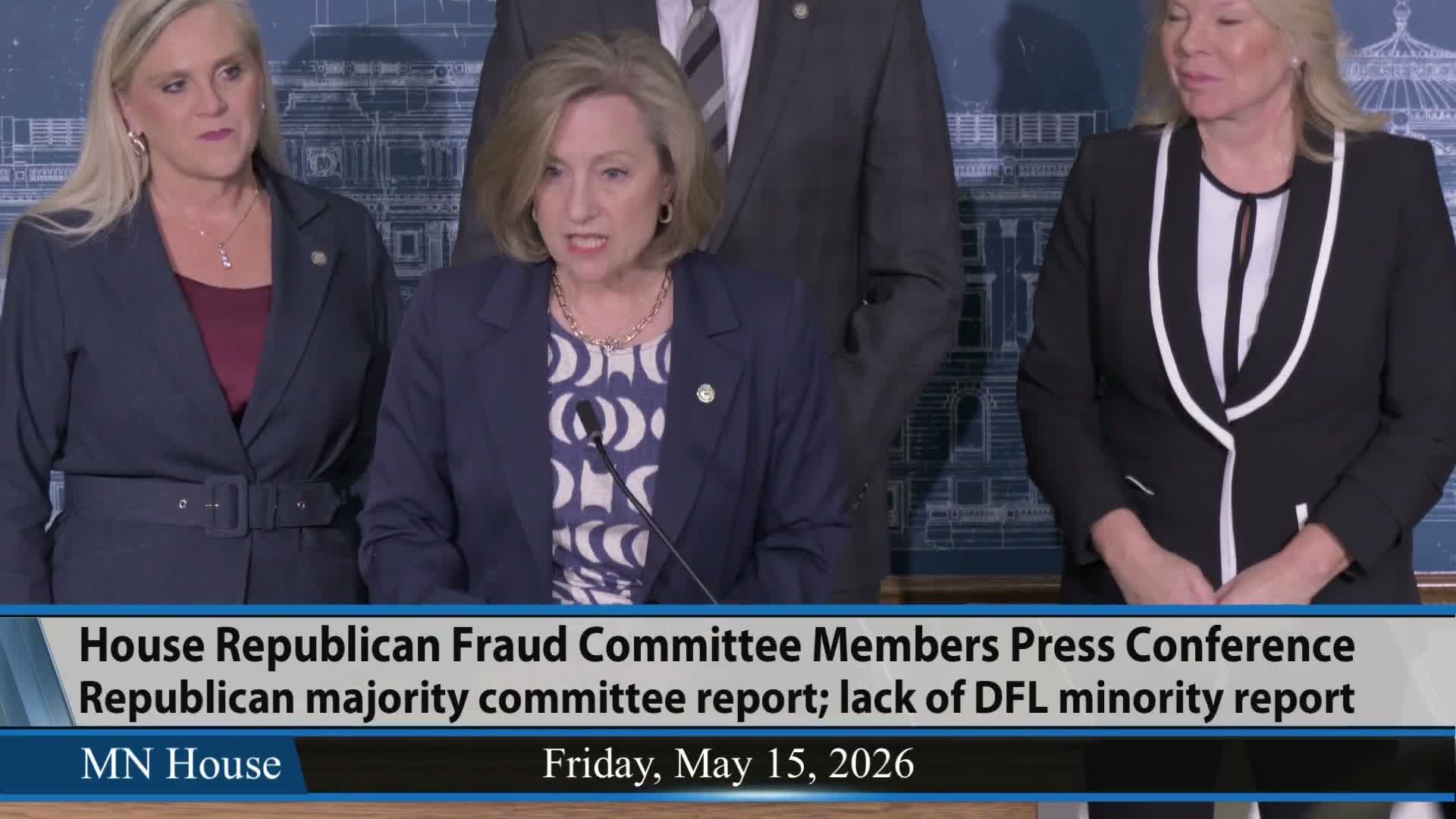
Kristen Robbins, chair of the House Fraud Prevention and State Agency Oversight Committee, on Monday unveiled the committee's 84-page majority report documenting what she called an "explosion of fraud" in state programs and urging stronger oversight and whistleblower protections. "Fraud is not a partisan issue," Robbins said, and she told the public the committee's whistleblower portal, mnfraud.com, will stay open so staff can continue investigating tips during the legislative interim.
The report traces the problem to earlier abuses in the Child Care Assistance Program (CCAP) beginning in the early 2010s that later morphed into schemes tied to the Feeding Our Future effort and then spread into a range of Medicaid waiver services, Robbins said. Those services named by the committee include housing stabilization, autism centers, adult day care, non-emergency medical transportation and interpretive services.
Rep. Pam Altendorf, a member of the committee, urged Minnesotans to read the report and said the scale of the problem is large. Quoting U.S. Attorney Joe Thompson, she said "we could not prosecute our way out of this fraud," and pointed to the housing stabilization program as a concrete example: an early estimate of roughly $2.6 million that the committee described later as expanding to about $105,000,000 before dropping to roughly $57,000,000 after public exposure and enforcement actions, including FBI raids in July 2025.
Rep. Isaac Schultz described the fraud as "industrial scale," saying the committee laid out how oversight failed and that available tools were not used to stop improper payments. Schultz repeated the committee's conclusion that some of the same actors moved between programs and that the state's experience will require sustained oversight and coordination to prevent recurrence.
A committee member introduced as Representative Anderson, who described prior service as a state auditor and commissioner, urged broad reforms and noted the legislature passed an office of inspector general (House File 1). Anderson said her understanding is the governor signed the OIG bill and that the inspector general's office will begin in January. She described a fall commission process to interview candidates (an eight-member, bipartisan panel that will recommend nominees to the next governor) and said the governor's nominee will require a three-fifths vote in the Senate.
Anderson told the committee the inspector general's office will have wide authority to look at any public dollar, program recipient or vendor. In an interim period while the office is staffed the inspector general can enter agreements with local or state law-enforcement partners; Anderson said the inspector general's full police powers (including arrest and direct prosecution authority) will phase in later, per the timeline discussed by the committee.
Committee members and questioners pressed officials on resources and staffing. Anderson said the fiscal note discussed by DHS included funding for additional oversight staff (she cited a fiscal-note line she described as about $5,000,000 tied to DHS oversight roles), and she said some recommendations from a prior O'Malley report were not enacted into statute because the legislature ran out of time.
Robbins and other panelists said culture change in agencies will be central to preventing fraud and restoring confidence among whistleblowers, and they emphasized the portal and new inspector general as mechanisms to make reporting effective.
The committee also recorded political accusations and contested explanations. Robbins said whistleblowers told committee staff they had been discouraged from reporting problems because some alleged abuses occurred within the Somali community and staff feared being accused of racism; she said the committee's position is that fraud must be called out regardless of the community involved.
The committee concluded without recording a formal vote during the briefing; members said they will continue oversight work during the interim and implement site visits and licensing changes described in the report. Officials said administrative details (including the OIG salary-setting process) will be set by the commission and the appropriate salary-setting commission or statute.
The report traces the problem to earlier abuses in the Child Care Assistance Program (CCAP) beginning in the early 2010s that later morphed into schemes tied to the Feeding Our Future effort and then spread into a range of Medicaid waiver services, Robbins said. Those services named by the committee include housing stabilization, autism centers, adult day care, non-emergency medical transportation and interpretive services.
Rep. Pam Altendorf, a member of the committee, urged Minnesotans to read the report and said the scale of the problem is large. Quoting U.S. Attorney Joe Thompson, she said "we could not prosecute our way out of this fraud," and pointed to the housing stabilization program as a concrete example: an early estimate of roughly $2.6 million that the committee described later as expanding to about $105,000,000 before dropping to roughly $57,000,000 after public exposure and enforcement actions, including FBI raids in July 2025.
Rep. Isaac Schultz described the fraud as "industrial scale," saying the committee laid out how oversight failed and that available tools were not used to stop improper payments. Schultz repeated the committee's conclusion that some of the same actors moved between programs and that the state's experience will require sustained oversight and coordination to prevent recurrence.
A committee member introduced as Representative Anderson, who described prior service as a state auditor and commissioner, urged broad reforms and noted the legislature passed an office of inspector general (House File 1). Anderson said her understanding is the governor signed the OIG bill and that the inspector general's office will begin in January. She described a fall commission process to interview candidates (an eight-member, bipartisan panel that will recommend nominees to the next governor) and said the governor's nominee will require a three-fifths vote in the Senate.
Anderson told the committee the inspector general's office will have wide authority to look at any public dollar, program recipient or vendor. In an interim period while the office is staffed the inspector general can enter agreements with local or state law-enforcement partners; Anderson said the inspector general's full police powers (including arrest and direct prosecution authority) will phase in later, per the timeline discussed by the committee.
Committee members and questioners pressed officials on resources and staffing. Anderson said the fiscal note discussed by DHS included funding for additional oversight staff (she cited a fiscal-note line she described as about $5,000,000 tied to DHS oversight roles), and she said some recommendations from a prior O'Malley report were not enacted into statute because the legislature ran out of time.
Robbins and other panelists said culture change in agencies will be central to preventing fraud and restoring confidence among whistleblowers, and they emphasized the portal and new inspector general as mechanisms to make reporting effective.
The committee also recorded political accusations and contested explanations. Robbins said whistleblowers told committee staff they had been discouraged from reporting problems because some alleged abuses occurred within the Somali community and staff feared being accused of racism; she said the committee's position is that fraud must be called out regardless of the community involved.
The committee concluded without recording a formal vote during the briefing; members said they will continue oversight work during the interim and implement site visits and licensing changes described in the report. Officials said administrative details (including the OIG salary-setting process) will be set by the commission and the appropriate salary-setting commission or statute.
View the Full Meeting & All Its Details
This article offers just a summary. Unlock complete video, transcripts, and insights as a Founder Member.
✓
Watch full, unedited meeting videos
✓
Search every word spoken in unlimited transcripts
✓
AI summaries & real-time alerts (all government levels)
✓
Permanent access to expanding government content
30-day money-back guarantee
