Senate Appropriations reviews H.935 provisions for emergency grants and reallocation of prior public-safety funds
May 15, 2026 | Appropriations, SENATE, Committees, Legislative , Vermont
This article was created by AI summarizing key points discussed. AI makes mistakes, so for full details and context, please refer to the video of the full meeting. Please report any errors so we can fix them. Report an error »
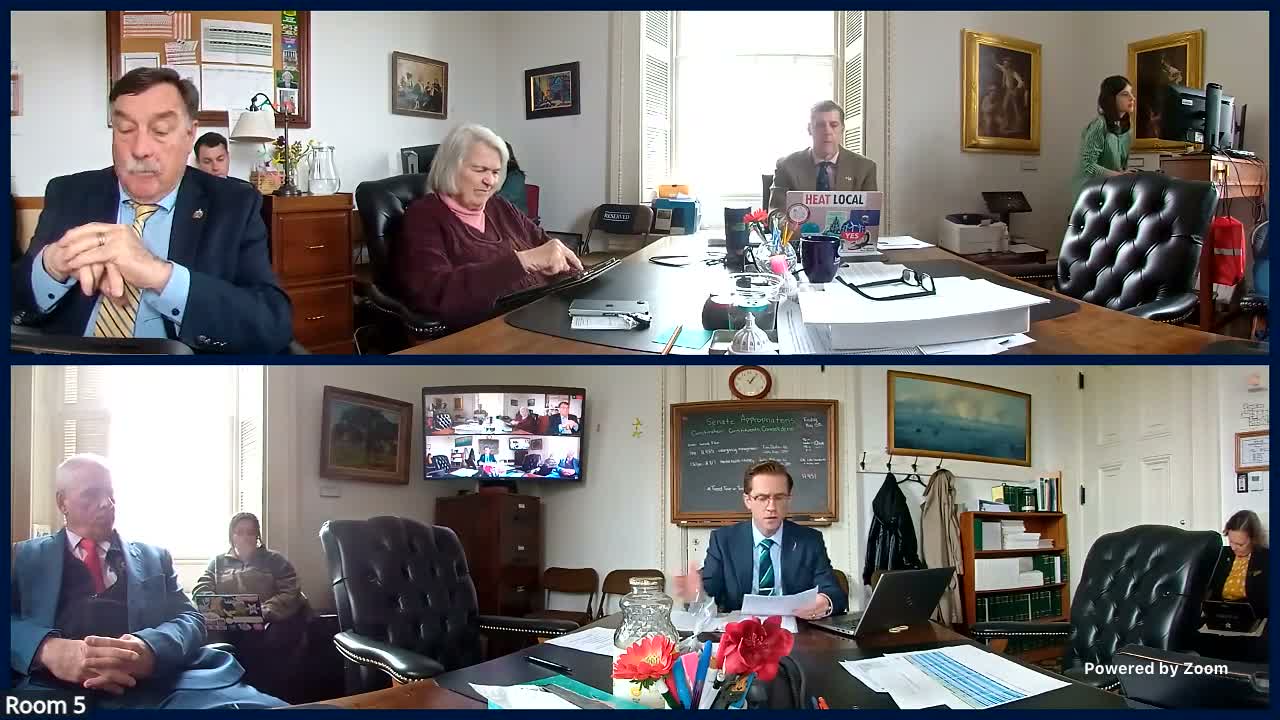
Tim Devlin, legislative council, told the Senate Appropriations committee that the bill (as amended by the Senate committee) would establish two grant programs and revise multiple public-safety statutes. "The first one is the ready response grant program," Devlin said, and "section 13 in particular will provide an appropriation, that's $500,000 for this program." He said the second, a technical-rescue grant program to assist rescue agencies with equipment and readiness, is included in statute but is not funded in the current constructs.
The nut of the discussion centered on three items: the ready-response grant and who would be eligible; the technical-rescue grants and how they would be administered; and how previously appropriated public-safety funds would be reallocated to support a statewide computer-aided dispatch (CAD) system and related radio-network work. Devlin described the ready-response grants as annual awards to an "eligible food bank" for sourcing, storing and distributing shelf-stable food and water in emergencies, while Urban Search and Rescue (USAR) was identified in the draft as the likely manager of the technical-rescue grants to local fire departments, EMS and rescue squads.
Joint Fiscal Office staff walked the committee through the fiscal picture for the CAD and related work, tracing the history of an $11,000,000 appropriation originally provided in Act 185 (2022) and modified by Act 78 (2023). According to staff, about $1.517 million of that appropriation has been released or spent; about $9.48 million remained. The bill as presented would make $2.25 million available immediately for initial CAD costs (including five years of software licensing), $190,000 for cybersecurity and GIS, and $4.5 million available incrementally over three years to expand the statewide mobile radio (LMR) network and pilot projects. Devlin said these changes do not represent new money beyond the original $11 million appropriation but rather propose reallocation and evolving uses of those previously appropriated funds.
Representative Lisa Hengo (House Government Operations and Military Affairs), who explained the House disposition to the committee, said the public-safety communications task force had produced reports and a comprehensive plan submitted January 15, 2026, and that the House language directs the Department of Public Safety to use previously appropriated funds in accordance with that plan. "Now we have a plan," Hengo said, noting that the House version requires multiple checkbacks and reports before the remainder of roughly $2.5 million could be released three years later.
Committee members repeatedly pressed staff on funding sources and approvals. A senator asked whether the $500,000 was included in the Senate budget construct; Devlin and JFO staff said the $500,000 was included in the House bill and is a general-fund appropriation, while much of the CAD and LMR funding would draw on prior appropriations held by DPS. Members also asked about the role of the Joint Fiscal Committee (JFC) and whether awards for pilot projects require its approval; staff said pilot awards required plans and approvals and that most of the $4.5 million set aside for pilots had not been spent because a plan was required before funds could be released.
The committee noted other statutory changes in the draft, including modernization of long-standing town forest-fire warden provisions (removing a nominal $30 annual compensation), clarification of municipal reimbursement for forest-fire suppression when funds are available, creation of a wildfire response-capacity task force with per-diem language and an extension of the public-safety communications task force through February 2027. Devlin also pointed to contingency language in section 13(a) that makes implementing the new grant programs dependent on whether DPS has sufficient funds to administer them; JFO recommended cleaning that language up to reflect current bill text.
No formal final vote on H.935 appears in the transcript. Devlin said the committee would "pick this up" later and would address outstanding amendment work and the conference-committee questions about the $500,000 general-fund item. The committee concluded the overview and thanked staff and witnesses.
What remains open: whether the House's $500,000 general-fund appropriation for the ready-response grant will be retained through conference, whether the technical-rescue grant will receive funding, and the sequence of required reports and JFC approvals before remaining reallocated funds are released. The transcript records the committee's review and follow-up plans but does not show a final committee action on the measure.
The nut of the discussion centered on three items: the ready-response grant and who would be eligible; the technical-rescue grants and how they would be administered; and how previously appropriated public-safety funds would be reallocated to support a statewide computer-aided dispatch (CAD) system and related radio-network work. Devlin described the ready-response grants as annual awards to an "eligible food bank" for sourcing, storing and distributing shelf-stable food and water in emergencies, while Urban Search and Rescue (USAR) was identified in the draft as the likely manager of the technical-rescue grants to local fire departments, EMS and rescue squads.
Joint Fiscal Office staff walked the committee through the fiscal picture for the CAD and related work, tracing the history of an $11,000,000 appropriation originally provided in Act 185 (2022) and modified by Act 78 (2023). According to staff, about $1.517 million of that appropriation has been released or spent; about $9.48 million remained. The bill as presented would make $2.25 million available immediately for initial CAD costs (including five years of software licensing), $190,000 for cybersecurity and GIS, and $4.5 million available incrementally over three years to expand the statewide mobile radio (LMR) network and pilot projects. Devlin said these changes do not represent new money beyond the original $11 million appropriation but rather propose reallocation and evolving uses of those previously appropriated funds.
Representative Lisa Hengo (House Government Operations and Military Affairs), who explained the House disposition to the committee, said the public-safety communications task force had produced reports and a comprehensive plan submitted January 15, 2026, and that the House language directs the Department of Public Safety to use previously appropriated funds in accordance with that plan. "Now we have a plan," Hengo said, noting that the House version requires multiple checkbacks and reports before the remainder of roughly $2.5 million could be released three years later.
Committee members repeatedly pressed staff on funding sources and approvals. A senator asked whether the $500,000 was included in the Senate budget construct; Devlin and JFO staff said the $500,000 was included in the House bill and is a general-fund appropriation, while much of the CAD and LMR funding would draw on prior appropriations held by DPS. Members also asked about the role of the Joint Fiscal Committee (JFC) and whether awards for pilot projects require its approval; staff said pilot awards required plans and approvals and that most of the $4.5 million set aside for pilots had not been spent because a plan was required before funds could be released.
The committee noted other statutory changes in the draft, including modernization of long-standing town forest-fire warden provisions (removing a nominal $30 annual compensation), clarification of municipal reimbursement for forest-fire suppression when funds are available, creation of a wildfire response-capacity task force with per-diem language and an extension of the public-safety communications task force through February 2027. Devlin also pointed to contingency language in section 13(a) that makes implementing the new grant programs dependent on whether DPS has sufficient funds to administer them; JFO recommended cleaning that language up to reflect current bill text.
No formal final vote on H.935 appears in the transcript. Devlin said the committee would "pick this up" later and would address outstanding amendment work and the conference-committee questions about the $500,000 general-fund item. The committee concluded the overview and thanked staff and witnesses.
What remains open: whether the House's $500,000 general-fund appropriation for the ready-response grant will be retained through conference, whether the technical-rescue grant will receive funding, and the sequence of required reports and JFC approvals before remaining reallocated funds are released. The transcript records the committee's review and follow-up plans but does not show a final committee action on the measure.
View the Full Meeting & All Its Details
This article offers just a summary. Unlock complete video, transcripts, and insights as a Founder Member.
✓
Watch full, unedited meeting videos
✓
Search every word spoken in unlimited transcripts
✓
AI summaries & real-time alerts (all government levels)
✓
Permanent access to expanding government content
30-day money-back guarantee
