Slipstream experts tell Kane County committee heat pumps can cut emissions but savings depend on utilities and design
May 15, 2026 | Kane County, Illinois
This article was created by AI summarizing key points discussed. AI makes mistakes, so for full details and context, please refer to the video of the full meeting. Please report any errors so we can fix them. Report an error »
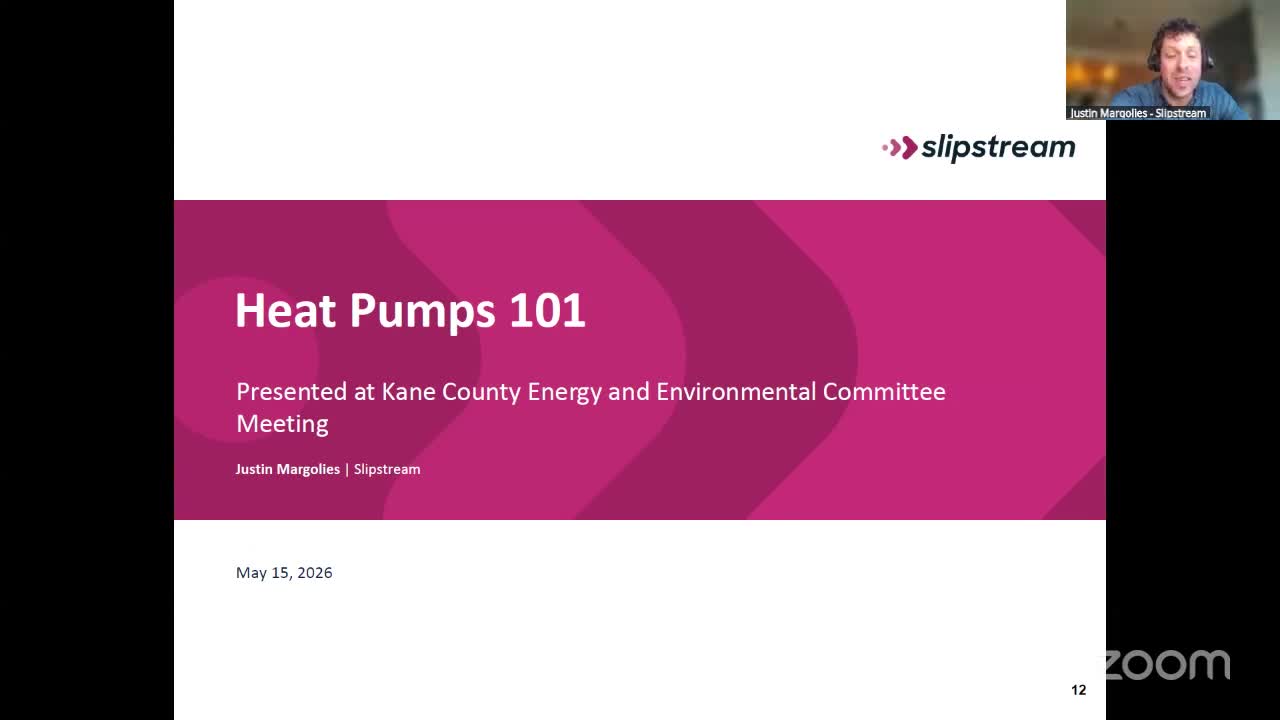
The Kane County Energy & Environmental Committee on May 15 heard a technical and policy briefing on heat pumps from Slipstream consultants Justin Margolis and Dan Strait, who outlined how the technology works, costs for customers, and local program options such as group-buy efforts and contractor training.
"It is a really bad name. It is a two-way air conditioner," Justin Margolis said, explaining that modern air-source heat pumps move heat in both directions and can achieve seasonal coefficients of performance (COP) well above 1. He described cold-climate, variable-speed compressors and three common distributions (ducted, short-run ducts and ductless mini-splits), noting many newer models maintain higher efficiency at low temperatures relevant to Kane County's climate.
Slipstream presented upfront cost comparisons drawn from a regional invoice dataset and emphasized that dual-fuel configurations (heat pump plus gas furnace) are the most commonly deployed option because they balance operating cost and environmental performance for many customers. "Dual fuel is more common because that's going to be a little lower in operational costs or you'll break even more," Margolis said, adding that customer goals and local utility rates must inform design choices.
The consultants outlined the "spark gap" concept: the price relationship between electricity and gas that determines when a heat pump will be cheaper to operate than a gas furnace. Using example utility prices, Margolis showed that, for many Kane County customers served by ComEd (electric) and Nicor (gas), an all-electric heat pump could raise annual bills modestly (roughly $100 in an example) unless rate design and incentives change. He also said certain cold-climate units can sustain higher COP at temperatures down to 5 degrees Fahrenheit, reducing the need to rely on backup heat.
Slipstream also covered lower-cost options such as heat-pump water heaters and room heat pumps (including plug-in or window-mounted units) that can be particularly useful for multifamily or low-income housing. Margolis said some compact room units can cost as little as several hundred dollars to install, while centrally ducted dual-fuel system retrofits averaged several thousand dollars more than like-for-like AC/furnace replacements in the dataset shown.
Dan Strait framed program and policy options for the county, describing group-buy programs, contractor summits and local code tools such as stretch codes and benchmarking. "A group buy does offer a really good strategy because you can vet the contractor to make sure they really know their stuff," Strait said, recommending outreach and contractor training to improve market offerings and consumer confidence.
Committee members asked how heat pumps interact with rooftop solar, automatic switching between heat pump and furnace, and how to present comparative costs to residents. Margolis said solar can lower operational costs and that many dual-fuel systems switch automatically. The presentation included links to resources (the Northeast Energy Efficiency Partnerships cold-climate list, a Midwest Heating & Cooling Collaborative toolkit, and a heat pump savings calculator) and an offer from Slipstream for follow-up technical assistance.
The committee did not take a formal vote on programs at the meeting but discussed next steps including potential participation in a group-buy and additional outreach. Slipstream said their team can provide one-on-one technical assistance to local governments and suggested a contractor summit and vetted procurement as practical next steps.
The presentation began with Slipstream's technical overview and ran through local program and policy suggestions; the county staff agreed to distribute the resource links and follow up with interested members.
"It is a really bad name. It is a two-way air conditioner," Justin Margolis said, explaining that modern air-source heat pumps move heat in both directions and can achieve seasonal coefficients of performance (COP) well above 1. He described cold-climate, variable-speed compressors and three common distributions (ducted, short-run ducts and ductless mini-splits), noting many newer models maintain higher efficiency at low temperatures relevant to Kane County's climate.
Slipstream presented upfront cost comparisons drawn from a regional invoice dataset and emphasized that dual-fuel configurations (heat pump plus gas furnace) are the most commonly deployed option because they balance operating cost and environmental performance for many customers. "Dual fuel is more common because that's going to be a little lower in operational costs or you'll break even more," Margolis said, adding that customer goals and local utility rates must inform design choices.
The consultants outlined the "spark gap" concept: the price relationship between electricity and gas that determines when a heat pump will be cheaper to operate than a gas furnace. Using example utility prices, Margolis showed that, for many Kane County customers served by ComEd (electric) and Nicor (gas), an all-electric heat pump could raise annual bills modestly (roughly $100 in an example) unless rate design and incentives change. He also said certain cold-climate units can sustain higher COP at temperatures down to 5 degrees Fahrenheit, reducing the need to rely on backup heat.
Slipstream also covered lower-cost options such as heat-pump water heaters and room heat pumps (including plug-in or window-mounted units) that can be particularly useful for multifamily or low-income housing. Margolis said some compact room units can cost as little as several hundred dollars to install, while centrally ducted dual-fuel system retrofits averaged several thousand dollars more than like-for-like AC/furnace replacements in the dataset shown.
Dan Strait framed program and policy options for the county, describing group-buy programs, contractor summits and local code tools such as stretch codes and benchmarking. "A group buy does offer a really good strategy because you can vet the contractor to make sure they really know their stuff," Strait said, recommending outreach and contractor training to improve market offerings and consumer confidence.
Committee members asked how heat pumps interact with rooftop solar, automatic switching between heat pump and furnace, and how to present comparative costs to residents. Margolis said solar can lower operational costs and that many dual-fuel systems switch automatically. The presentation included links to resources (the Northeast Energy Efficiency Partnerships cold-climate list, a Midwest Heating & Cooling Collaborative toolkit, and a heat pump savings calculator) and an offer from Slipstream for follow-up technical assistance.
The committee did not take a formal vote on programs at the meeting but discussed next steps including potential participation in a group-buy and additional outreach. Slipstream said their team can provide one-on-one technical assistance to local governments and suggested a contractor summit and vetted procurement as practical next steps.
The presentation began with Slipstream's technical overview and ran through local program and policy suggestions; the county staff agreed to distribute the resource links and follow up with interested members.
Don't Miss a Word: See the Full Meeting!
Go beyond summaries. Unlock every video, transcript, and key insight with a Founder Membership.
✓
Get instant access to full meeting videos
✓
Search and clip any phrase from complete transcripts
✓
Receive AI-powered summaries & custom alerts
✓
Enjoy lifetime, unrestricted access to government data
30-day money-back guarantee
