CDPHE explains consultation process as commissioners give produced‑water work group more time
May 15, 2026 | Energy and Mineral Impact Assistance State Advisory Committee, Governor's Boards and Commissions, Organizations, Executive, Colorado
This article was created by AI summarizing key points discussed. AI makes mistakes, so for full details and context, please refer to the video of the full meeting. Please report any errors so we can fix them. Report an error »
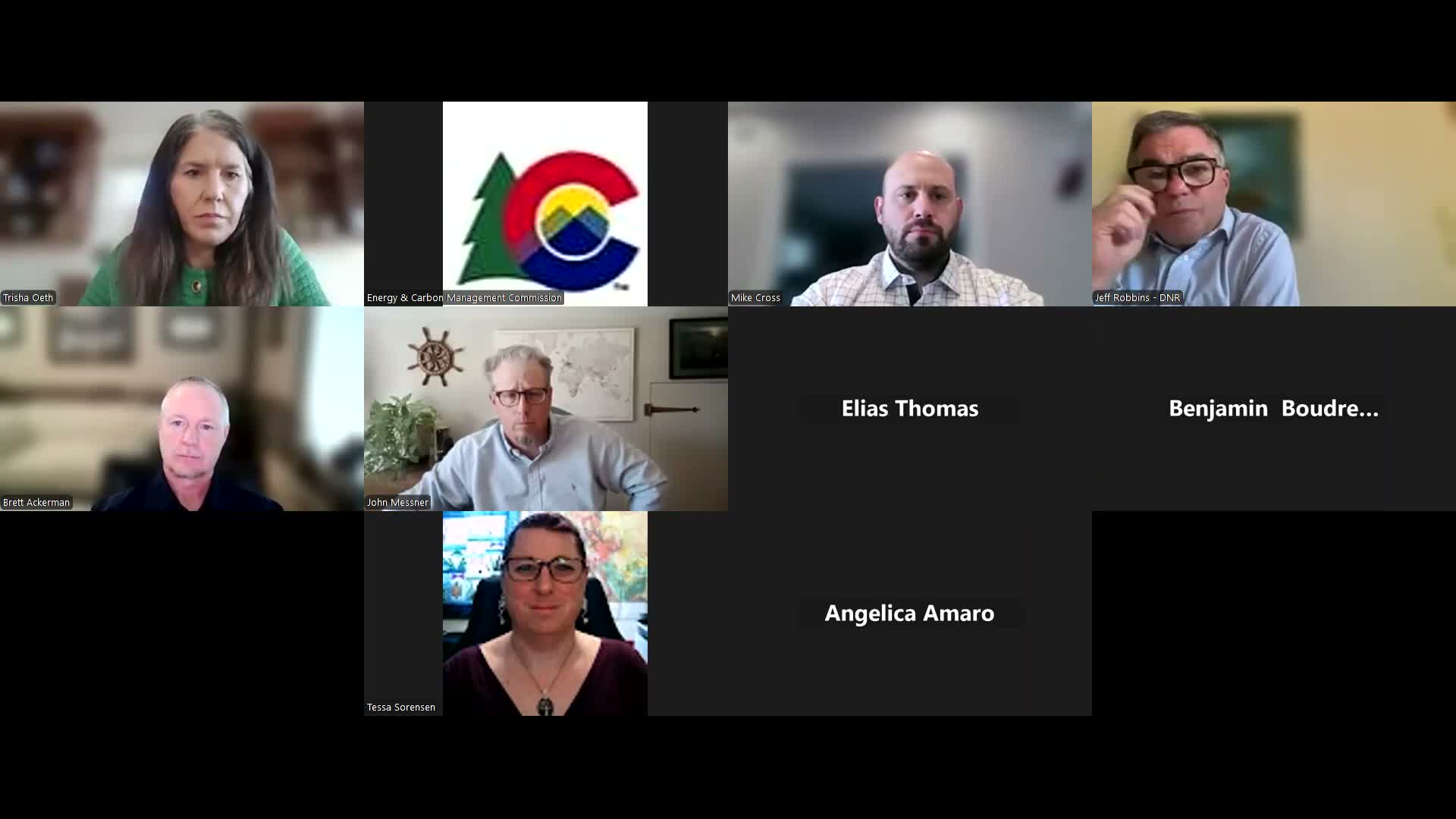
Tessa Sorensen, energy liaison for the Colorado Department of Public Health and Environment, told the Energy and Carbon Management Commission on May 13 that CDPHE consults on oil‑and‑gas permit applications to protect public health, the environment and to address cumulative impacts.
"ECMC has a requirement in their own rules to reach out to CDPHE in a lot of different situations," Sorensen said, describing how CDPHE’s air, water quality, hazardous materials and environmental health divisions participate in reviews. She outlined consultation triggers including requests from local governments, variances, underground injection control well proposals, and oil‑and‑gas development plans within proximity thresholds to residents or high‑occupancy buildings; standard consultation windows are 45 days from the start of public comment and extend to 60 days in disproportionately impacted communities.
Sorensen described CDPHE’s use of a 44‑item list of best‑management practices (BMPs) and said the department often recommends voluntary conditions of approval that operators commit to; those operator commitments become commission conditions of approval. She pointed to specific BMPs such as reductions in natural‑gas burner use and monitoring strategies, and said CDPHE has introduced new environmental‑justice BMPs that increase operator transparency, require accessible contact information for operators, and encourage post‑approval public information sessions when there is a long delay before drilling.
Commissioner Oates opened the meeting’s substantive discussion with an update on a produced‑water work group the commission convened after adopting produced‑water rules last March. Oates said the group found the question of whether increased use of recycled produced water can occur without raising air emissions is complex, and that stakeholders have reached a consensus that there is the potential for increased emissions and several data‑collection challenges.
"I believe that we should be able to accomplish this in the course of, I think, about 3 meetings or so," Oates said, asking the commission to allow the work group more time and proposing a work‑group wrap‑up by July with a report to the commission in mid‑August.
Commissioner Messner voiced support for Oates’ request and suggested the produced‑water consortium could continue refining data on storage, transportation and treatment technologies to inform the commission’s recommendations.
During questions, Sorensen said operators generally have been receptive to CDPHE’s consultations but often face uncertainty around timing, contracts and equipment that can limit immediate commitments. She noted CDPHE can recommend denial of an oil‑and‑gas development plan or a cap in rare cases but that most applications needing denial do not reach the commission because of pre‑application screening and the volume of staff review.
Sorensen cited program data showing CDPHE consulted on about 48% of relevant development plans through 2023 and said that rate rose to roughly 57% in the current year. She also reiterated that CDPHE’s recommendations and monitoring proposals are submitted in writing and logged in the hearing docket.
The commission voted to approve the consent agenda and later moved to adjourn. The chair asked Sorensen to return with a shorter update in the next quarter and requested that her presentation be posted to the ECMC homepage with accessibility accommodations.
The meeting adjourned with commissioners voting aye on the motion to end the session.
"ECMC has a requirement in their own rules to reach out to CDPHE in a lot of different situations," Sorensen said, describing how CDPHE’s air, water quality, hazardous materials and environmental health divisions participate in reviews. She outlined consultation triggers including requests from local governments, variances, underground injection control well proposals, and oil‑and‑gas development plans within proximity thresholds to residents or high‑occupancy buildings; standard consultation windows are 45 days from the start of public comment and extend to 60 days in disproportionately impacted communities.
Sorensen described CDPHE’s use of a 44‑item list of best‑management practices (BMPs) and said the department often recommends voluntary conditions of approval that operators commit to; those operator commitments become commission conditions of approval. She pointed to specific BMPs such as reductions in natural‑gas burner use and monitoring strategies, and said CDPHE has introduced new environmental‑justice BMPs that increase operator transparency, require accessible contact information for operators, and encourage post‑approval public information sessions when there is a long delay before drilling.
Commissioner Oates opened the meeting’s substantive discussion with an update on a produced‑water work group the commission convened after adopting produced‑water rules last March. Oates said the group found the question of whether increased use of recycled produced water can occur without raising air emissions is complex, and that stakeholders have reached a consensus that there is the potential for increased emissions and several data‑collection challenges.
"I believe that we should be able to accomplish this in the course of, I think, about 3 meetings or so," Oates said, asking the commission to allow the work group more time and proposing a work‑group wrap‑up by July with a report to the commission in mid‑August.
Commissioner Messner voiced support for Oates’ request and suggested the produced‑water consortium could continue refining data on storage, transportation and treatment technologies to inform the commission’s recommendations.
During questions, Sorensen said operators generally have been receptive to CDPHE’s consultations but often face uncertainty around timing, contracts and equipment that can limit immediate commitments. She noted CDPHE can recommend denial of an oil‑and‑gas development plan or a cap in rare cases but that most applications needing denial do not reach the commission because of pre‑application screening and the volume of staff review.
Sorensen cited program data showing CDPHE consulted on about 48% of relevant development plans through 2023 and said that rate rose to roughly 57% in the current year. She also reiterated that CDPHE’s recommendations and monitoring proposals are submitted in writing and logged in the hearing docket.
The commission voted to approve the consent agenda and later moved to adjourn. The chair asked Sorensen to return with a shorter update in the next quarter and requested that her presentation be posted to the ECMC homepage with accessibility accommodations.
The meeting adjourned with commissioners voting aye on the motion to end the session.
Don't Miss a Word: See the Full Meeting!
Go beyond summaries. Unlock every video, transcript, and key insight with a Founder Membership.
✓
Get instant access to full meeting videos
✓
Search and clip any phrase from complete transcripts
✓
Receive AI-powered summaries & custom alerts
✓
Enjoy lifetime, unrestricted access to government data
30-day money-back guarantee
