Los Angeles Unified updates Prop 39 colocation numbers, outlines renewal timeline
May 15, 2026 | Los Angeles Unified, School Districts, California
This article was created by AI summarizing key points discussed. AI makes mistakes, so for full details and context, please refer to the video of the full meeting. Please report any errors so we can fix them. Report an error »
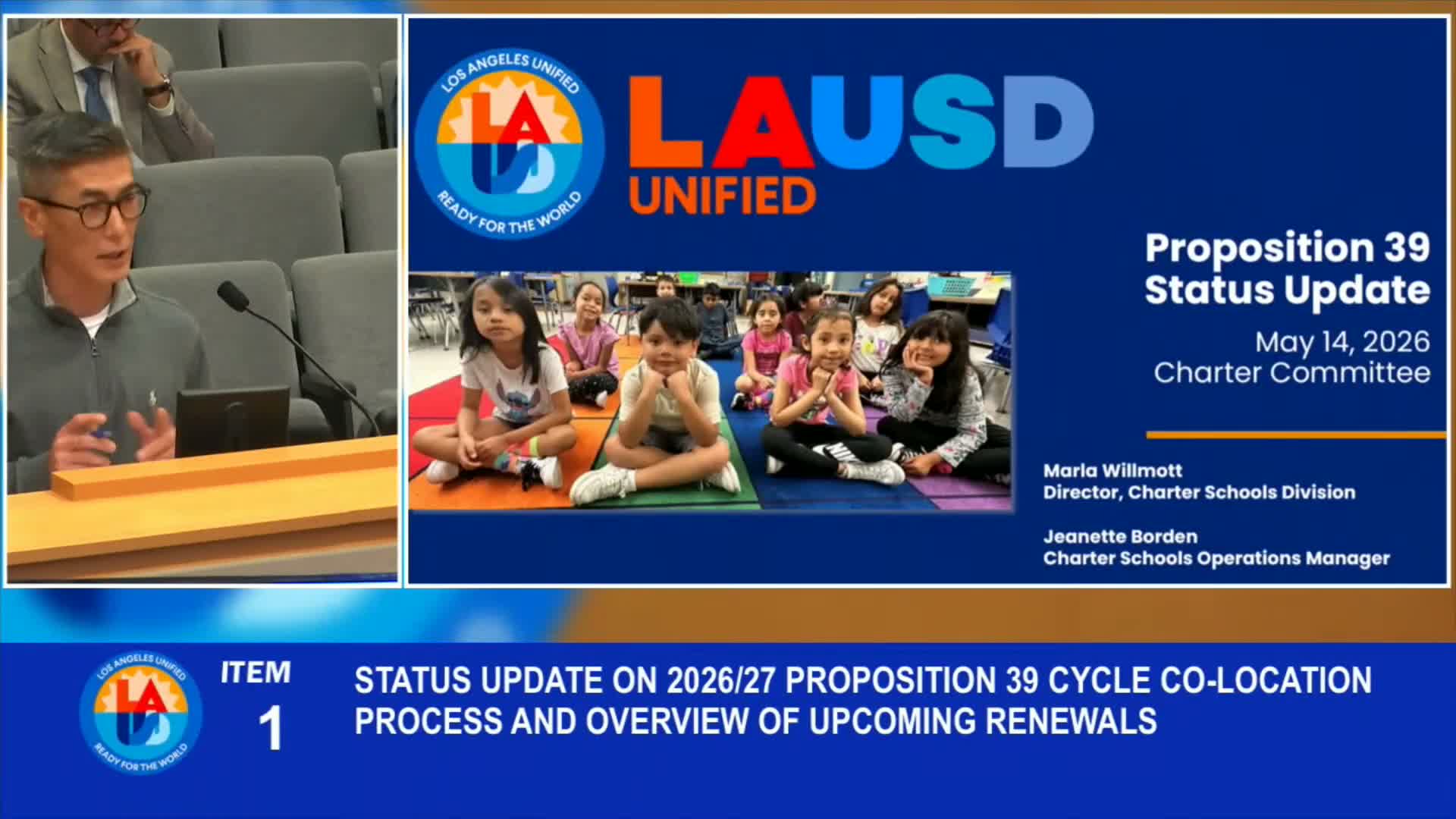
Los Angeles Unified officials on May 21 updated the Board’s Charter Schools Committee on two citywide processes that affect charter operations: the Prop 39 colocation cycle for 2026–27 and the district’s upcoming charter renewal calendar.
Daniel Huang, an operations coordinator in the district’s Charter Schools Division, summarized the Prop 39 schedule set by state regulation — requests due Nov. 1, district responses by Dec. 1, charter replies by Jan. 2, preliminary questions by March 1, final offers Apr. 1 and charter acceptances by May 1. Huang said the division received 37 facilities requests for 2026–27; of those, 2 withdrew, 4 were found ineligible, 2 declined final offers, 1 did not respond, and 9 accepted final offers. An additional 19 charter schools entered into alternative agreements with the district, bringing the total number of charter schools that will be colocated next year to 28.
"If the charter school accepts the final offer, the charter school is then able to occupy the site 10 business days prior to its first day of instruction," Huang said, describing operational timelines and region‑level coordination on space inventories and campus reconfigurations.
Huang also addressed overallocation, the state‑defined situation when allocated space exceeds a charter’s ADA‑based entitlement. He said the district has directed more than $12.6 million in overallocation reimbursements back to 71 host sites and noted that 12 charters were identified as overallocated for 2024–25 with invoices to be issued to cover 2025–26 overallocations by Aug. 15. "All active charter schools are current on payments," he said, and added that charters receive at least three notices during the year if data indicate a risk of overallocation.
Marla Wilmot, director of the Charter Schools Division, then reviewed renewal volumes and criteria under Education Code § 47605 and related state guidance. She said 69 renewals were submitted in 2025–26 and projected 83 renewals for 2026–27. Wilmot outlined the three renewal criteria used by the district: Criterion 1 (sound educational program and capacity), Criterion 2 (performance category: high/middle/low), and Criterion 3 (discriminatory enrollment practices, substantial governance or fiscal concerns). She explained the presumptions that attach to performance categories — high performing schools are presumptively eligible for longer terms, middle performing schools are limited to five‑year approvals, and low performing schools are presumptively subject to denial or shorter terms.
Wilmot and staff also told the committee they are monitoring pending trailer‑bill language that could reinstate verified data and short‑term growth measures into renewal consideration. "We’re watching that trailer bill to see the impact for low and middle performing schools," Wilmot said; she said the district expects clarity by the statutory trailer‑bill deadlines.
Board members asked how the district communicates colocation changes to host communities and how the district supports charters that are leaving a site. Huang said the regions provide template letters and hold operations meetings for colocated administrators; charters that need more time to move out can seek an amendment to their agreements. On fiscal impacts, Wilmot and Huang said repeated notices and the ability to return space can reduce surprise charges.
Next steps: regions will complete site preparations, the district will host an operations meeting for colocated administrators, and the committee will monitor trailer‑bill action that could change renewal criteria and the use of verified data.
Daniel Huang, an operations coordinator in the district’s Charter Schools Division, summarized the Prop 39 schedule set by state regulation — requests due Nov. 1, district responses by Dec. 1, charter replies by Jan. 2, preliminary questions by March 1, final offers Apr. 1 and charter acceptances by May 1. Huang said the division received 37 facilities requests for 2026–27; of those, 2 withdrew, 4 were found ineligible, 2 declined final offers, 1 did not respond, and 9 accepted final offers. An additional 19 charter schools entered into alternative agreements with the district, bringing the total number of charter schools that will be colocated next year to 28.
"If the charter school accepts the final offer, the charter school is then able to occupy the site 10 business days prior to its first day of instruction," Huang said, describing operational timelines and region‑level coordination on space inventories and campus reconfigurations.
Huang also addressed overallocation, the state‑defined situation when allocated space exceeds a charter’s ADA‑based entitlement. He said the district has directed more than $12.6 million in overallocation reimbursements back to 71 host sites and noted that 12 charters were identified as overallocated for 2024–25 with invoices to be issued to cover 2025–26 overallocations by Aug. 15. "All active charter schools are current on payments," he said, and added that charters receive at least three notices during the year if data indicate a risk of overallocation.
Marla Wilmot, director of the Charter Schools Division, then reviewed renewal volumes and criteria under Education Code § 47605 and related state guidance. She said 69 renewals were submitted in 2025–26 and projected 83 renewals for 2026–27. Wilmot outlined the three renewal criteria used by the district: Criterion 1 (sound educational program and capacity), Criterion 2 (performance category: high/middle/low), and Criterion 3 (discriminatory enrollment practices, substantial governance or fiscal concerns). She explained the presumptions that attach to performance categories — high performing schools are presumptively eligible for longer terms, middle performing schools are limited to five‑year approvals, and low performing schools are presumptively subject to denial or shorter terms.
Wilmot and staff also told the committee they are monitoring pending trailer‑bill language that could reinstate verified data and short‑term growth measures into renewal consideration. "We’re watching that trailer bill to see the impact for low and middle performing schools," Wilmot said; she said the district expects clarity by the statutory trailer‑bill deadlines.
Board members asked how the district communicates colocation changes to host communities and how the district supports charters that are leaving a site. Huang said the regions provide template letters and hold operations meetings for colocated administrators; charters that need more time to move out can seek an amendment to their agreements. On fiscal impacts, Wilmot and Huang said repeated notices and the ability to return space can reduce surprise charges.
Next steps: regions will complete site preparations, the district will host an operations meeting for colocated administrators, and the committee will monitor trailer‑bill action that could change renewal criteria and the use of verified data.
Don't Miss a Word: See the Full Meeting!
Go beyond summaries. Unlock every video, transcript, and key insight with a Founder Membership.
✓
Get instant access to full meeting videos
✓
Search and clip any phrase from complete transcripts
✓
Receive AI-powered summaries & custom alerts
✓
Enjoy lifetime, unrestricted access to government data
30-day money-back guarantee
