Neighbors and descendants urge City to push back on TxDOT highway expansions that would affect historic land and neighborhoods
May 14, 2026 | Austin, Travis County, Texas
This article was created by AI summarizing key points discussed. AI makes mistakes, so for full details and context, please refer to the video of the full meeting. Please report any errors so we can fix them. Report an error »
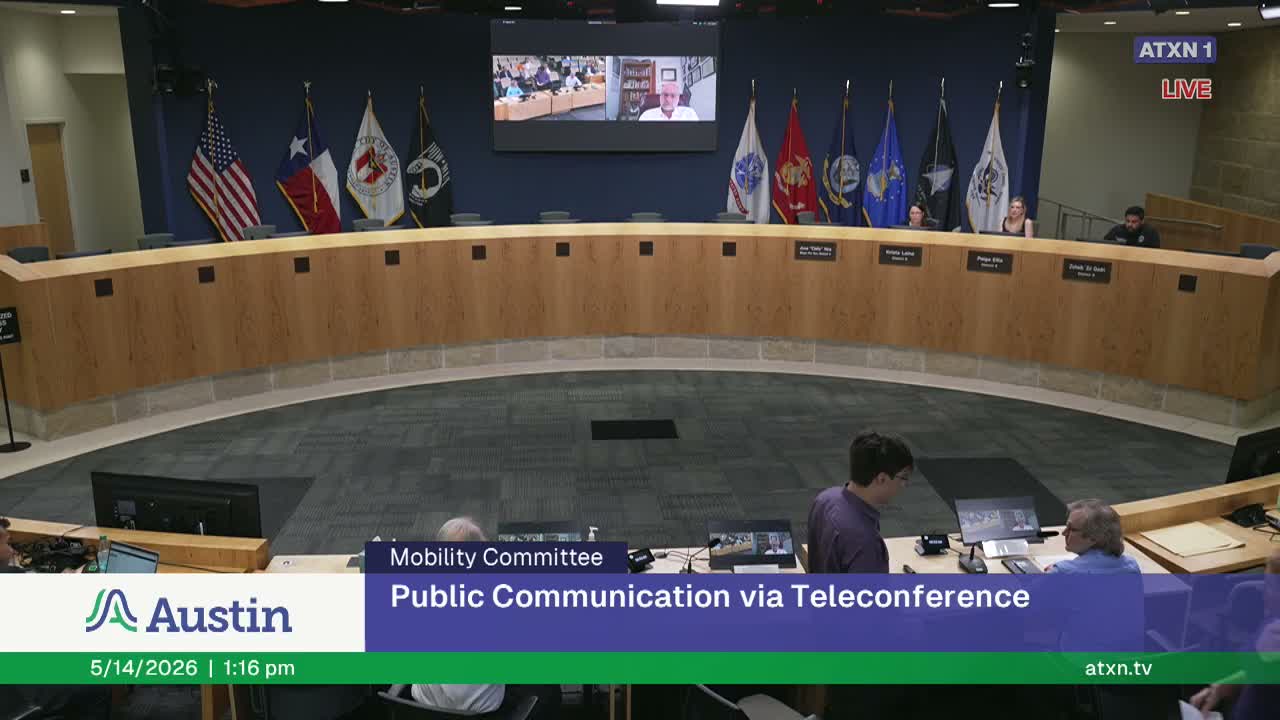
Residents and descendants of long‑standing Austin neighborhoods told the Mobility Committee on May 14 that planned state highway expansions risk historic sites, private property and community safety.
Rosalind Alexander Kasparik, who said she is a sixth‑generation descendant of the Alexander family, told the committee the Alexander Farm and its family cemetery have been in the family for 180 years and are threatened by a TxDOT expansion route for US‑183. "Our land legacy has been handed down for 180 years and counting," she said, and she urged that alternate routes and promised outreach be honored so the cultural landscape and archaeological remains are not obliterated.
Speakers from neighborhood groups raised similar concerns about RM 1826 and other projects. Jim McClintock, cofounder of United Neighbors of 1826, said his group represents nearly 8,000 homes along the 4.4‑mile corridor and criticized traffic projections that informed a $70,000,000 schematic. Frank Teal said the plan would affect about 190 property owners and take roughly 34 acres of private land, potentially impacting wells and septic systems and intruding on the Edwards Aquifer recharge zone. "If it were put through as written, it would put a highway right through the Edwards Aquifer recharge zone," he said.
Elizabeth Cubberley said the project's traffic numbers are inflated and warned that converting portions of the corridor to a divided, limited‑access highway could reduce emergency access and worsen wildfire evacuation risks. "This is an increase in risk in our neighborhood," she said.
Several commenters asked the committee to press TxDOT for more accurate data, smaller interim footprints where appropriate, and funding for neighborhood mitigations rather than full expansion. Laurel Chesky, vice president of the Windsor Park Neighborhood Association, said her neighborhood only learned in October that TxDOT posted a plan to extend Broadmoor Drive to the I‑35 feeder road; the association opposes that extension and asked TxDOT to fund mitigations and coordinate design with residents.
Some speakers also framed the matter as a choice about transportation priorities. Jose Loyola, a District 6 parent who runs a school bike‑bus, urged funding for protected bikeways and safer crossings so children can travel without a car: "For children, it is a freedom issue," he said. Eric Batista argued that widening highways fuels more driving and urged investment in transit and protected bike infrastructure rather than more lanes.
What happens next: TxDOT presenters said planning and public outreach are ongoing and agreed to follow up with council offices and neighborhood groups with timeline information and outreach plans.
Rosalind Alexander Kasparik, who said she is a sixth‑generation descendant of the Alexander family, told the committee the Alexander Farm and its family cemetery have been in the family for 180 years and are threatened by a TxDOT expansion route for US‑183. "Our land legacy has been handed down for 180 years and counting," she said, and she urged that alternate routes and promised outreach be honored so the cultural landscape and archaeological remains are not obliterated.
Speakers from neighborhood groups raised similar concerns about RM 1826 and other projects. Jim McClintock, cofounder of United Neighbors of 1826, said his group represents nearly 8,000 homes along the 4.4‑mile corridor and criticized traffic projections that informed a $70,000,000 schematic. Frank Teal said the plan would affect about 190 property owners and take roughly 34 acres of private land, potentially impacting wells and septic systems and intruding on the Edwards Aquifer recharge zone. "If it were put through as written, it would put a highway right through the Edwards Aquifer recharge zone," he said.
Elizabeth Cubberley said the project's traffic numbers are inflated and warned that converting portions of the corridor to a divided, limited‑access highway could reduce emergency access and worsen wildfire evacuation risks. "This is an increase in risk in our neighborhood," she said.
Several commenters asked the committee to press TxDOT for more accurate data, smaller interim footprints where appropriate, and funding for neighborhood mitigations rather than full expansion. Laurel Chesky, vice president of the Windsor Park Neighborhood Association, said her neighborhood only learned in October that TxDOT posted a plan to extend Broadmoor Drive to the I‑35 feeder road; the association opposes that extension and asked TxDOT to fund mitigations and coordinate design with residents.
Some speakers also framed the matter as a choice about transportation priorities. Jose Loyola, a District 6 parent who runs a school bike‑bus, urged funding for protected bikeways and safer crossings so children can travel without a car: "For children, it is a freedom issue," he said. Eric Batista argued that widening highways fuels more driving and urged investment in transit and protected bike infrastructure rather than more lanes.
What happens next: TxDOT presenters said planning and public outreach are ongoing and agreed to follow up with council offices and neighborhood groups with timeline information and outreach plans.
View the Full Meeting & All Its Details
This article offers just a summary. Unlock complete video, transcripts, and insights as a Founder Member.
✓
Watch full, unedited meeting videos
✓
Search every word spoken in unlimited transcripts
✓
AI summaries & real-time alerts (all government levels)
✓
Permanent access to expanding government content
30-day money-back guarantee
