House Energy committee reviews Senate changes to H.727 on data centers — 10‑year contracts, PFAS monitoring and water triggers added
May 15, 2026 | Environment & Energy, HOUSE OF REPRESENTATIVES, Committees, Legislative , Vermont
This article was created by AI summarizing key points discussed. AI makes mistakes, so for full details and context, please refer to the video of the full meeting. Please report any errors so we can fix them. Report an error »
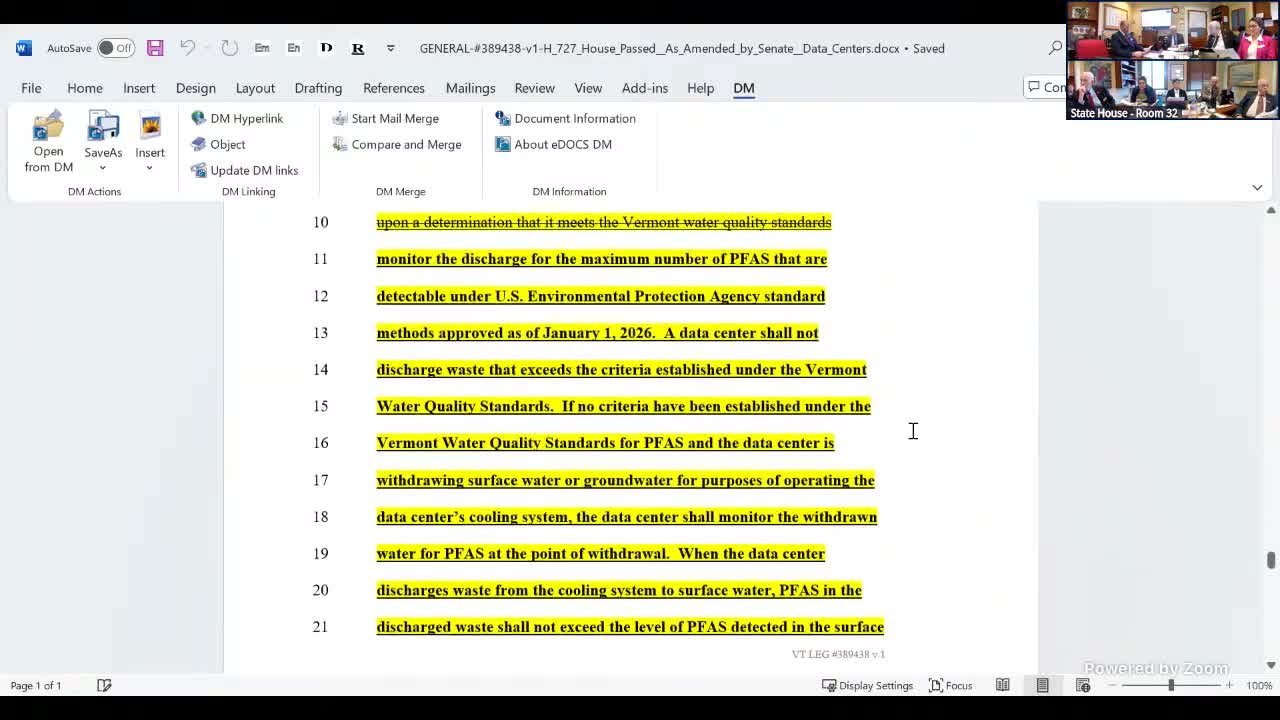
The House Energy and Digital Infrastructure committee discussed Senate amendments to H.727, the bill that would impose new regulatory and contractual requirements on proposed large data centers in Vermont.
The committee received a detailed readout from Legislative Counsel Maria Royal that the Senate’s package would (among other changes) treat multiple nonadjacent sites under common management as a single ‘‘facility’’ for threshold calculations, require large‑load contracts to insulate other ratepayer classes from the costs of new infrastructure, and set a proposed minimum contract length of 10 years.
Why it matters: lawmakers said the changes are intended to protect ratepayers from bearing the capital and operational costs of rapid data‑center deployment while giving utilities and regulators tools to manage grid stability and long‑term obligations.
Maria Royal said the Senate added a demand‑side management section that requires data centers to address stability, efficiency, reliability and resiliency and to satisfy detailed requirements in a new section 285. She told the committee that contracts must include provisions for load curtailment procedures and priorities during emergencies and that data centers “shall participate in a virtual power plant managed by the electric company if one is available and it is technically feasible.”
The Senate language limits combustion‑based backup generation to emergency use and prioritizes battery storage and on‑site renewables. Royal recited the proposed annual ‘‘energy transformation payment’’: “a data center shall make an annual payment directly into a fund managed by the electric company” and the draft ties the amount to 60% of prior‑year electricity use multiplied by the statutory alternative compliance payment rate.
PUC concerns and implementation questions
Greg Deaver of the Public Utility Commission told the committee the PUC already has authority to approve large‑load contracts and warned of implementation and jurisdictional confusion where Title 30 (PUC contract approval) interacts with Act 250 siting (Title 10). “We already have sufficient authority to approve large load service contracts when you do that,” he said, and raised questions about which agency would enforce operational requirements, who would have standing to bring compliance actions, and how periodic contract reviews would work in practice.
Water and PFAS
Legislative counsel and stakeholders described major edits to water sections. The Senate would require closed‑loop cooling except where the commission approves an alternative that uses no more water than an equivalent closed loop; and it would trigger an expanded 401‑style assessment when a proposal would withdraw more than 150,000 gallons per day of surface water. The bill also requires PFAS monitoring using EPA‑approved methods as of 01/01/2026 and directs the Agency of Natural Resources to recommend a surface‑water PFAS standard by 01/01/2027.
Environmental advocates welcomed the changes but warned implementation will be complex. John Grooveman of the Vermont Natural Resources Council said PFAS monitoring and treatment impose technical and cost challenges — noting reverse osmosis is one of the few effective treatment options — and observed the Senate approach is a cumbersome but pragmatic alternative to an outright discharge ban.
What happens next
Maria Royal said the Senate package has been placed on the Senate calendar and is expected for second reading; if the amendment package passes the Senate and comes back to the House, the House may either concur, ask for recommittal, or offer its own floor amendments. Committee members asked for additional drafting clarifications about the interaction between PUC contract approvals and Act 250 siting review, notification and compliance mechanisms for unexpected disconnections, and more specific standards for virtual power plant participation.
The committee did not take any formal votes during the briefing; members directed staff to continue work on clarified language and to consider targeted follow‑up testimony from utilities and ANR.
The committee received a detailed readout from Legislative Counsel Maria Royal that the Senate’s package would (among other changes) treat multiple nonadjacent sites under common management as a single ‘‘facility’’ for threshold calculations, require large‑load contracts to insulate other ratepayer classes from the costs of new infrastructure, and set a proposed minimum contract length of 10 years.
Why it matters: lawmakers said the changes are intended to protect ratepayers from bearing the capital and operational costs of rapid data‑center deployment while giving utilities and regulators tools to manage grid stability and long‑term obligations.
Maria Royal said the Senate added a demand‑side management section that requires data centers to address stability, efficiency, reliability and resiliency and to satisfy detailed requirements in a new section 285. She told the committee that contracts must include provisions for load curtailment procedures and priorities during emergencies and that data centers “shall participate in a virtual power plant managed by the electric company if one is available and it is technically feasible.”
The Senate language limits combustion‑based backup generation to emergency use and prioritizes battery storage and on‑site renewables. Royal recited the proposed annual ‘‘energy transformation payment’’: “a data center shall make an annual payment directly into a fund managed by the electric company” and the draft ties the amount to 60% of prior‑year electricity use multiplied by the statutory alternative compliance payment rate.
PUC concerns and implementation questions
Greg Deaver of the Public Utility Commission told the committee the PUC already has authority to approve large‑load contracts and warned of implementation and jurisdictional confusion where Title 30 (PUC contract approval) interacts with Act 250 siting (Title 10). “We already have sufficient authority to approve large load service contracts when you do that,” he said, and raised questions about which agency would enforce operational requirements, who would have standing to bring compliance actions, and how periodic contract reviews would work in practice.
Water and PFAS
Legislative counsel and stakeholders described major edits to water sections. The Senate would require closed‑loop cooling except where the commission approves an alternative that uses no more water than an equivalent closed loop; and it would trigger an expanded 401‑style assessment when a proposal would withdraw more than 150,000 gallons per day of surface water. The bill also requires PFAS monitoring using EPA‑approved methods as of 01/01/2026 and directs the Agency of Natural Resources to recommend a surface‑water PFAS standard by 01/01/2027.
Environmental advocates welcomed the changes but warned implementation will be complex. John Grooveman of the Vermont Natural Resources Council said PFAS monitoring and treatment impose technical and cost challenges — noting reverse osmosis is one of the few effective treatment options — and observed the Senate approach is a cumbersome but pragmatic alternative to an outright discharge ban.
What happens next
Maria Royal said the Senate package has been placed on the Senate calendar and is expected for second reading; if the amendment package passes the Senate and comes back to the House, the House may either concur, ask for recommittal, or offer its own floor amendments. Committee members asked for additional drafting clarifications about the interaction between PUC contract approvals and Act 250 siting review, notification and compliance mechanisms for unexpected disconnections, and more specific standards for virtual power plant participation.
The committee did not take any formal votes during the briefing; members directed staff to continue work on clarified language and to consider targeted follow‑up testimony from utilities and ANR.
View the Full Meeting & All Its Details
This article offers just a summary. Unlock complete video, transcripts, and insights as a Founder Member.
✓
Watch full, unedited meeting videos
✓
Search every word spoken in unlimited transcripts
✓
AI summaries & real-time alerts (all government levels)
✓
Permanent access to expanding government content
30-day money-back guarantee
