House panel hears Department of Revenue analysis of bill to replace some property taxes with a volumetric gas tax
May 14, 2026 | 2026 Legislature Alaska, Alaska
This article was created by AI summarizing key points discussed. AI makes mistakes, so for full details and context, please refer to the video of the full meeting. Please report any errors so we can fix them. Report an error »
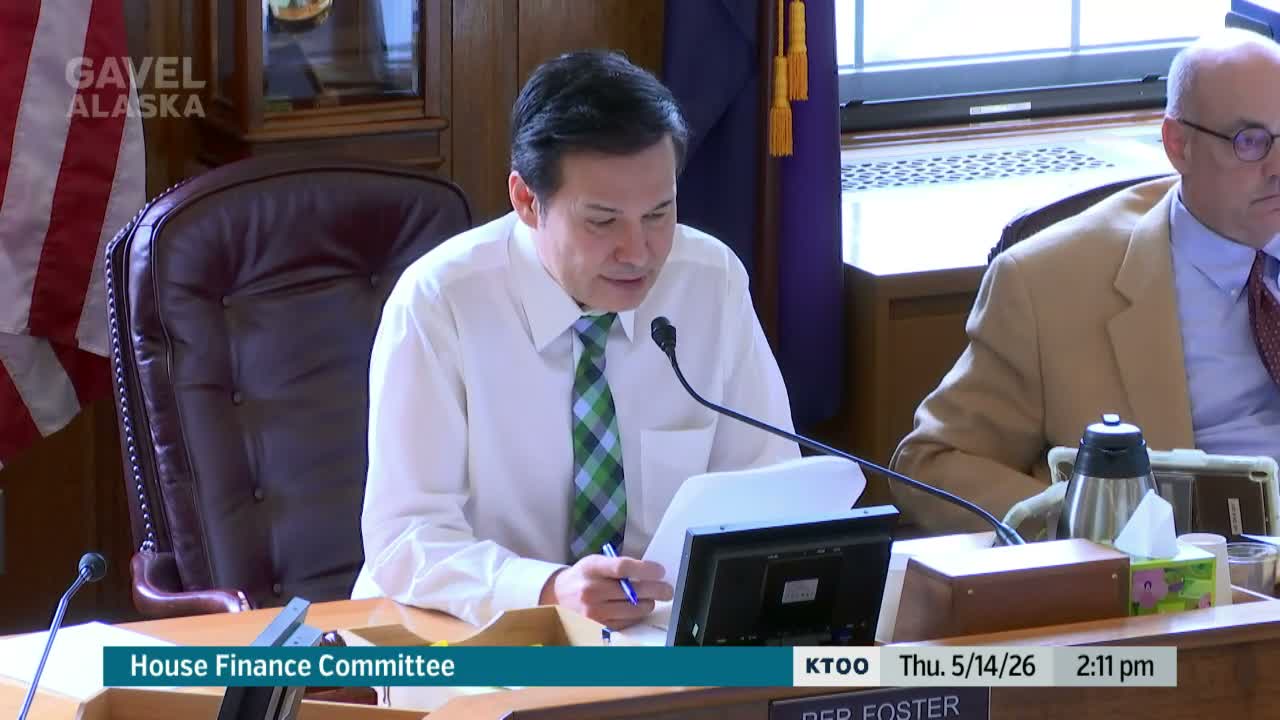
Co-Chair Foster called the House Finance Committee into session to hear the Department of Revenue’s fiscal analysis of House Bill 381, the governor-backed framework for taxation of the proposed AKLNG gas pipeline and related facilities.
Dan Sickle, chief economist for the Department of Revenue, told the committee the bill would create a statutory framework to replace certain state and municipal oil-and-gas property taxes with an alternative volumetric tax (AVT). "The tax would be 15¢ per thousand cubic feet transported through the gas pipeline," Sickle said, and adjustments would be indexed annually using a five-year average consumer price index. DOR modeled the committee substitute (version T) and noted some drafting ambiguities where the modeling follows the committee's understood intent rather than specific bill text.
Why it matters: DOR said the fiscal impact is indeterminate because it depends on whether the AKLNG project proceeds and on decisions by municipalities (notably North Slope Borough and Kenai Peninsula Borough). The department estimated that under current law, if the project proceeded without tax changes, state property-tax revenue might start near $25 million in 2029 and ramp to hundreds of millions by 2033, with municipal property-tax revenue also materially affected. Under the CS's AVT structure, DOR presented a range of modeled outcomes and said roughly 81% of AVT receipts would flow to municipalities and about 19% would be retained by the state.
Key provisions and conditions: Under the CS described to the committee, a project developer must meet eligibility conditions before receiving property-tax exemptions and the AVT: commit $40 million to a community impact fund, negotiate a project labor agreement for pipeline construction, and commit to constructing a Fairbanks spur line sized to meet projected demand. The spur line commitment includes timing triggers tied to the in-state mileage of the pipeline (a 730-mile in-state trigger) and requirements that permitting begin before or on completion of 730 miles of pipeline.
Municipal discretion and equity option: Municipalities would have the option to exempt, defer or adopt an alternative tax for the gas treatment plant and the LNG facility; the bill also permits municipalities to negotiate equity interest in lieu of property tax. DOR cautioned that those municipal choices are a major source of uncertainty in the fiscal note and stressed the department would certify eligibility conditions under a regulatory process.
Production taxes and carbon capture credits: Committee members pressed DOR on whether production-tax allocations between oil and gas would be administratively feasible; DOR said such allocations would be complex, costly and potentially subject to litigation. On carbon capture, DOR described the modeling assumption that a midstream owner (the gas-treatment plant owner) would monetize or transfer 45Q credits; DOR said reinjection logistics and credit monetization could be structured in several ways and may require negotiated agreements among project parties.
Modeling scenarios and next steps: Members requested additional scenarios (DOR agreed to provide corrected slides and to run 6¢, 12¢ and 15¢ AVT cases). DOR also asked for four additional positions and about $500,000 in capital updates to administer an AVT and estimated roughly $800,000 per year in annual costs to implement the new tax type.
The committee did not take a vote on the bill during this hearing. DOR provided that if construction of the first 730 miles had not begun by 2032 the AVT would repeal and the state would revert to current law property taxation; the AVT would also include a sunset provision in 2056.
Dan Sickle, chief economist for the Department of Revenue, told the committee the bill would create a statutory framework to replace certain state and municipal oil-and-gas property taxes with an alternative volumetric tax (AVT). "The tax would be 15¢ per thousand cubic feet transported through the gas pipeline," Sickle said, and adjustments would be indexed annually using a five-year average consumer price index. DOR modeled the committee substitute (version T) and noted some drafting ambiguities where the modeling follows the committee's understood intent rather than specific bill text.
Why it matters: DOR said the fiscal impact is indeterminate because it depends on whether the AKLNG project proceeds and on decisions by municipalities (notably North Slope Borough and Kenai Peninsula Borough). The department estimated that under current law, if the project proceeded without tax changes, state property-tax revenue might start near $25 million in 2029 and ramp to hundreds of millions by 2033, with municipal property-tax revenue also materially affected. Under the CS's AVT structure, DOR presented a range of modeled outcomes and said roughly 81% of AVT receipts would flow to municipalities and about 19% would be retained by the state.
Key provisions and conditions: Under the CS described to the committee, a project developer must meet eligibility conditions before receiving property-tax exemptions and the AVT: commit $40 million to a community impact fund, negotiate a project labor agreement for pipeline construction, and commit to constructing a Fairbanks spur line sized to meet projected demand. The spur line commitment includes timing triggers tied to the in-state mileage of the pipeline (a 730-mile in-state trigger) and requirements that permitting begin before or on completion of 730 miles of pipeline.
Municipal discretion and equity option: Municipalities would have the option to exempt, defer or adopt an alternative tax for the gas treatment plant and the LNG facility; the bill also permits municipalities to negotiate equity interest in lieu of property tax. DOR cautioned that those municipal choices are a major source of uncertainty in the fiscal note and stressed the department would certify eligibility conditions under a regulatory process.
Production taxes and carbon capture credits: Committee members pressed DOR on whether production-tax allocations between oil and gas would be administratively feasible; DOR said such allocations would be complex, costly and potentially subject to litigation. On carbon capture, DOR described the modeling assumption that a midstream owner (the gas-treatment plant owner) would monetize or transfer 45Q credits; DOR said reinjection logistics and credit monetization could be structured in several ways and may require negotiated agreements among project parties.
Modeling scenarios and next steps: Members requested additional scenarios (DOR agreed to provide corrected slides and to run 6¢, 12¢ and 15¢ AVT cases). DOR also asked for four additional positions and about $500,000 in capital updates to administer an AVT and estimated roughly $800,000 per year in annual costs to implement the new tax type.
The committee did not take a vote on the bill during this hearing. DOR provided that if construction of the first 730 miles had not begun by 2032 the AVT would repeal and the state would revert to current law property taxation; the AVT would also include a sunset provision in 2056.
Don't Miss a Word: See the Full Meeting!
Go beyond summaries. Unlock every video, transcript, and key insight with a Founder Membership.
✓
Get instant access to full meeting videos
✓
Search and clip any phrase from complete transcripts
✓
Receive AI-powered summaries & custom alerts
✓
Enjoy lifetime, unrestricted access to government data
30-day money-back guarantee
