Panel hears hours of testimony on bill requiring a "human safety operator" for autonomous vehicles; DOT and industry urge further work
May 14, 2026 | 2026 Legislature Alaska, Alaska
This article was created by AI summarizing key points discussed. AI makes mistakes, so for full details and context, please refer to the video of the full meeting. Please report any errors so we can fix them. Report an error »
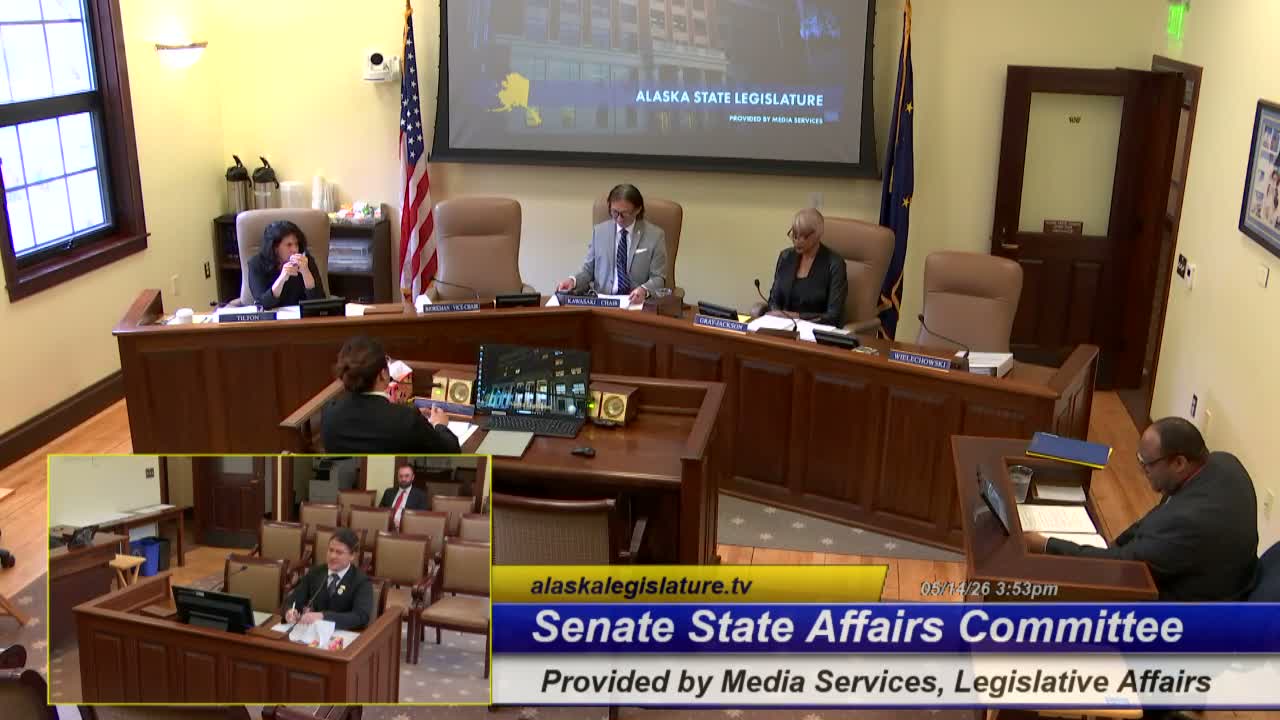
The Senate State Affairs Committee held a first hearing on HB 217, a wide-ranging bill that would set requirements for autonomous vehicles in Alaska and change portions of commercial-driver-license (CDL) testing.
Sponsor staff Griffin Succao said the bill amends AS 28.33.100 and related sections, sets legal definitions for autonomous vehicles while preserving collision-avoidance and ADAS functions, and allows CDL applicants who fail part of the test to retake only the failed portion rather than the whole test. "This aligns Alaska with federal guidelines and allows us to expedite the CDL process, alleviating the CDL shortage in Alaska," Succao said.
Department of Transportation Emerging Technologies Coordinator Benjamin Glenn urged more time to reconcile definitions and operational design domains with industry standards (for example, SAE J3016). Glenn said current language is "not sufficient" and could reduce the state's competitiveness for ITS grants and block useful DOT deployments such as autonomous follow-along safety vehicles or ADA transit shuttles.
Industry and labor witnesses split on the bill. Rose Feliciano of TechNet warned that as drafted the bill "would effectively stop autonomous vehicle development in Alaska" by foreclosing testing and investment; she urged the committee to work with DOT and industry on guardrails that permit testing. By contrast Patrick Fitzgerald of Teamsters Local 959 said the bill "requires a human safety operator to be present in the vehicle," which he argued is necessary given Alaska's challenging weather.
Legal counsel Claire Radford told the committee the bill does not define "human safety operator"; she said a court would likely construe the term to require whatever federal or state credential is applicable (for example, a CDL where required by vehicle size). Committee members pressed staff and DOT about whether the bill would affect robotaxi services like Waymo; staff said the CS language is intended to exempt certain commercial passenger carriers but DOT said ambiguity remains.
After follow-up questions and public testimony, Chair Kawasaki set HB 217 aside for possible future meeting work so the committee can review DOT input, industry concerns, and legal drafting concerns. The item was not reported from committee at this meeting.
Sponsor staff Griffin Succao said the bill amends AS 28.33.100 and related sections, sets legal definitions for autonomous vehicles while preserving collision-avoidance and ADAS functions, and allows CDL applicants who fail part of the test to retake only the failed portion rather than the whole test. "This aligns Alaska with federal guidelines and allows us to expedite the CDL process, alleviating the CDL shortage in Alaska," Succao said.
Department of Transportation Emerging Technologies Coordinator Benjamin Glenn urged more time to reconcile definitions and operational design domains with industry standards (for example, SAE J3016). Glenn said current language is "not sufficient" and could reduce the state's competitiveness for ITS grants and block useful DOT deployments such as autonomous follow-along safety vehicles or ADA transit shuttles.
Industry and labor witnesses split on the bill. Rose Feliciano of TechNet warned that as drafted the bill "would effectively stop autonomous vehicle development in Alaska" by foreclosing testing and investment; she urged the committee to work with DOT and industry on guardrails that permit testing. By contrast Patrick Fitzgerald of Teamsters Local 959 said the bill "requires a human safety operator to be present in the vehicle," which he argued is necessary given Alaska's challenging weather.
Legal counsel Claire Radford told the committee the bill does not define "human safety operator"; she said a court would likely construe the term to require whatever federal or state credential is applicable (for example, a CDL where required by vehicle size). Committee members pressed staff and DOT about whether the bill would affect robotaxi services like Waymo; staff said the CS language is intended to exempt certain commercial passenger carriers but DOT said ambiguity remains.
After follow-up questions and public testimony, Chair Kawasaki set HB 217 aside for possible future meeting work so the committee can review DOT input, industry concerns, and legal drafting concerns. The item was not reported from committee at this meeting.
View the Full Meeting & All Its Details
This article offers just a summary. Unlock complete video, transcripts, and insights as a Founder Member.
✓
Watch full, unedited meeting videos
✓
Search every word spoken in unlimited transcripts
✓
AI summaries & real-time alerts (all government levels)
✓
Permanent access to expanding government content
30-day money-back guarantee
