Senate Resources Committee Advances SB 280 Substitute After Fiscal Presentation on Gas Line
May 14, 2026 | 2026 Legislature Alaska, Alaska
This article was created by AI summarizing key points discussed. AI makes mistakes, so for full details and context, please refer to the video of the full meeting. Please report any errors so we can fix them. Report an error »
Juneau — The Alaska Senate Resources Committee on Thursday advanced a committee substitute (version L) for Senate Bill 280, the "Supporting a Gas Line for Alaskans Act," and heard a detailed fiscal presentation from the Department of Revenue.
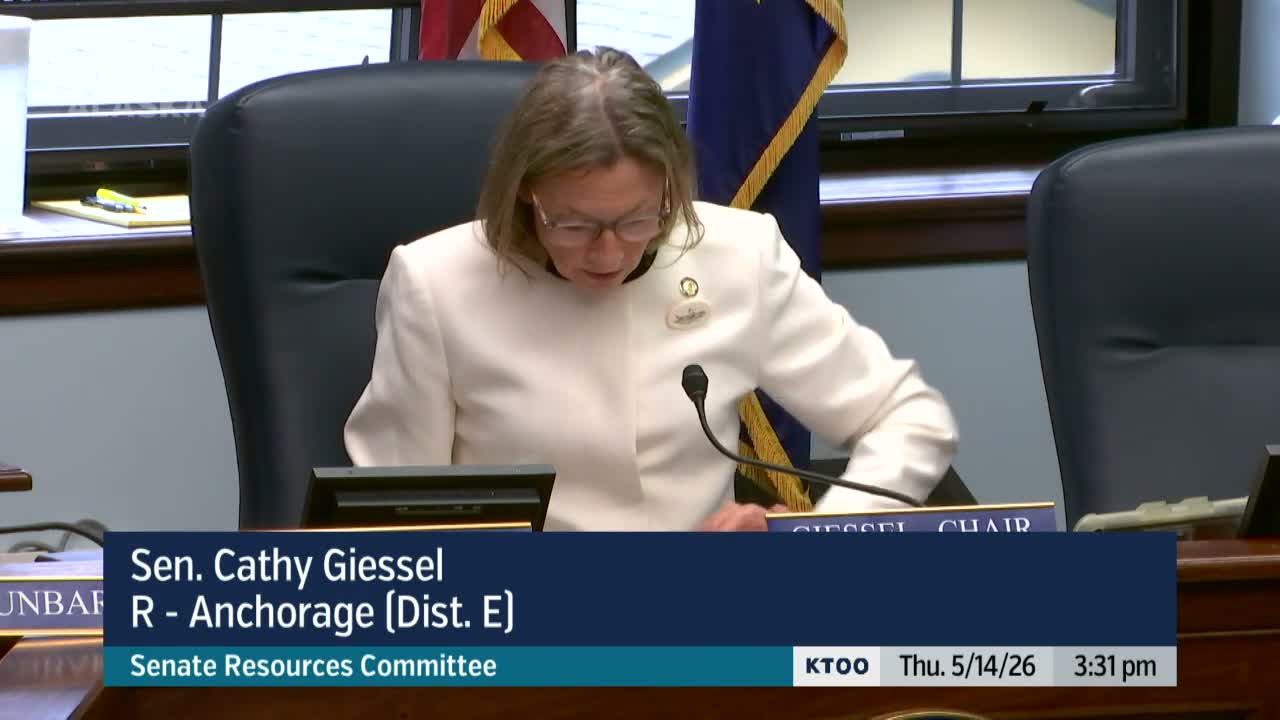
Chair Senator Giesel opened the session and set version L as the committee's working document after Senator Dunbar moved to adopt the committee substitute and Chair Giesel removed an initial objection. "The short title, supporting a gas line for Alaskans act, was added," Paige Brown, staff to Chair Giesel, told the committee as she read the summary of changes.
The bill's version L makes several substantive changes. It defines a $15,000,000,000 threshold for phase 1 pipeline cost overruns that "may not be recouped through utility costs charged to Alaskans," removes earlier provisions that would have allowed AGDC to share confidential information in executive session, and incorporates the governor's proposal from Senate Bill 227 to raise the gross minimum tax floor on North Slope oil from 4% to 6% beginning in 2027. The legislation renames the Pipeline Corridor Maintenance Fund, modifies valuation and taxation mechanics, and creates an Alaska Gas Line Community Impact Fund requiring a $50,000,000 initial deposit and $30,000,000 annual deposits for five years to unlock alternative volumetric tax (AVT) and property tax exemptions.
Dan Stickel, chief economist with the Department of Revenue, presented the fiscal modeling and stressed uncertainty. He told the committee that under the spring 2026 revenue forecast the bill produces variable outcomes across years: a modeled $71,000,000 increase for fiscal year 2027 (half‑year effect) and an average increase of $137,000,000 for fiscal years 2028–2032 absent AKLNG, rising to an average of $198,000,000 with AKLNG assumptions layered in. Stickel cautioned the fiscal note is indeterminate in places because estimates depend on project costs, producer behavior and carry‑forward lease expenditures.
On taxes and rates, Brown and Stickel described AVT rates starting at 6¢ per thousand cubic feet for the gas treatment plant and pipeline during phase 1, increasing to 10¢ and 15¢ after throughput thresholds are met, with a 15¢ AVT for LNG terminals at full phase 2 operations. The bill includes a 10‑year sunset for AVT and property tax exemptions after LNG export operations begin. Stickel said modeled breakeven in‑state cost of supply under version L is roughly $4.78 per thousand cubic feet (compared with $4.86 under current law), and delivered LNG breakeven is about $8.97 per thousand cubic feet (compared with $9.07 current law and $8.48 in the governor's introduced bill).
Committee members pressed on consumer protections and legal risk. Senator Rauscher sought clarity on the $15 billion cost‑overrun cap and whether smaller overruns could still be passed to consumers; legal counsel Sonia Kawasaki said the figure provides parameters so agencies such as AGDC and the Regulatory Commission of Alaska can judge whether overruns are being passed to Alaskans. Senator Klayman noted the committee should consider lowering the dollar figure if developer estimates are lower than $15 billion.
Senator Myers pressed on how cost‑overrun language would interact with statutory price caps on in‑state sales. Kawasaki said the caps and overrun provisions are not intended to operate in tandem in a way that would permit passing overruns to consumers, and that the caps were intended as a backstop aligned with public statements from the governor about expected consumer prices.
Senator Wilikowski criticized the complexity of Alaska's tax system during debate, saying "this just goes to show how absolutely insane our tax structure is," and raised questions about different revenue forecasts and why earlier fiscal estimates differed. Committee members also discussed the risk of future litigation when AVT sunsets and the state returns to property tax assessment rules.
Stickel described implementation costs: the Department of Revenue is requesting four positions to administer the new taxes and audits, $1,000,000 for tax revenue management programming changes, and $250,000 for contractual commercial analysis support. He said assessments and appeals tied to any future property tax transition would entail additional work beyond the fiscal note horizon.
The committee concluded with Chair Giesel noting an appendix that modeled outcomes if the AVT were not sunset and adjourning until the next session to continue consideration of SB 280. No final floor vote on the bill occurred; the committee set version L as its working document and will resume deliberations at the next scheduled meeting.
Chair Senator Giesel opened the session and set version L as the committee's working document after Senator Dunbar moved to adopt the committee substitute and Chair Giesel removed an initial objection. "The short title, supporting a gas line for Alaskans act, was added," Paige Brown, staff to Chair Giesel, told the committee as she read the summary of changes.
The bill's version L makes several substantive changes. It defines a $15,000,000,000 threshold for phase 1 pipeline cost overruns that "may not be recouped through utility costs charged to Alaskans," removes earlier provisions that would have allowed AGDC to share confidential information in executive session, and incorporates the governor's proposal from Senate Bill 227 to raise the gross minimum tax floor on North Slope oil from 4% to 6% beginning in 2027. The legislation renames the Pipeline Corridor Maintenance Fund, modifies valuation and taxation mechanics, and creates an Alaska Gas Line Community Impact Fund requiring a $50,000,000 initial deposit and $30,000,000 annual deposits for five years to unlock alternative volumetric tax (AVT) and property tax exemptions.
Dan Stickel, chief economist with the Department of Revenue, presented the fiscal modeling and stressed uncertainty. He told the committee that under the spring 2026 revenue forecast the bill produces variable outcomes across years: a modeled $71,000,000 increase for fiscal year 2027 (half‑year effect) and an average increase of $137,000,000 for fiscal years 2028–2032 absent AKLNG, rising to an average of $198,000,000 with AKLNG assumptions layered in. Stickel cautioned the fiscal note is indeterminate in places because estimates depend on project costs, producer behavior and carry‑forward lease expenditures.
On taxes and rates, Brown and Stickel described AVT rates starting at 6¢ per thousand cubic feet for the gas treatment plant and pipeline during phase 1, increasing to 10¢ and 15¢ after throughput thresholds are met, with a 15¢ AVT for LNG terminals at full phase 2 operations. The bill includes a 10‑year sunset for AVT and property tax exemptions after LNG export operations begin. Stickel said modeled breakeven in‑state cost of supply under version L is roughly $4.78 per thousand cubic feet (compared with $4.86 under current law), and delivered LNG breakeven is about $8.97 per thousand cubic feet (compared with $9.07 current law and $8.48 in the governor's introduced bill).
Committee members pressed on consumer protections and legal risk. Senator Rauscher sought clarity on the $15 billion cost‑overrun cap and whether smaller overruns could still be passed to consumers; legal counsel Sonia Kawasaki said the figure provides parameters so agencies such as AGDC and the Regulatory Commission of Alaska can judge whether overruns are being passed to Alaskans. Senator Klayman noted the committee should consider lowering the dollar figure if developer estimates are lower than $15 billion.
Senator Myers pressed on how cost‑overrun language would interact with statutory price caps on in‑state sales. Kawasaki said the caps and overrun provisions are not intended to operate in tandem in a way that would permit passing overruns to consumers, and that the caps were intended as a backstop aligned with public statements from the governor about expected consumer prices.
Senator Wilikowski criticized the complexity of Alaska's tax system during debate, saying "this just goes to show how absolutely insane our tax structure is," and raised questions about different revenue forecasts and why earlier fiscal estimates differed. Committee members also discussed the risk of future litigation when AVT sunsets and the state returns to property tax assessment rules.
Stickel described implementation costs: the Department of Revenue is requesting four positions to administer the new taxes and audits, $1,000,000 for tax revenue management programming changes, and $250,000 for contractual commercial analysis support. He said assessments and appeals tied to any future property tax transition would entail additional work beyond the fiscal note horizon.
The committee concluded with Chair Giesel noting an appendix that modeled outcomes if the AVT were not sunset and adjourning until the next session to continue consideration of SB 280. No final floor vote on the bill occurred; the committee set version L as its working document and will resume deliberations at the next scheduled meeting.
View the Full Meeting & All Its Details
This article offers just a summary. Unlock complete video, transcripts, and insights as a Founder Member.
✓
Watch full, unedited meeting videos
✓
Search every word spoken in unlimited transcripts
✓
AI summaries & real-time alerts (all government levels)
✓
Permanent access to expanding government content
30-day money-back guarantee
