Committee questions $423,500 fiscal estimate for address‑confidentiality program as DMV and DPS report zero fee impact
May 14, 2026 | 2026 Legislature Alaska, Alaska
This article was created by AI summarizing key points discussed. AI makes mistakes, so for full details and context, please refer to the video of the full meeting. Please report any errors so we can fix them. Report an error »
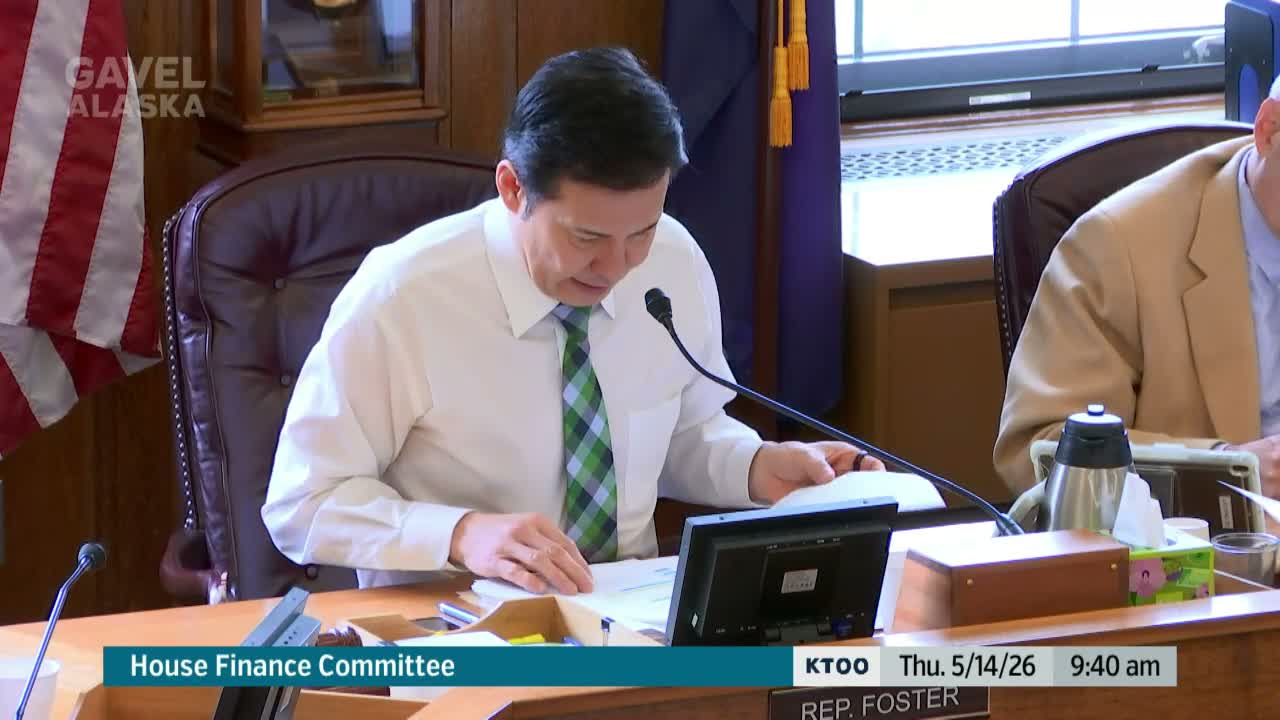
The House Finance Committee reviewed fiscal notes for House Bill 104, an address‑confidentiality bill that would allow qualifying Alaskans to use a state PO‑box address in place of a home address. Agency witnesses gave differing fiscal estimates and several representatives asked the sponsor and administration for follow‑up before the bill advances.
Kathy Wallace, director of the Division of Motor Vehicles, told the committee DMV submitted a zero‑fee fiscal note for HB104, saying the division can accept an alternate address for qualifying participants (control code MLQQX was provided). Diana Thornton, administrative services director at the Department of Public Safety, also testified the department submitted three zero fiscal notes for relevant components (Alaska State Troopers detachment, Violent Crimes Compensation Board and Council on Domestic Violence and Sexual Assault), and supplied control codes for their submissions.
By contrast, the Department of Administration’s centralized administrative services fiscal note (presented by Brody Anderson, staff to Co‑Chair Foster) estimated FY27 operating costs of $423,500, broken down as personal services $297,100; travel $3,000; services $112,800; commodities $10,600. The administration proposed two new FTEs (a business service project manager and an administrative officer), startup equipment (labeling machines and an ID card maker) and projected 400 participants in year one with an increase of 50 participants per year.
Several representatives pressed the administration on the assumptions driving the $423,500 estimate. Representative Galvin compared the estimate to a program in Washington state that reportedly ran at about $22,000 a year with 68 participants and asked the administration to explain the discrepancy. Representative Ballard noted Alaska has no existing infrastructure for this service and that start‑up and secure‑mailing costs could explain a higher estimate; Representative Tomaszewski asked whether the administration could use existing vacant positions instead of adding two FTEs.
Sponsor Representative Meares and her staff (Talia Ames) said a companion bill in the Senate has faced similar fiscal‑note scrutiny and that discussions with the department have not fully resolved the variance in estimates. Representatives also asked whether Department of Corrections systems (VINE) or other existing platforms could be leveraged in lieu of building a new program; the committee directed follow‑up with the administration to reconcile participant counts, costs and possible use of existing systems.
What’s next: Committee members indicated they will work with the sponsor and the administration to revisit the fiscal notes and participant assumptions. No final committee action on HB104 was recorded in this hearing.
Kathy Wallace, director of the Division of Motor Vehicles, told the committee DMV submitted a zero‑fee fiscal note for HB104, saying the division can accept an alternate address for qualifying participants (control code MLQQX was provided). Diana Thornton, administrative services director at the Department of Public Safety, also testified the department submitted three zero fiscal notes for relevant components (Alaska State Troopers detachment, Violent Crimes Compensation Board and Council on Domestic Violence and Sexual Assault), and supplied control codes for their submissions.
By contrast, the Department of Administration’s centralized administrative services fiscal note (presented by Brody Anderson, staff to Co‑Chair Foster) estimated FY27 operating costs of $423,500, broken down as personal services $297,100; travel $3,000; services $112,800; commodities $10,600. The administration proposed two new FTEs (a business service project manager and an administrative officer), startup equipment (labeling machines and an ID card maker) and projected 400 participants in year one with an increase of 50 participants per year.
Several representatives pressed the administration on the assumptions driving the $423,500 estimate. Representative Galvin compared the estimate to a program in Washington state that reportedly ran at about $22,000 a year with 68 participants and asked the administration to explain the discrepancy. Representative Ballard noted Alaska has no existing infrastructure for this service and that start‑up and secure‑mailing costs could explain a higher estimate; Representative Tomaszewski asked whether the administration could use existing vacant positions instead of adding two FTEs.
Sponsor Representative Meares and her staff (Talia Ames) said a companion bill in the Senate has faced similar fiscal‑note scrutiny and that discussions with the department have not fully resolved the variance in estimates. Representatives also asked whether Department of Corrections systems (VINE) or other existing platforms could be leveraged in lieu of building a new program; the committee directed follow‑up with the administration to reconcile participant counts, costs and possible use of existing systems.
What’s next: Committee members indicated they will work with the sponsor and the administration to revisit the fiscal notes and participant assumptions. No final committee action on HB104 was recorded in this hearing.
View the Full Meeting & All Its Details
This article offers just a summary. Unlock complete video, transcripts, and insights as a Founder Member.
✓
Watch full, unedited meeting videos
✓
Search every word spoken in unlimited transcripts
✓
AI summaries & real-time alerts (all government levels)
✓
Permanent access to expanding government content
30-day money-back guarantee
