Pender County utilities seek equipment, staff and debate creating in-house construction crew
May 15, 2026 | Pender County, North Carolina
This article was created by AI summarizing key points discussed. AI makes mistakes, so for full details and context, please refer to the video of the full meeting. Please report any errors so we can fix them. Report an error »
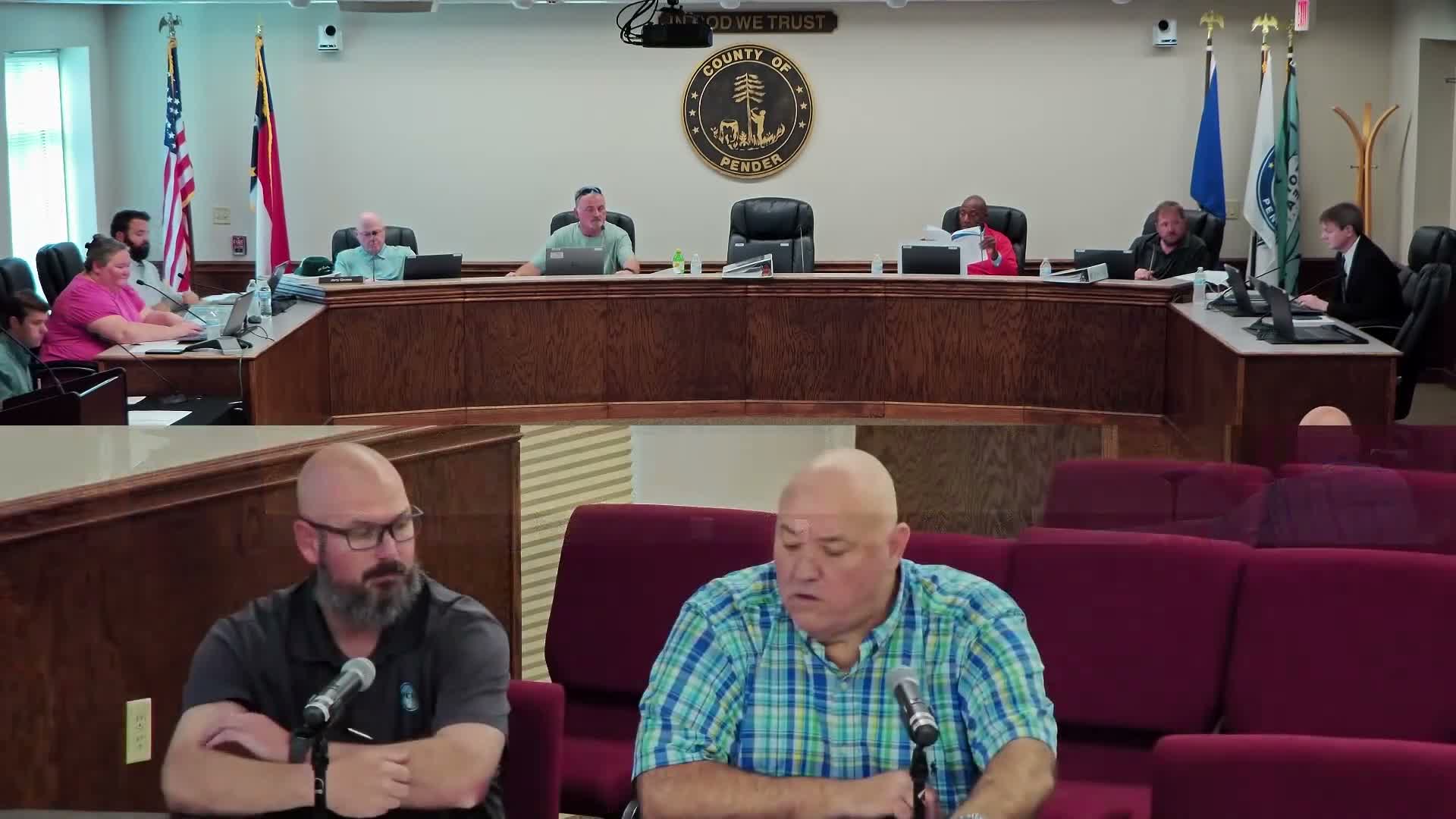
County utilities staff presented the FY 2026–27 proposed utilities enhancements and answered commissioners’ questions about equipment, staffing and the prospect of an in-house construction/install crew.
Staff outlined planned capital requests including bypass connections for lift stations, distribution and EQ pump replacements, additional GPR locators, turbidity meters required by the state, an autoclave for lab work, and vehicles including a hydro-vac (vacuum-jet combo) and a proposed amphibious vehicle to avoid a costly walkway replacement. Staff summarized the total utilities capital enhancements as roughly $3.88 million and capital vehicles near $882,000.
Staff asked for five new positions — a meter technician, a meter reader, two water‑plant operators to cover 24-hour operations, and a utilities inspector — and one reclassification. "Those 2 positions will allow the water plant now to work 24 hours a day instead of a split shift or a long 14 hour day," staff said, citing safety and response benefits.
Commissioners pressed whether the county should create an in-house construction/install crew. Staff presented an equipment-and-personnel cost estimate and said the current budget could not absorb the upfront difference. The county manager said he could not recommend forming an install crew now without a quantified long-term plan and revenue stream: "Without having the money and the projects to put pipe in the ground, we have equipment and staff with no way to realize the cost savings," he said.
Supporters noted potential cost savings on large projects (example discussed in the meeting: a utility line relocation tied to an Amazon project) but cautioned the county would need predictable work to justify ~ $1 million in startup costs and annual personnel costs in the first year. Staff also cited recent emergency contractor costs (one incident roughly $24,000) as context for equipment requirements but said transmission-line emergencies would still require contractors for very large repairs.
Next steps: staff will return budget materials, correct any transposed numbers, provide a prioritized list of enhancements for commissioners to indicate which items should remain in the proposed budget and bring back more precise cost analyses.
Staff outlined planned capital requests including bypass connections for lift stations, distribution and EQ pump replacements, additional GPR locators, turbidity meters required by the state, an autoclave for lab work, and vehicles including a hydro-vac (vacuum-jet combo) and a proposed amphibious vehicle to avoid a costly walkway replacement. Staff summarized the total utilities capital enhancements as roughly $3.88 million and capital vehicles near $882,000.
Staff asked for five new positions — a meter technician, a meter reader, two water‑plant operators to cover 24-hour operations, and a utilities inspector — and one reclassification. "Those 2 positions will allow the water plant now to work 24 hours a day instead of a split shift or a long 14 hour day," staff said, citing safety and response benefits.
Commissioners pressed whether the county should create an in-house construction/install crew. Staff presented an equipment-and-personnel cost estimate and said the current budget could not absorb the upfront difference. The county manager said he could not recommend forming an install crew now without a quantified long-term plan and revenue stream: "Without having the money and the projects to put pipe in the ground, we have equipment and staff with no way to realize the cost savings," he said.
Supporters noted potential cost savings on large projects (example discussed in the meeting: a utility line relocation tied to an Amazon project) but cautioned the county would need predictable work to justify ~ $1 million in startup costs and annual personnel costs in the first year. Staff also cited recent emergency contractor costs (one incident roughly $24,000) as context for equipment requirements but said transmission-line emergencies would still require contractors for very large repairs.
Next steps: staff will return budget materials, correct any transposed numbers, provide a prioritized list of enhancements for commissioners to indicate which items should remain in the proposed budget and bring back more precise cost analyses.
View the Full Meeting & All Its Details
This article offers just a summary. Unlock complete video, transcripts, and insights as a Founder Member.
✓
Watch full, unedited meeting videos
✓
Search every word spoken in unlimited transcripts
✓
AI summaries & real-time alerts (all government levels)
✓
Permanent access to expanding government content
30-day money-back guarantee
