St. Louis water officials and consultants propose 40% revenue increase to fund $442 million repair plan
May 14, 2026 | St. Louis City, St. Louis County, Missouri
This article was created by AI summarizing key points discussed. AI makes mistakes, so for full details and context, please refer to the video of the full meeting. Please report any errors so we can fix them. Report an error »
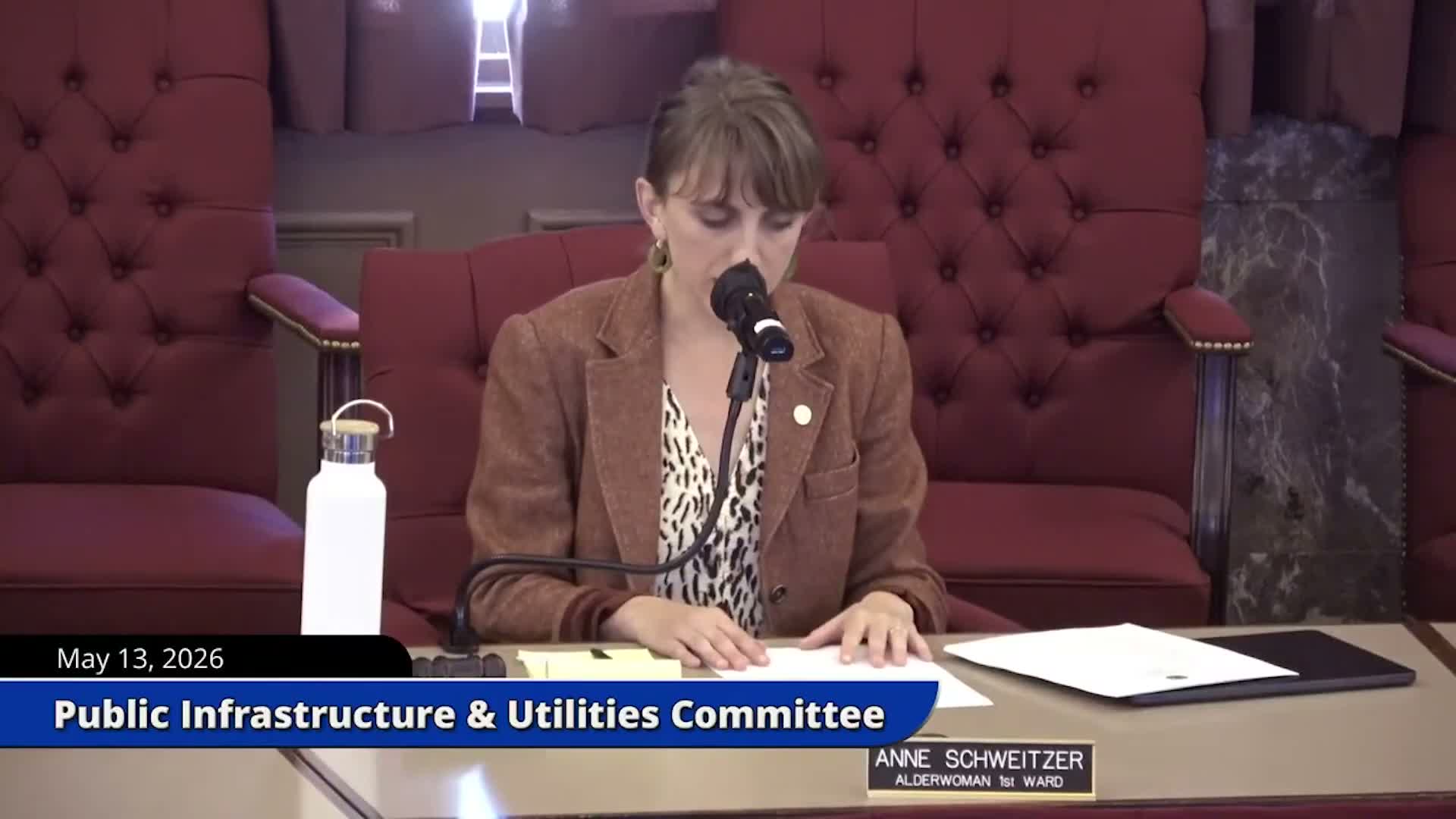
Director of Public Utilities Neeraj Patel and consultants from Black & Veatch told the St. Louis City Public Infrastructure & Utilities Committee on May 13 that the water division needs a multi‑year revenue plan — led by a proposed 40% increase in fiscal 2027 — to finance a $442 million capital improvement program (CIP), meet basic operating needs and build reserves.
The consultants said the six‑year CIP is driven by urgent treatment‑plant upgrades and transmission and distribution work that cannot be deferred. Prabha Kumar, managing director and project director for Black & Veatch, summarized the study’s objective as restoring the enterprise fund’s self‑sufficiency and modest reserves while balancing customer impacts. “What we are finding is in fiscal 27, you need a significant boost in increase, which is a 40% increase in revenue,” Kumar said during the presentation.
Why it matters: the water division reported that system losses and unmetered service create a structural revenue shortfall. Director Patel said the system produces about 47 billion gallons annually but that nonrevenue water (leaks and water used by city entities) accounts for a large share of that total; the division also has roughly 80,000 residential flat‑rate (unmetered) accounts and about 12,000 metered accounts. Patel warned of operational risk from aging assets and pointed to widely reported system failures elsewhere, saying at one point, “This is not a drill.” He described scenarios in which a single large main break could force significant service restrictions.
The numbers: Black & Veatch presented a plan that combines revenue bonds, state revolving fund (SRF) loans and some cash financing to execute the $442,000,000 CIP. The consultants estimated debt service would ramp from roughly $2.4 million in FY27 to about $23.2 million in FY32. Under the proposed 40% increase, consultants projected total water revenues would rise from an estimated $76–78 million under existing rates to about $102 million in FY27, covering operations, gross receipts tax, a modest cash financing program and a first deposit into an operating reserve. A subsequent 6% increase in 2028 and smaller increases in later years would be used to continue building a rate‑stabilization reserve to smooth future spikes in debt service.
Bill impact example: Alberto Morales, the Black & Veatch project manager for the study, presented a sample monthly bill for a typical nonmetered household. “With the increases, their first year…bill will go from $42.65 to $59.17,” Morales said, with further increases projected over the study period under the consultants’ scenario.
Affordability and assistance: committee members repeatedly pressed staff on affordability and conversion to meters. Patel said the division offers structured repayment plans and works with commercial customers, but that the division lacks funding to convert all unmetered accounts at once. The study models a scenario that assumes a $60 million allocation from Rams/GRAM funds; consultants said that level of one‑time funding reduces pressure on rates, while lower allocations would increase near‑term rate or cash‑financing pressure.
Public response: consumer advocates and residents urged caution and additional review. John Kaufman of the Consumers Council of Missouri thanked the committee for transparency and said his group has hired an independent rate expert; he asked for roughly 60 days to analyze the study assumptions, calling for alternatives and affordability proposals. Homeowner Claude Breckwold described local cast‑iron pipe failures and urged comprehensive infrastructure replacement rather than short‑term patches. Cheryl Glaze (signed up as a public commenter) alleged that the consultant’s role in local utility work has produced an inequitable rate structure that burdens unmetered residents and called for an audit and further public review; she urged removing Black & Veatch from local contracts.
What happens next: the rate proposal presented is advisory to the committee; no Board of Aldermen bill to set rates was before the committee that night. The consultants and staff said a separate cost‑of‑service study is planned next; that study is expected to inform how the division allocates costs among customer classes and whether metering or rate‑design changes are warranted. Committee members and the consultants noted additional public comment opportunities will follow as the Board of Aldermen considers any formal rate ordinance.
Provenance: the rate sufficiency study presentation and committee questioning are recorded in the committee transcript beginning with the water‑division introduction (SEG 215) through the consultants’ financial plan and public comments (segments through SEG 2884).
The consultants said the six‑year CIP is driven by urgent treatment‑plant upgrades and transmission and distribution work that cannot be deferred. Prabha Kumar, managing director and project director for Black & Veatch, summarized the study’s objective as restoring the enterprise fund’s self‑sufficiency and modest reserves while balancing customer impacts. “What we are finding is in fiscal 27, you need a significant boost in increase, which is a 40% increase in revenue,” Kumar said during the presentation.
Why it matters: the water division reported that system losses and unmetered service create a structural revenue shortfall. Director Patel said the system produces about 47 billion gallons annually but that nonrevenue water (leaks and water used by city entities) accounts for a large share of that total; the division also has roughly 80,000 residential flat‑rate (unmetered) accounts and about 12,000 metered accounts. Patel warned of operational risk from aging assets and pointed to widely reported system failures elsewhere, saying at one point, “This is not a drill.” He described scenarios in which a single large main break could force significant service restrictions.
The numbers: Black & Veatch presented a plan that combines revenue bonds, state revolving fund (SRF) loans and some cash financing to execute the $442,000,000 CIP. The consultants estimated debt service would ramp from roughly $2.4 million in FY27 to about $23.2 million in FY32. Under the proposed 40% increase, consultants projected total water revenues would rise from an estimated $76–78 million under existing rates to about $102 million in FY27, covering operations, gross receipts tax, a modest cash financing program and a first deposit into an operating reserve. A subsequent 6% increase in 2028 and smaller increases in later years would be used to continue building a rate‑stabilization reserve to smooth future spikes in debt service.
Bill impact example: Alberto Morales, the Black & Veatch project manager for the study, presented a sample monthly bill for a typical nonmetered household. “With the increases, their first year…bill will go from $42.65 to $59.17,” Morales said, with further increases projected over the study period under the consultants’ scenario.
Affordability and assistance: committee members repeatedly pressed staff on affordability and conversion to meters. Patel said the division offers structured repayment plans and works with commercial customers, but that the division lacks funding to convert all unmetered accounts at once. The study models a scenario that assumes a $60 million allocation from Rams/GRAM funds; consultants said that level of one‑time funding reduces pressure on rates, while lower allocations would increase near‑term rate or cash‑financing pressure.
Public response: consumer advocates and residents urged caution and additional review. John Kaufman of the Consumers Council of Missouri thanked the committee for transparency and said his group has hired an independent rate expert; he asked for roughly 60 days to analyze the study assumptions, calling for alternatives and affordability proposals. Homeowner Claude Breckwold described local cast‑iron pipe failures and urged comprehensive infrastructure replacement rather than short‑term patches. Cheryl Glaze (signed up as a public commenter) alleged that the consultant’s role in local utility work has produced an inequitable rate structure that burdens unmetered residents and called for an audit and further public review; she urged removing Black & Veatch from local contracts.
What happens next: the rate proposal presented is advisory to the committee; no Board of Aldermen bill to set rates was before the committee that night. The consultants and staff said a separate cost‑of‑service study is planned next; that study is expected to inform how the division allocates costs among customer classes and whether metering or rate‑design changes are warranted. Committee members and the consultants noted additional public comment opportunities will follow as the Board of Aldermen considers any formal rate ordinance.
Provenance: the rate sufficiency study presentation and committee questioning are recorded in the committee transcript beginning with the water‑division introduction (SEG 215) through the consultants’ financial plan and public comments (segments through SEG 2884).
View the Full Meeting & All Its Details
This article offers just a summary. Unlock complete video, transcripts, and insights as a Founder Member.
✓
Watch full, unedited meeting videos
✓
Search every word spoken in unlimited transcripts
✓
AI summaries & real-time alerts (all government levels)
✓
Permanent access to expanding government content
30-day money-back guarantee
