Registrar briefs board on sweeping Virginia election‑law changes and November ballot items
May 14, 2026 | Albemarle County, Virginia
This article was created by AI summarizing key points discussed. AI makes mistakes, so for full details and context, please refer to the video of the full meeting. Please report any errors so we can fix them. Report an error »
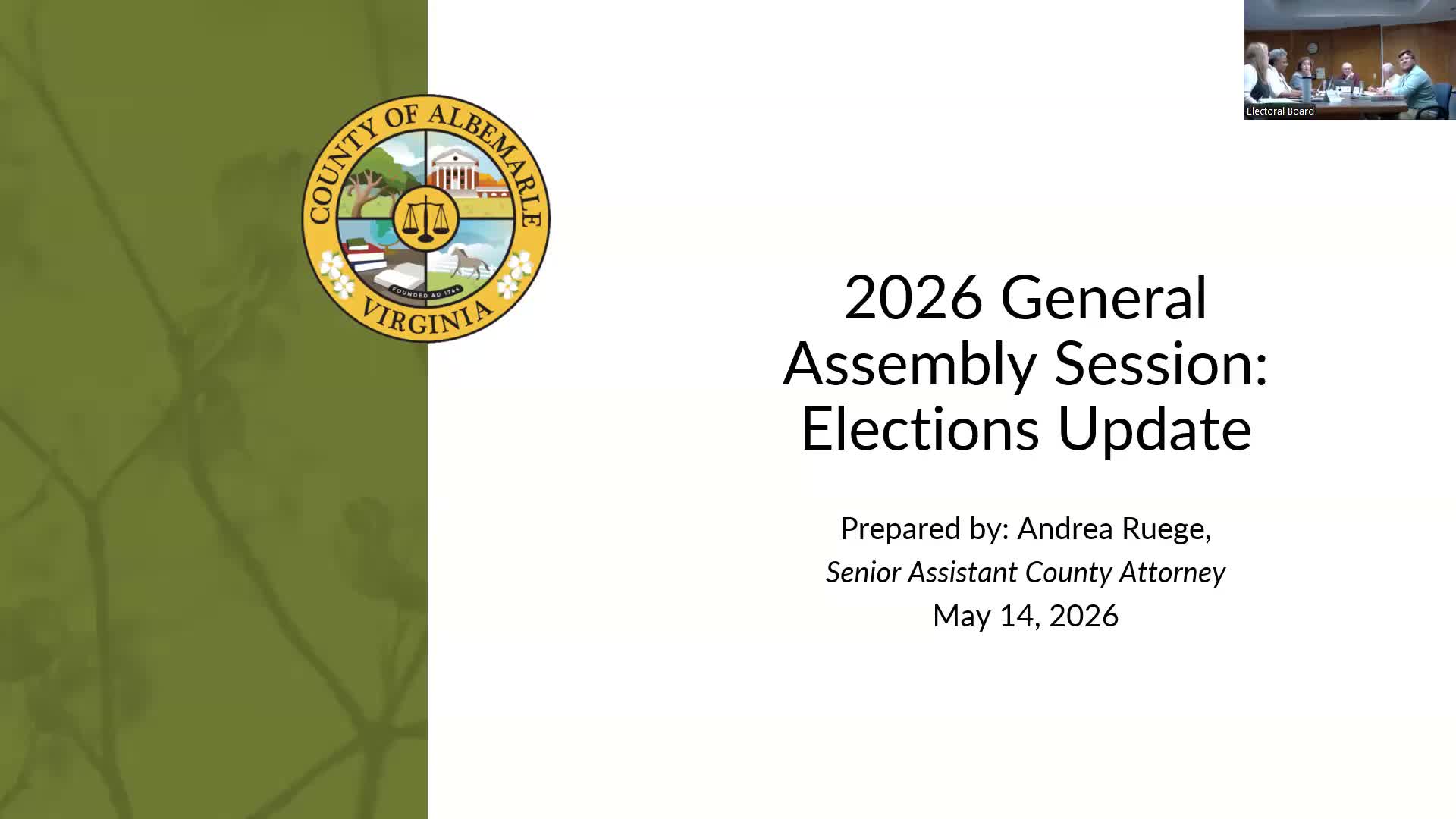
Andrea, a presenter for the elections office, told the Albemarle County Electoral Board on May 14 that the Virginia Supreme Court recently found aspects of a referendum’s map unconstitutional and, until further appellate action, the existing map will govern November races. She said the U.S. Supreme Court has been asked to review the case but may decline.
The presenter summarized numerous General Assembly changes that will affect local administration. House Bill 78 makes certification of election results a non‑discretionary, ministerial duty for local boards and creates removal exposure and a monetary penalty if a local board refuses to certify; the state board can certify in a local board’s stead. The presenter said the Department of Elections will issue implementation guidance.
Andrea said the legislature will require board members to wear ID badges on election day displaying name, locality, position and term expiration; the law includes a small fine for knowing failure to wear the badge. She also cited House Bill 909, which expands the conduct rules that apply at in‑person absentee sites to match polling‑place conduct rules and increases the firearm‑free buffer to 100 feet from building entrances (other conduct restrictions remain at 40 feet), noting potential implications for signage and courthouse coordination.
On voter registration and list maintenance, Andrea said the law tightens cancellation procedures: cancellations must be driven by Department of Elections‑approved sources, include unique identifiers, and require notice to affected voters with a 14‑day ability to contest some cancellations. She described provision for safeguards for active‑duty military voters and changes that centralize and standardize data sources and confidence scores used to confirm removals.
The presenter also reviewed absentee and provisional ballot changes that will affect local operations. Among them: extended cure windows (deadlines moving to later in the week after elections in some instances), daily updating of absentee‑ballot acceptance/rejection status with notice requirements, and a requirement to permit Sunday early voting (two Sundays immediately preceding an election, with a minimum five‑hour window between 11 a.m. and 5 p.m.). Andrea said many provisions have staggered effective dates, with a number taking effect July 1 and some effective the following year.
On ballot counting, she said machine‑readable ballots must be scanned by ballot scanners rather than hand‑counted except when scanners are inoperable and a backup is unavailable; damaged machine‑readable ballots must be duplicated by a bipartisan team and cross‑referenced to the original, but state guidance is expected on handling originals after duplication.
Why it matters: the changes shift several duties toward statewide standards and oversight and impose new operational requirements — from additional signage and badges to altered timelines for curing ballots and for list maintenance — that will affect staffing, training and outreach ahead of November’s election.
The board asked for follow‑up materials and noted the registrar and staff will issue guidance and update training and policy documents as Department of Elections guidance is released. "We may need to request additional signage," Andrea said. "I'll be on the lookout for those badges."
The presenter summarized numerous General Assembly changes that will affect local administration. House Bill 78 makes certification of election results a non‑discretionary, ministerial duty for local boards and creates removal exposure and a monetary penalty if a local board refuses to certify; the state board can certify in a local board’s stead. The presenter said the Department of Elections will issue implementation guidance.
Andrea said the legislature will require board members to wear ID badges on election day displaying name, locality, position and term expiration; the law includes a small fine for knowing failure to wear the badge. She also cited House Bill 909, which expands the conduct rules that apply at in‑person absentee sites to match polling‑place conduct rules and increases the firearm‑free buffer to 100 feet from building entrances (other conduct restrictions remain at 40 feet), noting potential implications for signage and courthouse coordination.
On voter registration and list maintenance, Andrea said the law tightens cancellation procedures: cancellations must be driven by Department of Elections‑approved sources, include unique identifiers, and require notice to affected voters with a 14‑day ability to contest some cancellations. She described provision for safeguards for active‑duty military voters and changes that centralize and standardize data sources and confidence scores used to confirm removals.
The presenter also reviewed absentee and provisional ballot changes that will affect local operations. Among them: extended cure windows (deadlines moving to later in the week after elections in some instances), daily updating of absentee‑ballot acceptance/rejection status with notice requirements, and a requirement to permit Sunday early voting (two Sundays immediately preceding an election, with a minimum five‑hour window between 11 a.m. and 5 p.m.). Andrea said many provisions have staggered effective dates, with a number taking effect July 1 and some effective the following year.
On ballot counting, she said machine‑readable ballots must be scanned by ballot scanners rather than hand‑counted except when scanners are inoperable and a backup is unavailable; damaged machine‑readable ballots must be duplicated by a bipartisan team and cross‑referenced to the original, but state guidance is expected on handling originals after duplication.
Why it matters: the changes shift several duties toward statewide standards and oversight and impose new operational requirements — from additional signage and badges to altered timelines for curing ballots and for list maintenance — that will affect staffing, training and outreach ahead of November’s election.
The board asked for follow‑up materials and noted the registrar and staff will issue guidance and update training and policy documents as Department of Elections guidance is released. "We may need to request additional signage," Andrea said. "I'll be on the lookout for those badges."
View the Full Meeting & All Its Details
This article offers just a summary. Unlock complete video, transcripts, and insights as a Founder Member.
✓
Watch full, unedited meeting videos
✓
Search every word spoken in unlimited transcripts
✓
AI summaries & real-time alerts (all government levels)
✓
Permanent access to expanding government content
30-day money-back guarantee
