Committee advances S.230 amendments to protect health‑care workers’ ability to speak
May 15, 2026 | Economic Development, Housing & General Affairs, SENATE, Committees, Legislative , Vermont
This article was created by AI summarizing key points discussed. AI makes mistakes, so for full details and context, please refer to the video of the full meeting. Please report any errors so we can fix them. Report an error »
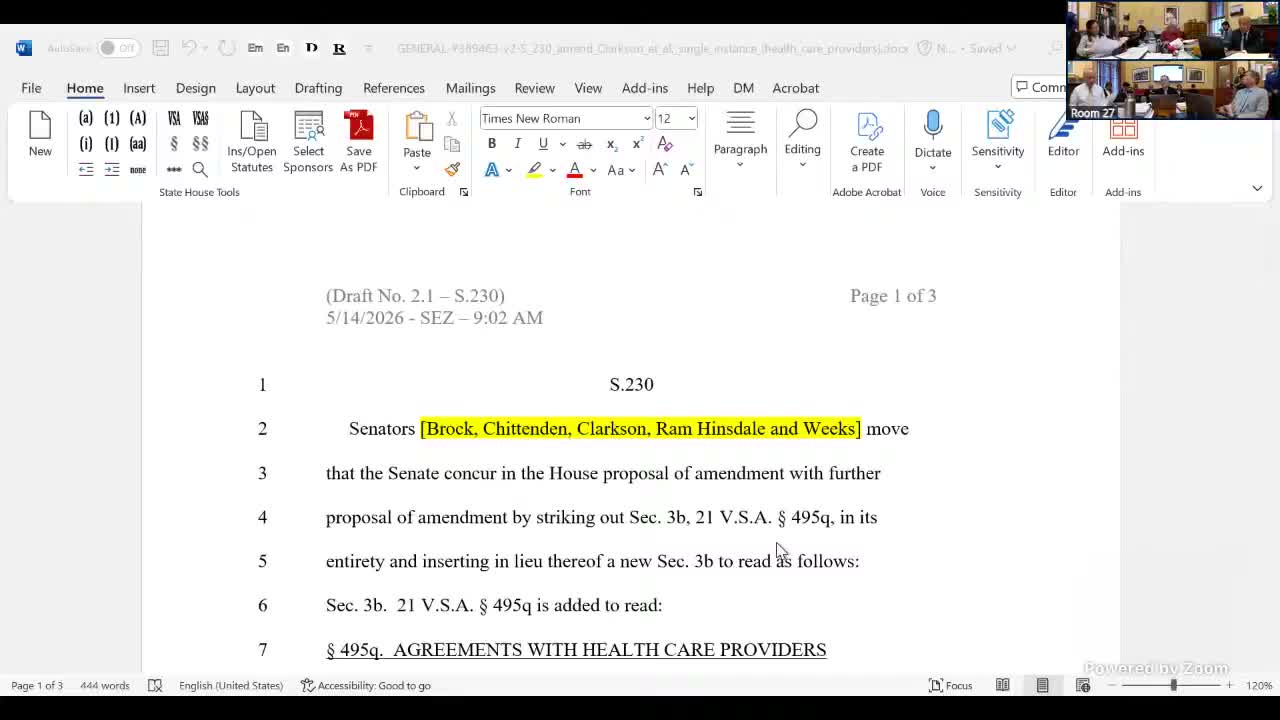
The Senate Committee on Economic Development, Housing & General Affairs advanced amendments to S.230 that would add a statutory definition of "health care provider" and bar enforceable nondisparagement provisions in contracts with licensed health‑care workers.
Legislative counsel Sophie Sedatnik presented draft 2.1 and read the proposed definition aloud: "Health care provider means person licensed, certified, or authorized by law to provide a professional health care service in the state to an individual during that individual's medical care, treatment, or confinement," a formulation the committee acknowledged as a standard definition used broadly.
Committee members then debated a provision that would render nondisparagement terms void and unenforceable where those terms would prevent a health‑care provider from making disparaging statements about another party to the contract. Some members asked whether the provision would apply only at contract entry or also to post‑termination settlement clauses; legislative counsel clarified the drafting is intended to make the nondisparagement clause itself unenforceable while leaving the remainder of a contract intact.
Stakeholders urged the committee to preserve protections that allow clinicians to raise concerns. "The intent is that during the course of your employment, you could raise concerns about quality of care or other issues," said Jessa Barner of the Vermont Medical Society, who described the language as originating from concerns about private‑equity takeovers in other states. Steven Green of the Vermont Association of Hospitals and Health Systems said the amendment is "more of a forward looking protective measure," noting hospitals commonly use nondisparagement in settlement contexts but do not generally impose noncompetes on clinicians today.
Members also discussed the definition's scope (who counts as a "party to the contract" or a third‑party beneficiary) and whether the drafting might create unintended differences among future noncompete rules for other occupations. After discussion, the committee signaled broad agreement to include the legislative counsel's definition of "health care provider" in the first instance of the amendment.
A committee member moved to report S.230 favorably with the proposed amendments (both instances to be at draft 2.1); members recorded agreement and reported the measure out of the committee by a 5‑0 tally.
The committee's action does not itself change statute; it forwards the amended bill with the committee's recommendations and scheduling language to the next stage of consideration.
Legislative counsel Sophie Sedatnik presented draft 2.1 and read the proposed definition aloud: "Health care provider means person licensed, certified, or authorized by law to provide a professional health care service in the state to an individual during that individual's medical care, treatment, or confinement," a formulation the committee acknowledged as a standard definition used broadly.
Committee members then debated a provision that would render nondisparagement terms void and unenforceable where those terms would prevent a health‑care provider from making disparaging statements about another party to the contract. Some members asked whether the provision would apply only at contract entry or also to post‑termination settlement clauses; legislative counsel clarified the drafting is intended to make the nondisparagement clause itself unenforceable while leaving the remainder of a contract intact.
Stakeholders urged the committee to preserve protections that allow clinicians to raise concerns. "The intent is that during the course of your employment, you could raise concerns about quality of care or other issues," said Jessa Barner of the Vermont Medical Society, who described the language as originating from concerns about private‑equity takeovers in other states. Steven Green of the Vermont Association of Hospitals and Health Systems said the amendment is "more of a forward looking protective measure," noting hospitals commonly use nondisparagement in settlement contexts but do not generally impose noncompetes on clinicians today.
Members also discussed the definition's scope (who counts as a "party to the contract" or a third‑party beneficiary) and whether the drafting might create unintended differences among future noncompete rules for other occupations. After discussion, the committee signaled broad agreement to include the legislative counsel's definition of "health care provider" in the first instance of the amendment.
A committee member moved to report S.230 favorably with the proposed amendments (both instances to be at draft 2.1); members recorded agreement and reported the measure out of the committee by a 5‑0 tally.
The committee's action does not itself change statute; it forwards the amended bill with the committee's recommendations and scheduling language to the next stage of consideration.
View the Full Meeting & All Its Details
This article offers just a summary. Unlock complete video, transcripts, and insights as a Founder Member.
✓
Watch full, unedited meeting videos
✓
Search every word spoken in unlimited transcripts
✓
AI summaries & real-time alerts (all government levels)
✓
Permanent access to expanding government content
30-day money-back guarantee
