Maricopa Unified board approves modest FY26 budget revision after public hearing
May 14, 2026 | Maricopa Unified School District (4441), School Districts, Arizona
This article was created by AI summarizing key points discussed. AI makes mistakes, so for full details and context, please refer to the video of the full meeting. Please report any errors so we can fix them. Report an error »
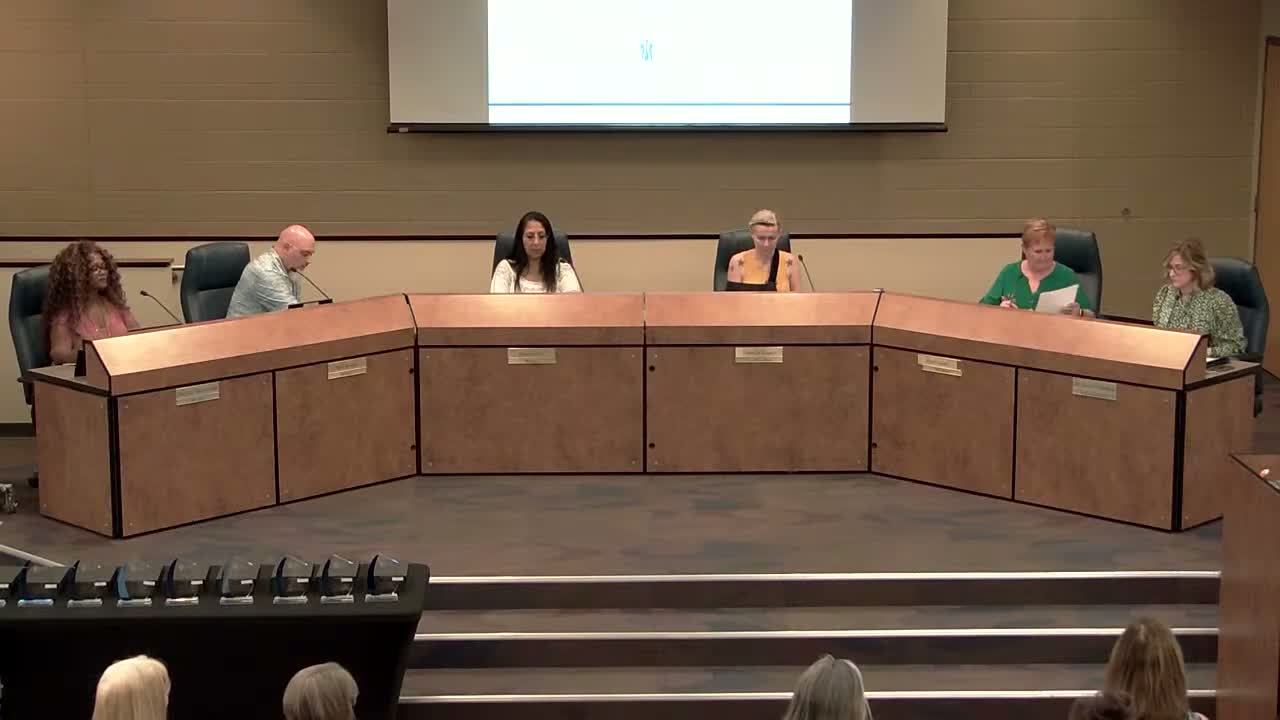
The Maricopa Unified School District Governing Board unanimously approved a revised fiscal year 2026 budget during its May 13 meeting following a short public hearing and a staff presentation.
District finance officer Mr. Harmon presented the final revision, saying the district's actual average daily membership (ADM) is 9,222, down 121 from December projections, and total weighted student count is 14,058, about 80 lower than earlier estimates. "This brings a net decrease of about $148,000 across our three main funds," Harmon said, citing changes in the maintenance and operations (M&O), capital and Classroom Site Fund limits.
The nut graf: the revision reduces the general M&O budget-limit to about $87.8 million, adds roughly $5,500 to unrestricted capital outlay (driven by one-time DAA funding) and keeps the Classroom Site Fund unchanged because it is based on prior-year ADM. Harmon emphasized the district is not overspending and that the revision aligns spending limits with actual enrollment and one-time funding changes.
Board members tested key assumptions in follow-up questions on enrollment accounting and online-student funding. When asked whether online students count fully for ADM, Harmon explained part-time online students are funded at 85% and full-time online students at 95% for state funding calculations. He also told the board the weighted ADM increase—largely from special-education categories—partially offsets declines in regular ADM.
The board moved to approve the revision by motion; roll call votes recorded unanimous "Aye" answers from Board members Shontay Rothschild, Ben Owens, Lisa Garcia, Caroline Lopez and President Patty Cutre.
Board documents and the public presentation list the combined budget limit for the three main funds as $113,229,675 after the revision. The board did not adopt additional spending cuts at the meeting; Mr. Harmon said the district will monitor enrollment and revenue forecasts and return with any needed adjustments.
The approval follows the public hearing held at the start of the meeting; no members of the public spoke during that hearing portion. The board then proceeded with its regular agenda and scheduled routine financial oversight and reporting for the coming months.
The board adjourned into business items and later voted to enter executive session to conduct the superintendent's quarterly evaluation.
District finance officer Mr. Harmon presented the final revision, saying the district's actual average daily membership (ADM) is 9,222, down 121 from December projections, and total weighted student count is 14,058, about 80 lower than earlier estimates. "This brings a net decrease of about $148,000 across our three main funds," Harmon said, citing changes in the maintenance and operations (M&O), capital and Classroom Site Fund limits.
The nut graf: the revision reduces the general M&O budget-limit to about $87.8 million, adds roughly $5,500 to unrestricted capital outlay (driven by one-time DAA funding) and keeps the Classroom Site Fund unchanged because it is based on prior-year ADM. Harmon emphasized the district is not overspending and that the revision aligns spending limits with actual enrollment and one-time funding changes.
Board members tested key assumptions in follow-up questions on enrollment accounting and online-student funding. When asked whether online students count fully for ADM, Harmon explained part-time online students are funded at 85% and full-time online students at 95% for state funding calculations. He also told the board the weighted ADM increase—largely from special-education categories—partially offsets declines in regular ADM.
The board moved to approve the revision by motion; roll call votes recorded unanimous "Aye" answers from Board members Shontay Rothschild, Ben Owens, Lisa Garcia, Caroline Lopez and President Patty Cutre.
Board documents and the public presentation list the combined budget limit for the three main funds as $113,229,675 after the revision. The board did not adopt additional spending cuts at the meeting; Mr. Harmon said the district will monitor enrollment and revenue forecasts and return with any needed adjustments.
The approval follows the public hearing held at the start of the meeting; no members of the public spoke during that hearing portion. The board then proceeded with its regular agenda and scheduled routine financial oversight and reporting for the coming months.
The board adjourned into business items and later voted to enter executive session to conduct the superintendent's quarterly evaluation.
View the Full Meeting & All Its Details
This article offers just a summary. Unlock complete video, transcripts, and insights as a Founder Member.
✓
Watch full, unedited meeting videos
✓
Search every word spoken in unlimited transcripts
✓
AI summaries & real-time alerts (all government levels)
✓
Permanent access to expanding government content
30-day money-back guarantee
