Richmond Rent Board approves FY 2026–27 budget, sets residential rental fees at $261/$149
May 14, 2026 | Richmond, Contra Costa County, California
This article was created by AI summarizing key points discussed. AI makes mistakes, so for full details and context, please refer to the video of the full meeting. Please report any errors so we can fix them. Report an error »
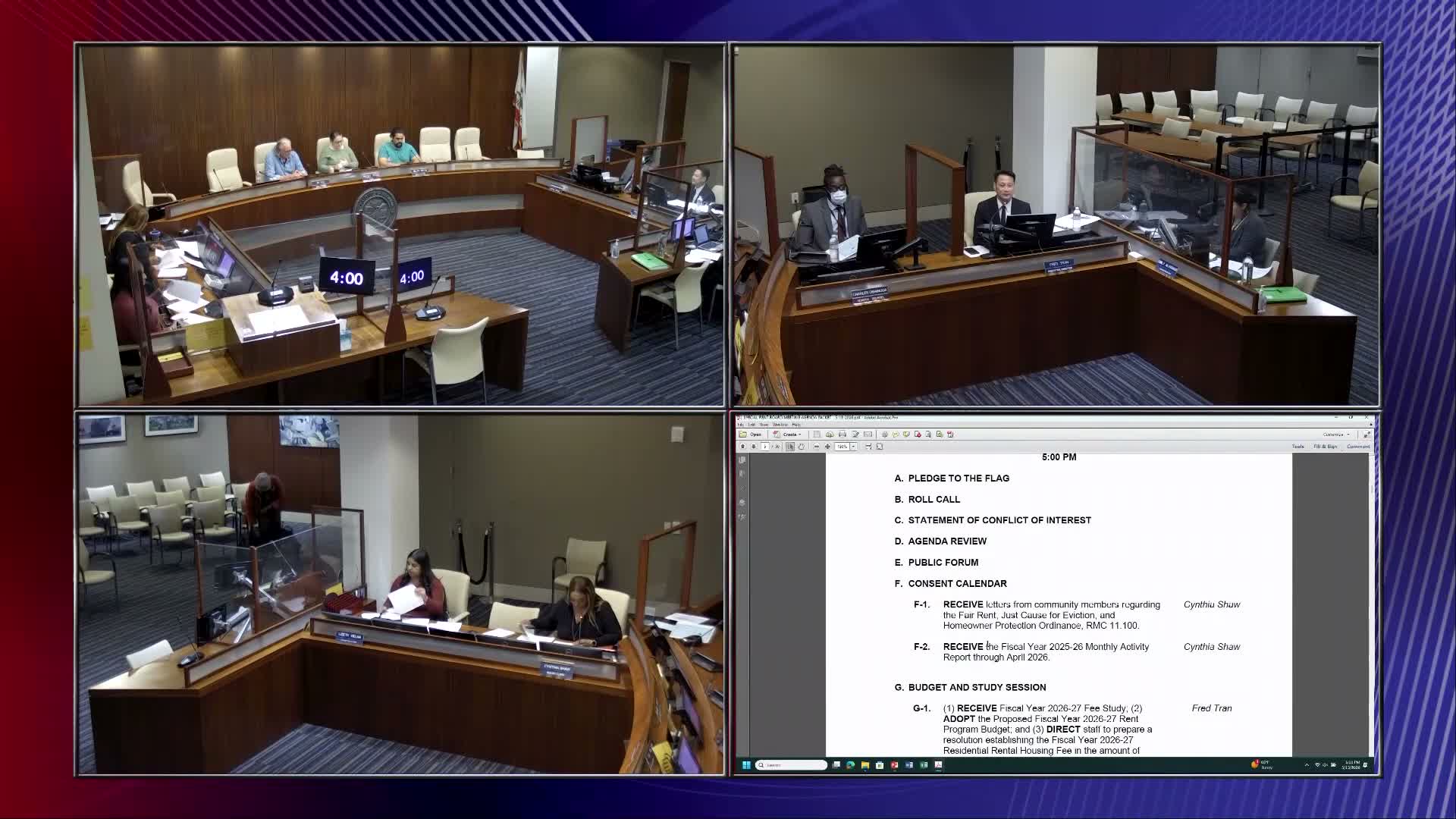
The Richmond Rent Board on May 13 approved the proposed fiscal year 2026–27 rent program budget and directed staff to bring a resolution to the Richmond City Council to adopt updated residential rental housing fees.
Executive Director Fred Tran told the board that, if adopted by the board, staff would present a resolution to the city council in June to update the city’s master fee schedule. “If the proposed budget is approved tonight, staff intends to bring a resolution to city council in June for approval of the updated residential rental housing fee in the city's master fee schedule,” Tran said during his presentation.
Tran said the budget would authorize approximately $3,600,000 in revenue and about $3,500,000 in expenditures. The staff-recommended fee amounts are $261 for fully covered rental units and $149 for partially covered units; Tran noted those figures represent modest decreases from the prior year (about a $6 decrease for fully covered units and roughly $2 for partially covered units).
Board members asked how Richmond’s collection rate compares with other programs. Staff described San Jose and Berkeley as examples with collection rates near 90–95% under stronger enforcement and billing practices, and said COVID-era patterns produced outlier years in which collection figures were anomalously high. Tran and other staff also estimated the program currently collects just over $3,000,000 annually (about 83% of the budgeted amount as of 04/30/2026).
The board discussed steps to improve collections before relying on stronger enforcement: cleaning program data, pursuing a lien ordinance that would show unpaid program charges on property tax bills, improving targeted outreach to tenants and landlords, and using tenant reports to identify unbilled units. Staff said the board has previously directed work on a lien ordinance and on real‑estate disclosure forms and that those tools are part of a broader compliance strategy.
A board member moved to direct staff to prepare a resolution to establish the FY 2026–27 rent program budget and to bring the proposed fee schedule to the city council for adoption; a friendly amendment to also receive the fee study and adopt the budget was accepted. The motion passed with affirmative votes recorded; Board members Espinosa and Vice Chair Cantor were absent. The board directed staff to pursue the scheduled next steps with city staff and to return with the resolution for the city council calendars in June (the staff target date was June 16, with June 23 as a fallback if the council defers the item).
The board also reviewed budget details that staff said were included in option 3: status‑quo non‑personnel spending, $30,000 set aside to consider a possible one‑tier fee design via a fee study, and $50,000 recommended for a hearing‑examiner contract to assist with petitions. Staff noted the board‑approved position control lists 15 full‑time staff with roughly one‑third of positions vacant and said staff would request hiring three positions: an office assistant, an administrative trainee and a rent program service analyst.
The board’s adoption of the budget directs staff to prepare the council resolution; after council action staff would begin billing and invoice processes.
Executive Director Fred Tran told the board that, if adopted by the board, staff would present a resolution to the city council in June to update the city’s master fee schedule. “If the proposed budget is approved tonight, staff intends to bring a resolution to city council in June for approval of the updated residential rental housing fee in the city's master fee schedule,” Tran said during his presentation.
Tran said the budget would authorize approximately $3,600,000 in revenue and about $3,500,000 in expenditures. The staff-recommended fee amounts are $261 for fully covered rental units and $149 for partially covered units; Tran noted those figures represent modest decreases from the prior year (about a $6 decrease for fully covered units and roughly $2 for partially covered units).
Board members asked how Richmond’s collection rate compares with other programs. Staff described San Jose and Berkeley as examples with collection rates near 90–95% under stronger enforcement and billing practices, and said COVID-era patterns produced outlier years in which collection figures were anomalously high. Tran and other staff also estimated the program currently collects just over $3,000,000 annually (about 83% of the budgeted amount as of 04/30/2026).
The board discussed steps to improve collections before relying on stronger enforcement: cleaning program data, pursuing a lien ordinance that would show unpaid program charges on property tax bills, improving targeted outreach to tenants and landlords, and using tenant reports to identify unbilled units. Staff said the board has previously directed work on a lien ordinance and on real‑estate disclosure forms and that those tools are part of a broader compliance strategy.
A board member moved to direct staff to prepare a resolution to establish the FY 2026–27 rent program budget and to bring the proposed fee schedule to the city council for adoption; a friendly amendment to also receive the fee study and adopt the budget was accepted. The motion passed with affirmative votes recorded; Board members Espinosa and Vice Chair Cantor were absent. The board directed staff to pursue the scheduled next steps with city staff and to return with the resolution for the city council calendars in June (the staff target date was June 16, with June 23 as a fallback if the council defers the item).
The board also reviewed budget details that staff said were included in option 3: status‑quo non‑personnel spending, $30,000 set aside to consider a possible one‑tier fee design via a fee study, and $50,000 recommended for a hearing‑examiner contract to assist with petitions. Staff noted the board‑approved position control lists 15 full‑time staff with roughly one‑third of positions vacant and said staff would request hiring three positions: an office assistant, an administrative trainee and a rent program service analyst.
The board’s adoption of the budget directs staff to prepare the council resolution; after council action staff would begin billing and invoice processes.
View the Full Meeting & All Its Details
This article offers just a summary. Unlock complete video, transcripts, and insights as a Founder Member.
✓
Watch full, unedited meeting videos
✓
Search every word spoken in unlimited transcripts
✓
AI summaries & real-time alerts (all government levels)
✓
Permanent access to expanding government content
30-day money-back guarantee
