RTA briefed on system growth, Wake Transit funding and safety plans at Go Raleigh Station
May 14, 2026 | Raleigh, Wake County, North Carolina
This article was created by AI summarizing key points discussed. AI makes mistakes, so for full details and context, please refer to the video of the full meeting. Please report any errors so we can fix them. Report an error »
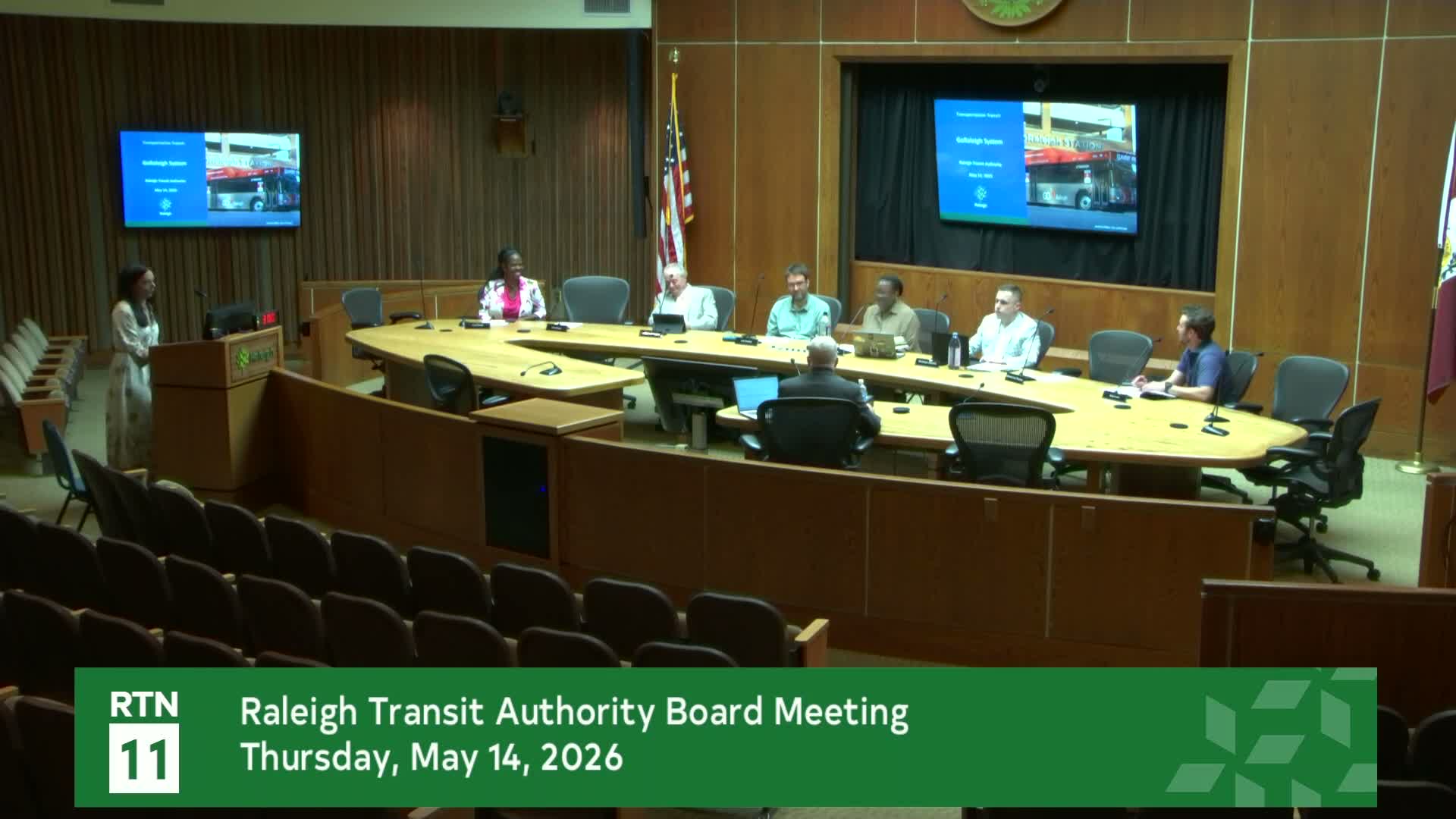
City transit staff presented a system-wide briefing to the Raleigh Transit Authority outlining service statistics, funding sources, and safety and security measures at Go Raleigh Station and across the system.
The presenter told the board Go Raleigh operates 34 routes with about 120 active buses, just over 1,400 bus stops and roughly 7.5 million fixed-route trips last year. The presenter said the annual operating budget for the system is about $94.7 million and noted that Wake Transit Plan funding contributes a large share of recent service frequency improvements; staff said Wake Transit contributed about 49% of the system budget in the most recent year and is projected to increase its share in out years under the plan’s financial model.
On safety and security, staff said they are coordinating with the Raleigh Police Department’s hospitality and transit unit and with contracted security (Capital Special Police) to increase visibility and patrols at Go Raleigh Station. Staff highlighted recent workforce and operational changes: an updated code of conduct, de-escalation and mental-health training for operators, an employee assistance program, and two additional road supervisors and two dispatchers added to the operations budget to improve incident response.
The board discussed whether Raleigh should retain a hub-and-spoke model centered on Go Raleigh Station (where staff said 32% of riders make transfers and the majority of transfers occur) or pursue a more decentralized gridded network. Staff said a feasibility study could examine decentralized alternatives, but that gridded networks require more transfer nodes and capital infrastructure and bring different safety and operational tradeoffs.
When asked whether specific bus stops had been flagged for safety redesign, staff said no individual stops were singled out in the presentation and agreed to work with Raleigh Police Department to obtain crime data for targeted reviews. On fuel costs, staff said about 83% of the fleet is CNG or electric, and 70 CNG buses use locally sourced renewable natural gas (RNG) under a one-year flat-rate contract, providing relative price stability compared with diesel markets.
Board members asked for follow-up details on low-performing routes, stop-level safety data and a report on route performance that staff said would be provided in June. The presentation closed with staff noting continued implementation of the Wake Transit Plan and ongoing steps to make the system safer and more reliable for riders.
The presenter told the board Go Raleigh operates 34 routes with about 120 active buses, just over 1,400 bus stops and roughly 7.5 million fixed-route trips last year. The presenter said the annual operating budget for the system is about $94.7 million and noted that Wake Transit Plan funding contributes a large share of recent service frequency improvements; staff said Wake Transit contributed about 49% of the system budget in the most recent year and is projected to increase its share in out years under the plan’s financial model.
On safety and security, staff said they are coordinating with the Raleigh Police Department’s hospitality and transit unit and with contracted security (Capital Special Police) to increase visibility and patrols at Go Raleigh Station. Staff highlighted recent workforce and operational changes: an updated code of conduct, de-escalation and mental-health training for operators, an employee assistance program, and two additional road supervisors and two dispatchers added to the operations budget to improve incident response.
The board discussed whether Raleigh should retain a hub-and-spoke model centered on Go Raleigh Station (where staff said 32% of riders make transfers and the majority of transfers occur) or pursue a more decentralized gridded network. Staff said a feasibility study could examine decentralized alternatives, but that gridded networks require more transfer nodes and capital infrastructure and bring different safety and operational tradeoffs.
When asked whether specific bus stops had been flagged for safety redesign, staff said no individual stops were singled out in the presentation and agreed to work with Raleigh Police Department to obtain crime data for targeted reviews. On fuel costs, staff said about 83% of the fleet is CNG or electric, and 70 CNG buses use locally sourced renewable natural gas (RNG) under a one-year flat-rate contract, providing relative price stability compared with diesel markets.
Board members asked for follow-up details on low-performing routes, stop-level safety data and a report on route performance that staff said would be provided in June. The presentation closed with staff noting continued implementation of the Wake Transit Plan and ongoing steps to make the system safer and more reliable for riders.
View the Full Meeting & All Its Details
This article offers just a summary. Unlock complete video, transcripts, and insights as a Founder Member.
✓
Watch full, unedited meeting videos
✓
Search every word spoken in unlimited transcripts
✓
AI summaries & real-time alerts (all government levels)
✓
Permanent access to expanding government content
30-day money-back guarantee
