Liberty Lake council reviews governance manual draft, flags public‑comment limits and enforcement risks
May 14, 2026 | Liberty Lake, Spokane County, Washington
This article was created by AI summarizing key points discussed. AI makes mistakes, so for full details and context, please refer to the video of the full meeting. Please report any errors so we can fix them. Report an error »
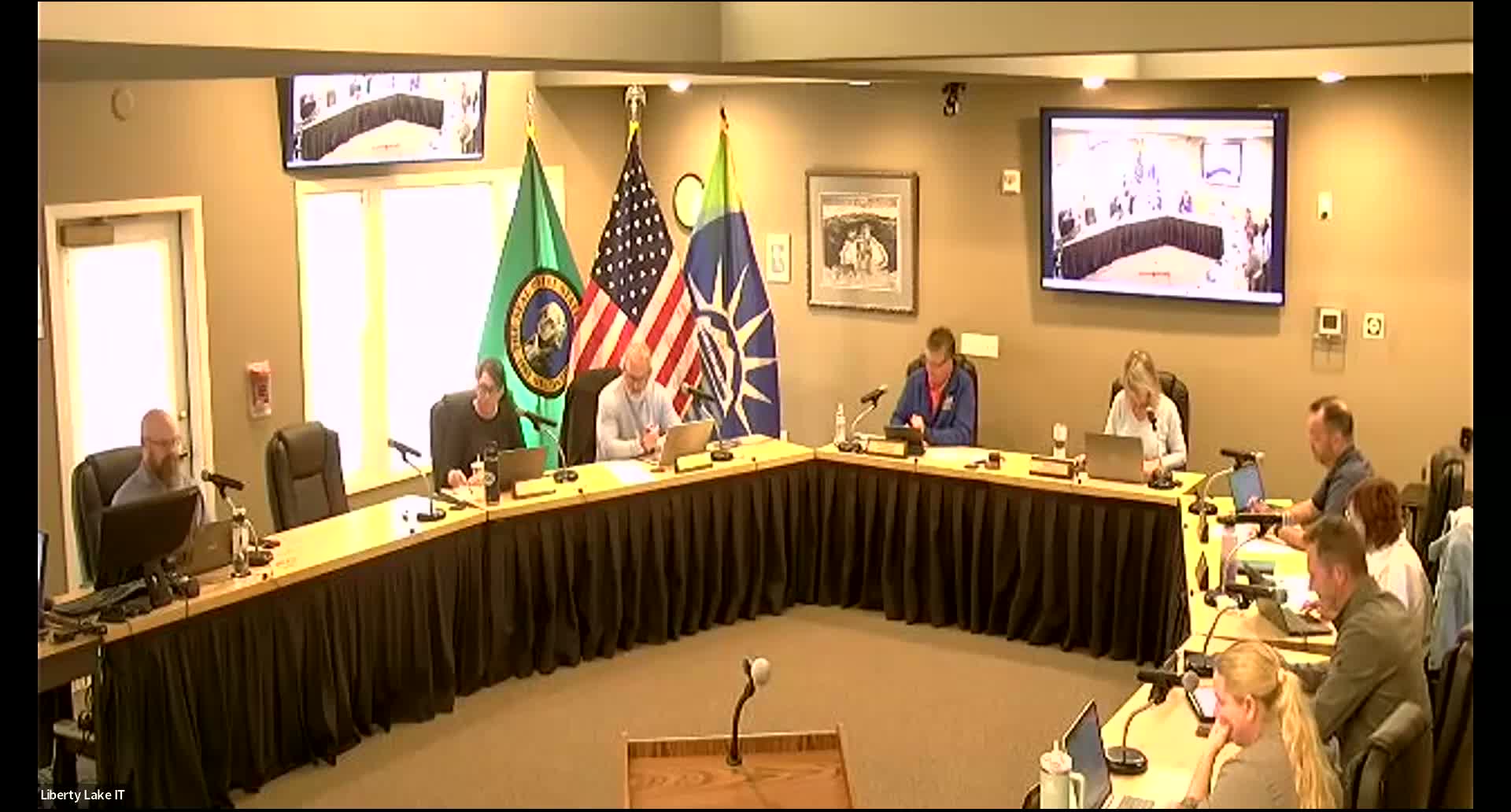
Liberty Lake Mayor Mateu convened a special City Council meeting on May 12 to continue review of a proposed governance manual, centering debate on language that lawyers warned could raise constitutional and procedural problems.
City legal reviewer Rick told the council the manual contains “several potential concerns” after cross‑checking the draft against state law and cited RCW 42.17A.555 and the Open Public Meetings Act as points of tension. “RCW 42.17A.555 prohibits the city itself from using public facilities, resources to support, or oppose campaigns,” he said, and warned the manual’s current phrasing “goes much further and restricts what citizens themselves may say during public comment,” exposing the city to “viewpoint discrimination” and First Amendment risk.
Sean (the city attorney) said the statute’s intent is to prevent use of public resources for campaigns, not to shut down individual citizens’ speech. He recommended staff revise the language to make that distinction clear and pledged to review the draft in full. “The intent here was campaign‑related matters,” he said, adding the council can still speak collectively on ballot measures while individual council members should avoid using city resources for campaign advantage.
Council members pressed for concrete edits and clearer terminology. Several members worried the manual’s use of the phrase “public comment” could be read to bar ordinary citizen remarks and asked staff to reword the section so it regulates staff and elected‑official use of city resources without limiting citizens’ time‑and‑manner rights. The council asked that the revised draft explicitly tie limits to campaign‑related conduct and add cross‑references to other sections that mention ballot measures.
The manual also contains a provision allowing a majority vote to exclude a council member from an executive session for conflicts or appearance‑of‑fairness concerns. Rick and others cautioned the council that Washington law does not clearly authorize excluding an elected official absent statutory authority, a court order, or clear legal disqualification. Sean walked through hypothetical cases — for example, where a council member has a direct financial interest in a contract — and recommended voluntary recusal where possible and a narrowly defined process if exclusion is contemplated: notice, a motion, an opportunity for the affected member to be heard during the motion, and a vote.
A later passage proposing a 90‑day speaking suspension for disruptive participants drew particular scrutiny. Council members and legal staff agreed long‑term speaking bans typically require due process, neutrality and an appeal mechanism; Sean suggested removing a fixed 90‑day ban and instead authorizing removal from the current meeting with the possibility of a separately justified suspension or trespass enforcement if warranted.
Other topics flagged for revision included wording that may imply the city administrator could filter council access to staff, OPMA‑related language that should not exceed state law, and detailed mechanics for appointing advisory‑board members (residency/district rules, application timelines and online vs. paper application accommodations).
On appointments, the council asked staff to clarify whether the 14‑day mayor appointment timeline refers to 14 days after the application closes and to add a minimum two‑week advertising window. For advisory boards the council discussed removing or revising geographic‑district requirements — notably for the community engagement commission — but agreed such changes might be best handled in individual commission ordinances rather than the governance manual.
On enforcement and adherence, council members urged a graduated approach that prioritizes informal correction, education and peer accountability before resorting to formal sanctions or hearing‑examiner processes. “Enforcement is the hardest topic,” one member said, and the council directed staff to draft practical, stepwise language rather than a single punitive path.
Meeting management items also drew attention. The draft’s recommended order of business was debated (proclamations, special guests, citizen comments, informational reports, consent, general business); the council tentatively agreed to place special presentations right after citizen comments and asked staff to clarify definitions so the public knows what constitutes a presentation versus an informational report.
The council approved two routine motions at the start of the special meeting — to excuse Council member Fisher (motion recorded and approved by voice) and to adopt the evening’s agenda (approved 6‑0). The council concluded by asking staff and legal counsel to return a redlined draft that cross‑references the cited RCWs and the ordinances that govern commissions and appointments. The meeting adjourned at 8:51 p.m.
The city attorney and staff were asked to return proposed edits and statutory cross‑checks before the council’s next scheduled review.
City legal reviewer Rick told the council the manual contains “several potential concerns” after cross‑checking the draft against state law and cited RCW 42.17A.555 and the Open Public Meetings Act as points of tension. “RCW 42.17A.555 prohibits the city itself from using public facilities, resources to support, or oppose campaigns,” he said, and warned the manual’s current phrasing “goes much further and restricts what citizens themselves may say during public comment,” exposing the city to “viewpoint discrimination” and First Amendment risk.
Sean (the city attorney) said the statute’s intent is to prevent use of public resources for campaigns, not to shut down individual citizens’ speech. He recommended staff revise the language to make that distinction clear and pledged to review the draft in full. “The intent here was campaign‑related matters,” he said, adding the council can still speak collectively on ballot measures while individual council members should avoid using city resources for campaign advantage.
Council members pressed for concrete edits and clearer terminology. Several members worried the manual’s use of the phrase “public comment” could be read to bar ordinary citizen remarks and asked staff to reword the section so it regulates staff and elected‑official use of city resources without limiting citizens’ time‑and‑manner rights. The council asked that the revised draft explicitly tie limits to campaign‑related conduct and add cross‑references to other sections that mention ballot measures.
The manual also contains a provision allowing a majority vote to exclude a council member from an executive session for conflicts or appearance‑of‑fairness concerns. Rick and others cautioned the council that Washington law does not clearly authorize excluding an elected official absent statutory authority, a court order, or clear legal disqualification. Sean walked through hypothetical cases — for example, where a council member has a direct financial interest in a contract — and recommended voluntary recusal where possible and a narrowly defined process if exclusion is contemplated: notice, a motion, an opportunity for the affected member to be heard during the motion, and a vote.
A later passage proposing a 90‑day speaking suspension for disruptive participants drew particular scrutiny. Council members and legal staff agreed long‑term speaking bans typically require due process, neutrality and an appeal mechanism; Sean suggested removing a fixed 90‑day ban and instead authorizing removal from the current meeting with the possibility of a separately justified suspension or trespass enforcement if warranted.
Other topics flagged for revision included wording that may imply the city administrator could filter council access to staff, OPMA‑related language that should not exceed state law, and detailed mechanics for appointing advisory‑board members (residency/district rules, application timelines and online vs. paper application accommodations).
On appointments, the council asked staff to clarify whether the 14‑day mayor appointment timeline refers to 14 days after the application closes and to add a minimum two‑week advertising window. For advisory boards the council discussed removing or revising geographic‑district requirements — notably for the community engagement commission — but agreed such changes might be best handled in individual commission ordinances rather than the governance manual.
On enforcement and adherence, council members urged a graduated approach that prioritizes informal correction, education and peer accountability before resorting to formal sanctions or hearing‑examiner processes. “Enforcement is the hardest topic,” one member said, and the council directed staff to draft practical, stepwise language rather than a single punitive path.
Meeting management items also drew attention. The draft’s recommended order of business was debated (proclamations, special guests, citizen comments, informational reports, consent, general business); the council tentatively agreed to place special presentations right after citizen comments and asked staff to clarify definitions so the public knows what constitutes a presentation versus an informational report.
The council approved two routine motions at the start of the special meeting — to excuse Council member Fisher (motion recorded and approved by voice) and to adopt the evening’s agenda (approved 6‑0). The council concluded by asking staff and legal counsel to return a redlined draft that cross‑references the cited RCWs and the ordinances that govern commissions and appointments. The meeting adjourned at 8:51 p.m.
The city attorney and staff were asked to return proposed edits and statutory cross‑checks before the council’s next scheduled review.
View the Full Meeting & All Its Details
This article offers just a summary. Unlock complete video, transcripts, and insights as a Founder Member.
✓
Watch full, unedited meeting videos
✓
Search every word spoken in unlimited transcripts
✓
AI summaries & real-time alerts (all government levels)
✓
Permanent access to expanding government content
30-day money-back guarantee
