Petaluma board backs HVAC electrification amendment; trustees warned of multi‑million‑dollar bond impacts
May 14, 2026 | Petaluma City Elementary, School Districts, California
This article was created by AI summarizing key points discussed. AI makes mistakes, so for full details and context, please refer to the video of the full meeting. Please report any errors so we can fix them. Report an error »
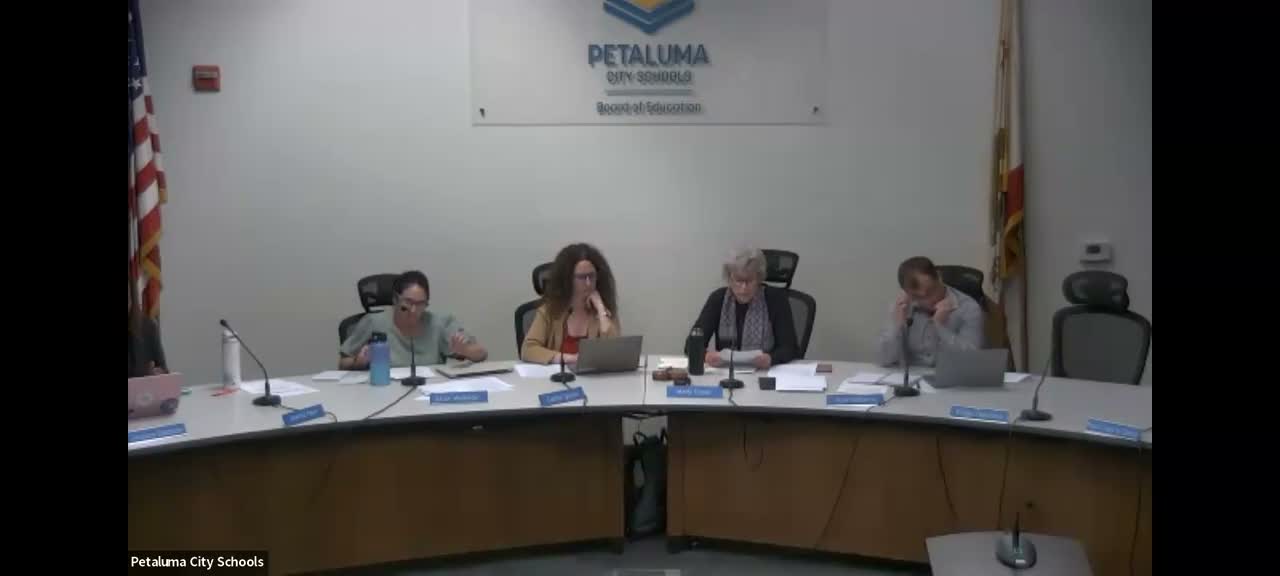
Petaluma — The Petaluma City Schools Board on May 12 authorized staff to pursue an amendment to the district’s energy services agreement to electrify aging HVAC systems across sites, a move district staff said would reduce greenhouse gases but increase bond capital and operating costs in the near term.
The vote: After an extended presentation from Climate Tech and staff, trustees voted to authorize the amendment authorizing full electrification; the motion passed with four in favor and one abstention. Board discussion focused on up‑front capital increases, site electrical capacity constraints and how additional solar and utility upgrades would be funded under the district bond program.
What staff presented: Climate Tech and director Ashley Lowe explained that converting gas HVAC to all‑electric heat‑pump systems at the district’s pilot sites would require upsizing solar and possibly electrical service upgrades at several constrained schools. Staff said a previously allocated $25,000,000 bond pot covers the broader program but that full electrification increases capital outlay by an estimated $2,000,000 (presented as an example of amendment costs) plus potential utility upgrades of roughly $1,000,000 at some sites and another $3,000,000 tied to planned future projects — a possible additional $4–5 million in infrastructure work the district would need to address or to offset by reducing scope elsewhere.
Environmental and budget tradeoffs: Staff framed the amendment as improving long‑term emissions reductions. In the original scope staff estimated roughly 41,400,000 pounds of CO2 reductions from the earlier modernization plan; in the amended full‑electrification scenario, staff presented an estimate of about 59,000,000 pounds of CO2 reductions over equipment life, after adding more solar capacity. Staff cautioned that the district’s current solar net‑energy‑metering (NEM) status will change after five years, which affects long‑term savings projections.
Trustees’ concerns and staff recommendations: Several trustees raised concerns about budget timing, the risk of rising electricity rates, and capacity constraints at four sites (McNear, Valley Vista, McDowell and McKinley) that staff said are at or near electrical capacity and would need transformer or service upgrades to fully electrify now. Staff recommended a hybrid approach for those constrained sites (replace like‑for‑like now and electrify later when larger projects make upgrades more economical) while advancing electrification at other sites.
What happens next: The resolution authorizes staff to amend the bond scope and continue design work. Any additional utility upgrade costs would require rebalancing bond priorities or identifying additional funding; the board instructed staff to return with options and clarified that future scope changes would come back to the board for approval.
The vote: After an extended presentation from Climate Tech and staff, trustees voted to authorize the amendment authorizing full electrification; the motion passed with four in favor and one abstention. Board discussion focused on up‑front capital increases, site electrical capacity constraints and how additional solar and utility upgrades would be funded under the district bond program.
What staff presented: Climate Tech and director Ashley Lowe explained that converting gas HVAC to all‑electric heat‑pump systems at the district’s pilot sites would require upsizing solar and possibly electrical service upgrades at several constrained schools. Staff said a previously allocated $25,000,000 bond pot covers the broader program but that full electrification increases capital outlay by an estimated $2,000,000 (presented as an example of amendment costs) plus potential utility upgrades of roughly $1,000,000 at some sites and another $3,000,000 tied to planned future projects — a possible additional $4–5 million in infrastructure work the district would need to address or to offset by reducing scope elsewhere.
Environmental and budget tradeoffs: Staff framed the amendment as improving long‑term emissions reductions. In the original scope staff estimated roughly 41,400,000 pounds of CO2 reductions from the earlier modernization plan; in the amended full‑electrification scenario, staff presented an estimate of about 59,000,000 pounds of CO2 reductions over equipment life, after adding more solar capacity. Staff cautioned that the district’s current solar net‑energy‑metering (NEM) status will change after five years, which affects long‑term savings projections.
Trustees’ concerns and staff recommendations: Several trustees raised concerns about budget timing, the risk of rising electricity rates, and capacity constraints at four sites (McNear, Valley Vista, McDowell and McKinley) that staff said are at or near electrical capacity and would need transformer or service upgrades to fully electrify now. Staff recommended a hybrid approach for those constrained sites (replace like‑for‑like now and electrify later when larger projects make upgrades more economical) while advancing electrification at other sites.
What happens next: The resolution authorizes staff to amend the bond scope and continue design work. Any additional utility upgrade costs would require rebalancing bond priorities or identifying additional funding; the board instructed staff to return with options and clarified that future scope changes would come back to the board for approval.
View the Full Meeting & All Its Details
This article offers just a summary. Unlock complete video, transcripts, and insights as a Founder Member.
✓
Watch full, unedited meeting videos
✓
Search every word spoken in unlimited transcripts
✓
AI summaries & real-time alerts (all government levels)
✓
Permanent access to expanding government content
30-day money-back guarantee
