Montana committee hears national warnings about data‑center energy demands and grid risks
May 14, 2026 | 2026 Legislature MT, Montana
This article was created by AI summarizing key points discussed. AI makes mistakes, so for full details and context, please refer to the video of the full meeting. Please report any errors so we can fix them. Report an error »
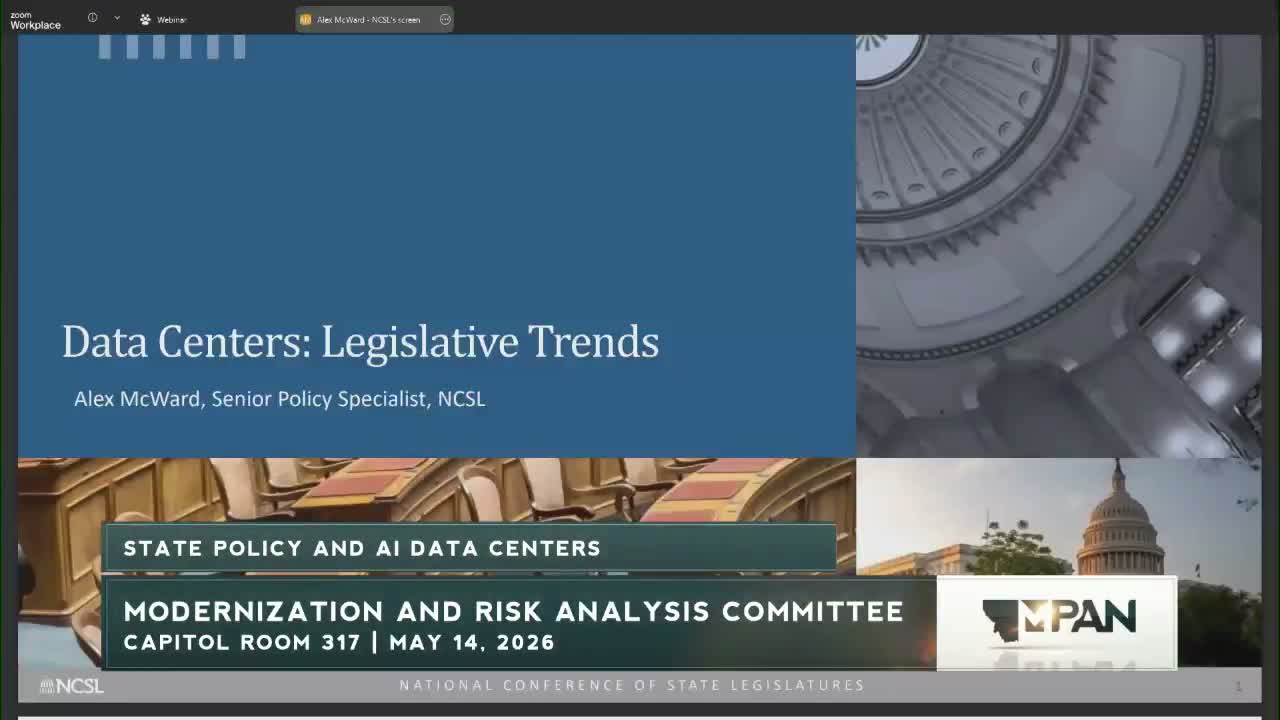
Chair Jones convened the Modernization and Risk Analysis Committee and invited national experts to brief lawmakers on the implications of large data‑center projects for Montana’s grid and ratepayers.
Alex McWard of the National Conference of State Legislatures told the committee that states are tracking a surge of bills addressing data‑center energy use — from reporting and tax incentives to new customer classes and tariffs for very large electric loads. “Data centers currently account for a little more than 4% of energy consumption in the U.S.,” McWard said, and “forecast suggests that this could more than double by the end of the decade.” He reviewed examples of state responses, such as Maryland’s requirement that utilities file specific rate schedules for large‑load customers and Utah’s rule requiring large loads to pay interconnection study and upgrade costs.
Pete Cappers, a staff scientist at Lawrence Berkeley National Laboratory, framed the issue for utility planners and regulators. He said recent studies predict dramatic growth in data‑center electricity use and cautioned that new interconnection infrastructure can take three to 11 years to build. “Traditional cost allocation methods will ultimately result in residential customers getting assigned some fraction of these additional costs,” Cappers said, noting transmission projects can cost “nearly $1,000,000 a mile” and generator capacity “$1–3 million per megawatt.” He described tariff reforms regulators and utilities are using: minimum bills, minimum load factors, upfront cost responsibility, exit fees, collateral and longer contract terms tied to the infrastructure payback period.
Kyle Thomas of Elevate Energy Consulting described operational and technical threats that have already surfaced in other regions: large interconnected facilities can trip off unexpectedly in a disturbance, creating system instability. He pointed to July 2024 events in Northern Virginia where roughly 1,500 MW of data‑center load tripped after a transmission fault and to ride‑through failures in other markets. Thomas urged states to require stronger interconnection processes: higher queue entry standards (site control, financial assurances), mandatory model and data sharing under nondisclosure protections, technical ride‑through and power‑quality requirements, and ongoing post‑commissioning monitoring.
Committee members asked whether state policy should move first (tariffs, interconnection rules) or wait for federal guidance; speakers urged both. Cappers noted NERC and FERC activity and said states still play the primary role in load interconnection policy and tariff implementation. Thomas suggested states prepare clear interconnection rules so utilities cannot be undercut by more permissive neighboring jurisdictions.
The committee did not take action but directed staff to keep exploring tariff design, interconnection practices, and potential state rule options so lawmakers can weigh legislation in the upcoming session.
Alex McWard of the National Conference of State Legislatures told the committee that states are tracking a surge of bills addressing data‑center energy use — from reporting and tax incentives to new customer classes and tariffs for very large electric loads. “Data centers currently account for a little more than 4% of energy consumption in the U.S.,” McWard said, and “forecast suggests that this could more than double by the end of the decade.” He reviewed examples of state responses, such as Maryland’s requirement that utilities file specific rate schedules for large‑load customers and Utah’s rule requiring large loads to pay interconnection study and upgrade costs.
Pete Cappers, a staff scientist at Lawrence Berkeley National Laboratory, framed the issue for utility planners and regulators. He said recent studies predict dramatic growth in data‑center electricity use and cautioned that new interconnection infrastructure can take three to 11 years to build. “Traditional cost allocation methods will ultimately result in residential customers getting assigned some fraction of these additional costs,” Cappers said, noting transmission projects can cost “nearly $1,000,000 a mile” and generator capacity “$1–3 million per megawatt.” He described tariff reforms regulators and utilities are using: minimum bills, minimum load factors, upfront cost responsibility, exit fees, collateral and longer contract terms tied to the infrastructure payback period.
Kyle Thomas of Elevate Energy Consulting described operational and technical threats that have already surfaced in other regions: large interconnected facilities can trip off unexpectedly in a disturbance, creating system instability. He pointed to July 2024 events in Northern Virginia where roughly 1,500 MW of data‑center load tripped after a transmission fault and to ride‑through failures in other markets. Thomas urged states to require stronger interconnection processes: higher queue entry standards (site control, financial assurances), mandatory model and data sharing under nondisclosure protections, technical ride‑through and power‑quality requirements, and ongoing post‑commissioning monitoring.
Committee members asked whether state policy should move first (tariffs, interconnection rules) or wait for federal guidance; speakers urged both. Cappers noted NERC and FERC activity and said states still play the primary role in load interconnection policy and tariff implementation. Thomas suggested states prepare clear interconnection rules so utilities cannot be undercut by more permissive neighboring jurisdictions.
The committee did not take action but directed staff to keep exploring tariff design, interconnection practices, and potential state rule options so lawmakers can weigh legislation in the upcoming session.
View the Full Meeting & All Its Details
This article offers just a summary. Unlock complete video, transcripts, and insights as a Founder Member.
✓
Watch full, unedited meeting videos
✓
Search every word spoken in unlimited transcripts
✓
AI summaries & real-time alerts (all government levels)
✓
Permanent access to expanding government content
30-day money-back guarantee
