MPS contract compliance officials outline paid student internships, COIN certification and contractor obligations
May 14, 2026 | Milwaukee , Milwaukee County, Wisconsin
This article was created by AI summarizing key points discussed. AI makes mistakes, so for full details and context, please refer to the video of the full meeting. Please report any errors so we can fix them. Report an error »
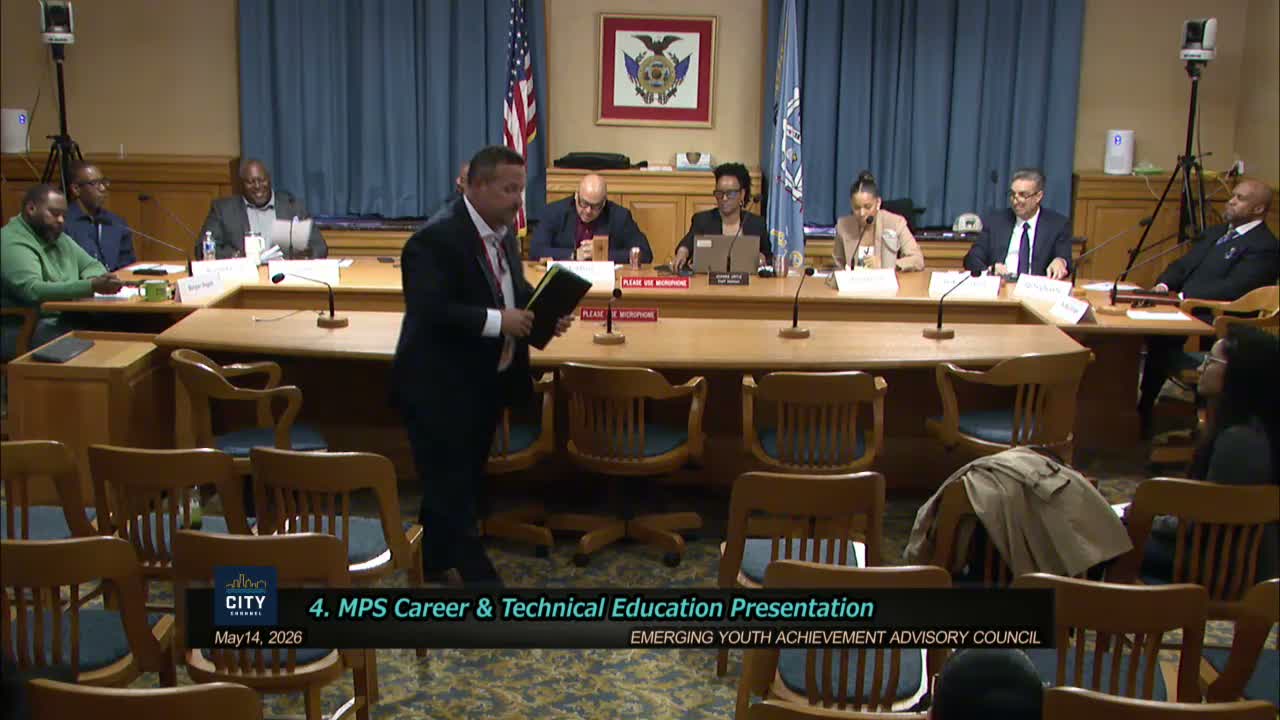
Jaquina Cohen, manager of Contract Compliance Services at Milwaukee Public Schools, told the Emerging Youth Achievement Advisory Council on May 14 that the district’s contract compliance office integrates student engagement and workforce requirements into procurements of $50,000 or more to create paid internship opportunities and support career education.
Cohen said the student‑employment program has three placement tracks: students placed inside vendor organizations, placements through community‑based organizations, and an internship sponsorship option in which a contractor hires and pays the student directly. "Our program serves about 300 students a year," Cohen said; last fiscal year the office placed 212 students and at the time of the meeting had 55 active participants with 90 students signed up for summer work.
Claudia Garcia described COIN (Communities in Need), the district’s workforce‑preference certification for city residents on general construction projects, saying the program — adopted into district policy in 2003 — aims for 25% of annual workforce hours to be completed by COIN‑certified individuals. Garcia said last year the district recorded 24,962 total workforce hours on monitored construction projects, of which 9,225 were COIN‑certified, representing 36% against the 25% goal.
Garcia explained eligibility and monitoring: participants must be city residents, 18 or older, have a valid Wisconsin driver’s license (or be on track to receive one), meet income rules and, in some cases, hold a high‑school diploma or GED. COIN certification is valid for three years with possible extensions; vendors must report COIN hours monthly to the district’s database and are subject to workforce audits.
Council members asked about program scale and funding. Cohen said the office is small and monitors the subset of contracts above the $50,000 threshold; staffing and the reduction in contract volume since fiscal peaks limit capacity. The presenters noted some CTE supports come from the Carl Perkins federal grant and district budgets but that Perkins funds typically cover equipment and supplies rather than teacher salaries.
The presenters also described enforcement tools: according to the presentation transcript the district applies financial sanctions for noncompliance reported during the meeting as $100 per hour for missing student‑employment requirements, $250 per hour for career‑education shortfalls and $30 per hour for COIN shortfalls. Garcia said the office prefers to work collaboratively with contractors to meet requirements and provides training, recruiting assistance and contact information for certifying agencies.
Cohen said the student‑employment program has three placement tracks: students placed inside vendor organizations, placements through community‑based organizations, and an internship sponsorship option in which a contractor hires and pays the student directly. "Our program serves about 300 students a year," Cohen said; last fiscal year the office placed 212 students and at the time of the meeting had 55 active participants with 90 students signed up for summer work.
Claudia Garcia described COIN (Communities in Need), the district’s workforce‑preference certification for city residents on general construction projects, saying the program — adopted into district policy in 2003 — aims for 25% of annual workforce hours to be completed by COIN‑certified individuals. Garcia said last year the district recorded 24,962 total workforce hours on monitored construction projects, of which 9,225 were COIN‑certified, representing 36% against the 25% goal.
Garcia explained eligibility and monitoring: participants must be city residents, 18 or older, have a valid Wisconsin driver’s license (or be on track to receive one), meet income rules and, in some cases, hold a high‑school diploma or GED. COIN certification is valid for three years with possible extensions; vendors must report COIN hours monthly to the district’s database and are subject to workforce audits.
Council members asked about program scale and funding. Cohen said the office is small and monitors the subset of contracts above the $50,000 threshold; staffing and the reduction in contract volume since fiscal peaks limit capacity. The presenters noted some CTE supports come from the Carl Perkins federal grant and district budgets but that Perkins funds typically cover equipment and supplies rather than teacher salaries.
The presenters also described enforcement tools: according to the presentation transcript the district applies financial sanctions for noncompliance reported during the meeting as $100 per hour for missing student‑employment requirements, $250 per hour for career‑education shortfalls and $30 per hour for COIN shortfalls. Garcia said the office prefers to work collaboratively with contractors to meet requirements and provides training, recruiting assistance and contact information for certifying agencies.
View the Full Meeting & All Its Details
This article offers just a summary. Unlock complete video, transcripts, and insights as a Founder Member.
✓
Watch full, unedited meeting videos
✓
Search every word spoken in unlimited transcripts
✓
AI summaries & real-time alerts (all government levels)
✓
Permanent access to expanding government content
30-day money-back guarantee
