Project manager outlines BEAD awards covering roughly 1,300 locations in Bedford County
May 14, 2026 | Bedford County, Pennsylvania
This article was created by AI summarizing key points discussed. AI makes mistakes, so for full details and context, please refer to the video of the full meeting. Please report any errors so we can fix them. Report an error »
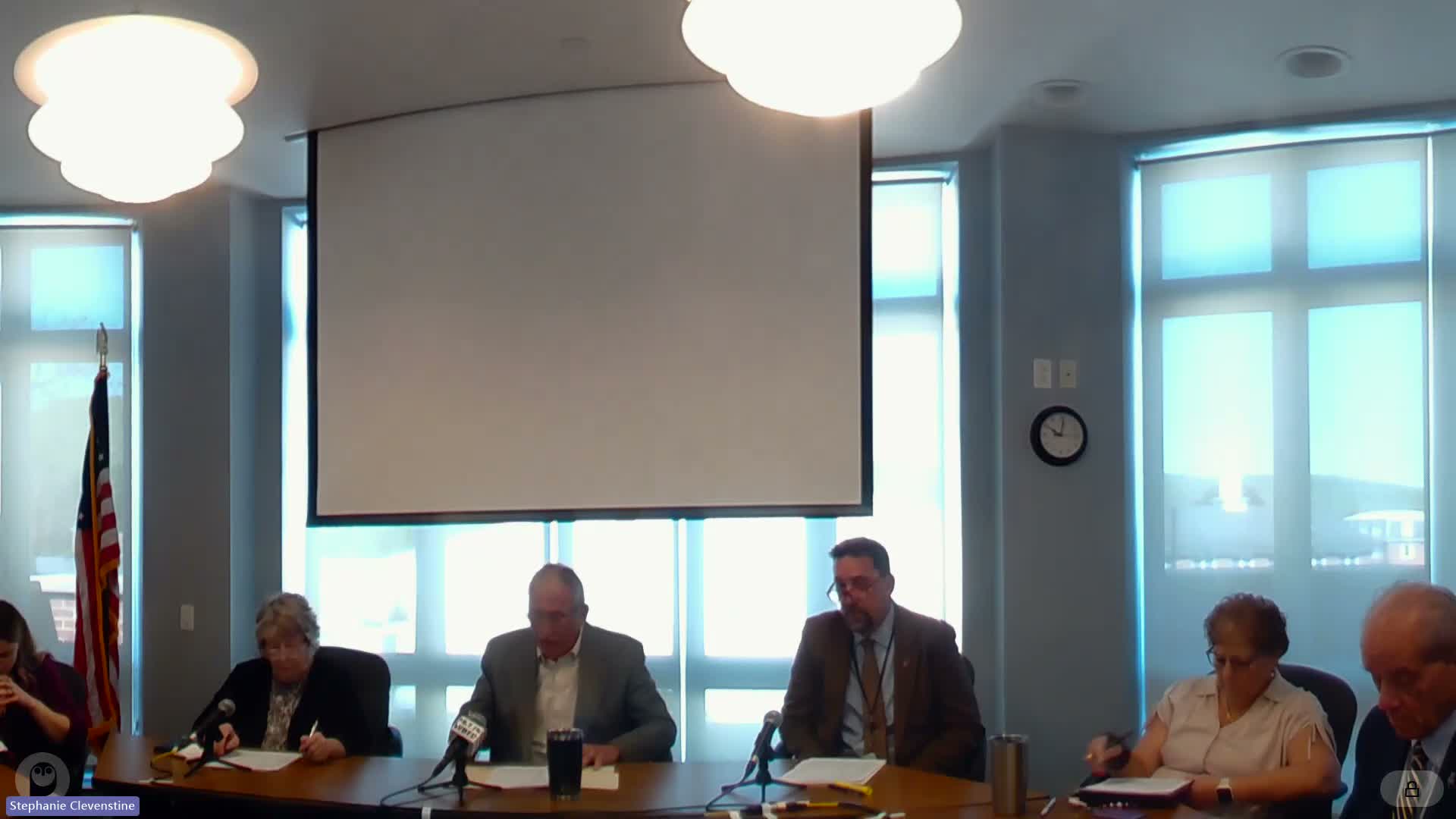
Dustin Bishop, project manager for Allegheny Broadband (ABI), told Bedford County commissioners that Pennsylvania received roughly $1.2 billion through the federal BEAD program and has already awarded about $711 million for deployment projects. “There’s a total of a 130,000 locations in Pennsylvania that…are either unserved or underserved,” Bishop said.
Bishop said the largest BEAD project in Bedford County covers about 1,300 locations; when other smaller awards are included he estimated the county total at roughly 1,500–1,600 locations and said he would provide a more precise count next week. He also described the technology mix in the recent awards, saying about 60% of locations are slated for fiber, roughly 23% for low-Earth-orbit satellite or similar services, and the remainder for fixed wireless or hybrid coaxial deployments.
The presenter emphasized that the state broadband authority (the Pennsylvania Broadband Development Authority, PBDA) made the award decisions. In response to commissioners’ questions, Bishop said PBDA used a scoring criterion focused on cost per location after subsidy and that the county did not select providers. “It is PBDA’s decision to make that, not a venture county,” Bishop said.
Bishop identified the main awardees in Bedford County as the fiber projects led by Bright Speed (referred to in the presentation) and eCommunity Fiber (A2D); he also said Amazon and SpaceX were awarded satellite/LEO locations, and that Verizon received a single location in the county. He noted Comcast received no awarded locations in Bedford County in this round.
Bishop described open-access network arrangements in which an infrastructure owner operates a network that multiple retail providers can use, arguing competition on an open-access model can lower prices. He added that one named provider in the presentation proposed 1 Gbps symmetrical service at an expected monthly price of $45–$65.
On next steps, Bishop said Pennsylvania has executed a contract with NTIA and that contracts between PBDA and awardees should follow; once those agreements are signed the work sequence is planning, engineering, permitting, construction and testing, with a maximum four-year window for project completion under the grant agreements.
The presentation concluded with a brief update that seven tower sites tied to an NTIA-funded project are entering construction in Bedford County (five new towers, two existing), with foundations in place for some sites and a contractor selected to begin buildout.
The board asked Bishop to return with a detailed county map showing which providers will serve which addresses.
Bishop said the largest BEAD project in Bedford County covers about 1,300 locations; when other smaller awards are included he estimated the county total at roughly 1,500–1,600 locations and said he would provide a more precise count next week. He also described the technology mix in the recent awards, saying about 60% of locations are slated for fiber, roughly 23% for low-Earth-orbit satellite or similar services, and the remainder for fixed wireless or hybrid coaxial deployments.
The presenter emphasized that the state broadband authority (the Pennsylvania Broadband Development Authority, PBDA) made the award decisions. In response to commissioners’ questions, Bishop said PBDA used a scoring criterion focused on cost per location after subsidy and that the county did not select providers. “It is PBDA’s decision to make that, not a venture county,” Bishop said.
Bishop identified the main awardees in Bedford County as the fiber projects led by Bright Speed (referred to in the presentation) and eCommunity Fiber (A2D); he also said Amazon and SpaceX were awarded satellite/LEO locations, and that Verizon received a single location in the county. He noted Comcast received no awarded locations in Bedford County in this round.
Bishop described open-access network arrangements in which an infrastructure owner operates a network that multiple retail providers can use, arguing competition on an open-access model can lower prices. He added that one named provider in the presentation proposed 1 Gbps symmetrical service at an expected monthly price of $45–$65.
On next steps, Bishop said Pennsylvania has executed a contract with NTIA and that contracts between PBDA and awardees should follow; once those agreements are signed the work sequence is planning, engineering, permitting, construction and testing, with a maximum four-year window for project completion under the grant agreements.
The presentation concluded with a brief update that seven tower sites tied to an NTIA-funded project are entering construction in Bedford County (five new towers, two existing), with foundations in place for some sites and a contractor selected to begin buildout.
The board asked Bishop to return with a detailed county map showing which providers will serve which addresses.
View the Full Meeting & All Its Details
This article offers just a summary. Unlock complete video, transcripts, and insights as a Founder Member.
✓
Watch full, unedited meeting videos
✓
Search every word spoken in unlimited transcripts
✓
AI summaries & real-time alerts (all government levels)
✓
Permanent access to expanding government content
30-day money-back guarantee
