County engineers warn of multi-million dollar bridge need; commissioners adopt $5 vehicle registration fee
May 14, 2026 | Bedford County, Pennsylvania
This article was created by AI summarizing key points discussed. AI makes mistakes, so for full details and context, please refer to the video of the full meeting. Please report any errors so we can fix them. Report an error »
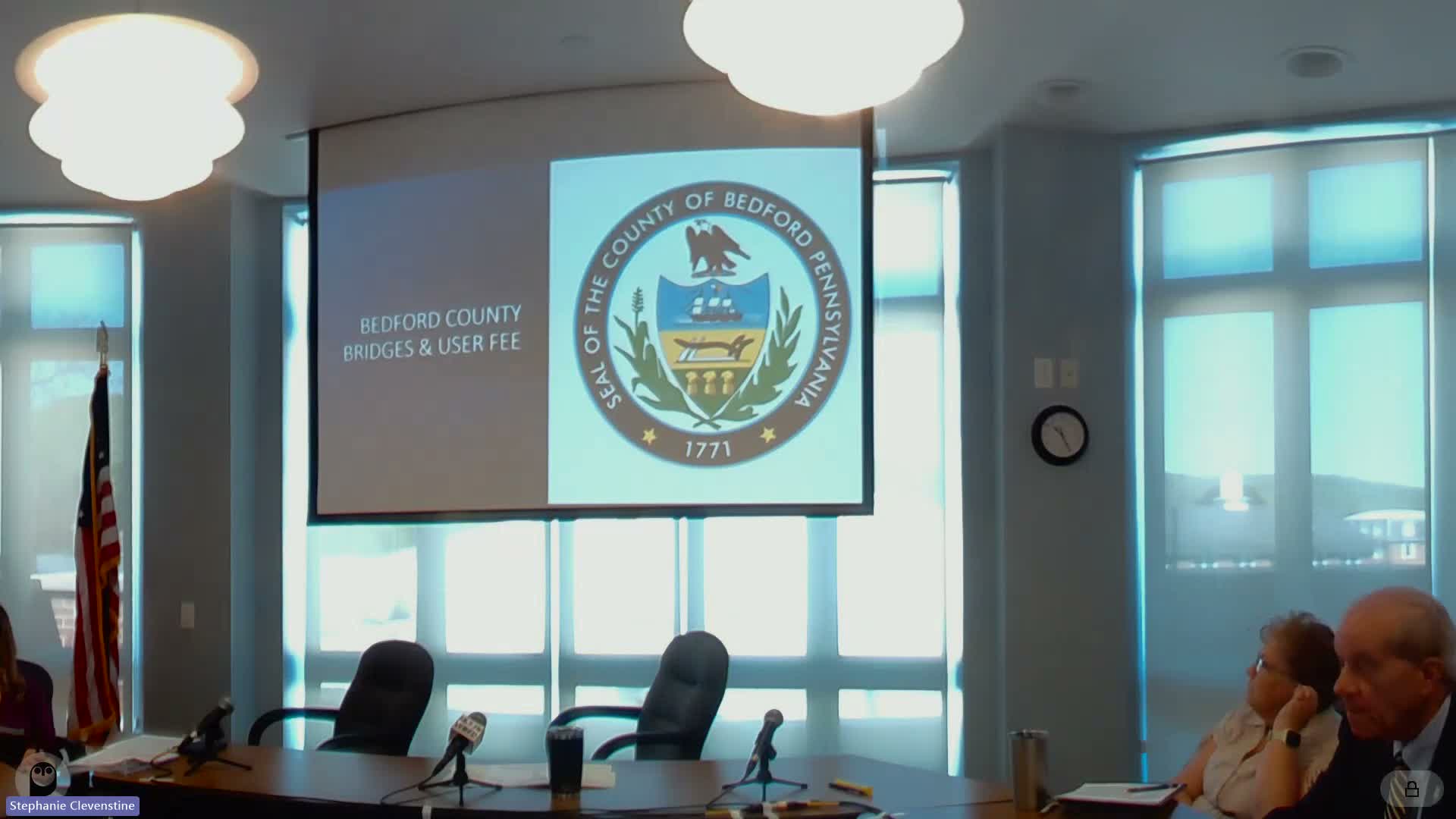
Aaron Craig, county engineer with ATCS, told the Bedford County Board of Commissioners that the county maintains 87 locally owned vehicular bridges (50 municipal, 37 county-owned) and that several structures are in poor condition. He highlighted four bridges—Bridge 2, Bridge 13, Bridge 33 and Bridge 41—as priorities and said Bridge 33, at the Maryland border, had beam deterioration that led the county to restrict traffic to a single lane while inspections continue.
Craig presented programming-level cost estimates and said nine covered bridges account for an estimated $2.4 million of planned work; the larger set of four priority bridges carries engineering and replacement estimates he summarized at roughly $15 million over five years (about $3 million per year). Craig emphasized the county lacks the budget to cover those costs alone and outlined funding streams: liquid fuels tax, Act 13 (Marcellus shale impact funds) restricted to certain bridge work, TIP programming through PennDOT and competitive grants. He also discussed alternative models including road-directed reimbursement (county fronts money and seeks reimbursement) and public–private partnerships, noting each carries risk if reimbursement or revenue does not materialize.
Commissioners discussed repair-versus-replace choices. One commissioner urged a stronger maintenance program to prolong bridge life and potentially avoid full replacement; Craig agreed repairs can extend service but cautioned some bridges show deterioration that may make only temporary fixes feasible.
Following the presentation the board adopted an ordinance (No. 05.12 0.2026) to impose a $5 fee on each nonexempt vehicle registration under Act 89 to generate dedicated local funds for roads and bridges. The chair explained the fee is expected to generate approximately $330,000 annually for county road and bridge work; the ordinance passed by voice vote with one recorded dissenting 'nay.'
The board also discussed TIP programming limits—typically one locally owned bridge per county every two years—and the need to pursue grants and plan strategically to address the backlog.
Next steps identified by staff included pursuing grant opportunities with PennDOT and DCED and developing a capital asset management plan to prioritize maintenance and replacement work.
Craig presented programming-level cost estimates and said nine covered bridges account for an estimated $2.4 million of planned work; the larger set of four priority bridges carries engineering and replacement estimates he summarized at roughly $15 million over five years (about $3 million per year). Craig emphasized the county lacks the budget to cover those costs alone and outlined funding streams: liquid fuels tax, Act 13 (Marcellus shale impact funds) restricted to certain bridge work, TIP programming through PennDOT and competitive grants. He also discussed alternative models including road-directed reimbursement (county fronts money and seeks reimbursement) and public–private partnerships, noting each carries risk if reimbursement or revenue does not materialize.
Commissioners discussed repair-versus-replace choices. One commissioner urged a stronger maintenance program to prolong bridge life and potentially avoid full replacement; Craig agreed repairs can extend service but cautioned some bridges show deterioration that may make only temporary fixes feasible.
Following the presentation the board adopted an ordinance (No. 05.12 0.2026) to impose a $5 fee on each nonexempt vehicle registration under Act 89 to generate dedicated local funds for roads and bridges. The chair explained the fee is expected to generate approximately $330,000 annually for county road and bridge work; the ordinance passed by voice vote with one recorded dissenting 'nay.'
The board also discussed TIP programming limits—typically one locally owned bridge per county every two years—and the need to pursue grants and plan strategically to address the backlog.
Next steps identified by staff included pursuing grant opportunities with PennDOT and DCED and developing a capital asset management plan to prioritize maintenance and replacement work.
View the Full Meeting & All Its Details
This article offers just a summary. Unlock complete video, transcripts, and insights as a Founder Member.
✓
Watch full, unedited meeting videos
✓
Search every word spoken in unlimited transcripts
✓
AI summaries & real-time alerts (all government levels)
✓
Permanent access to expanding government content
30-day money-back guarantee
