Camarillo council rejects youth-backed climate resolution after 22-person public hearing
May 14, 2026 | Camarillo, Ventura County, California
This article was created by AI summarizing key points discussed. AI makes mistakes, so for full details and context, please refer to the video of the full meeting. Please report any errors so we can fix them. Report an error »
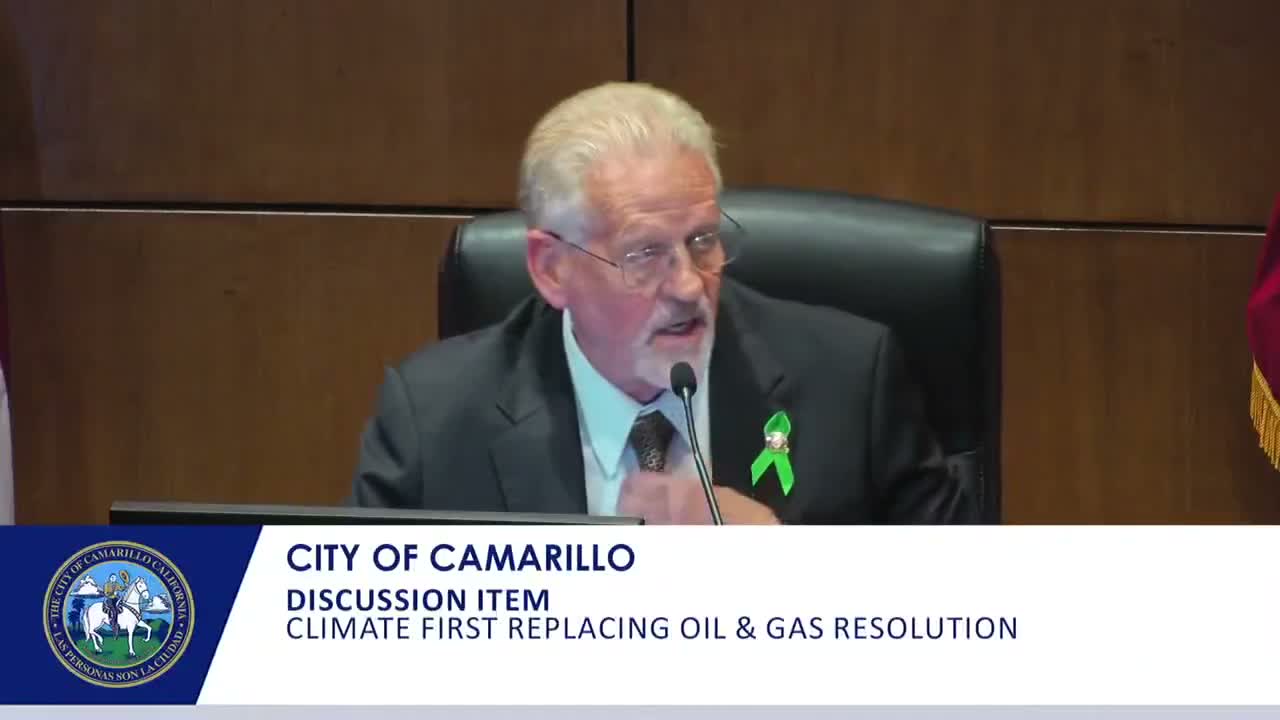
Camarillo, May 13, 2026 — The Camarillo City Council on Wednesday declined to adopt a resolution urging a phase-out of oil and gas and support for health setbacks and a so-called 'climate superfund,' following a lengthy public hearing and a 2–3 roll-call vote.
Staff presented the resolution as submitted by local climate advocacy group Climate First Replacing Oil and Gas, outlining its goals to urge the governor and county to stop issuing new oil and gas permits, defend the 3,200-foot health-protection setbacks established under SB 1137, and press for accountable cleanup of idle and orphan wells. "The proposed resolution urges the city and other governmental agencies to support several policy positions related to oil and gas production in California," staff said during the presentation.
The nut graf: Twenty-two speakers testified during the public hearing, including youth organizers who linked recent wildfires and local health concerns to fossil fuel impacts and industry representatives who warned the council against acting outside its jurisdiction. After debate, Council member Santangelo moved to adopt the resolution; it was seconded and failed on a 2–3 vote (Santangelo and Vice Mayor Martinez Bravo: yes; Kildee, Tremblay and Mayor Tennyson: no).
Proponents emphasized public-health risks and intergenerational impacts. Abra Stewart, program manager at Climate First, said the measure would "protect public health and invest in a sustainable future" and argued local resolutions show leadership even where direct regulation is limited. Students and youth leaders urged adoption as a precaution and a signal to state lawmakers: "This resolution is about protecting public health, supporting wildfire resistance, holding polluters accountable instead of placing the burden entirely on taxpayers and future generations," said Anna Orsa, a junior at Simi Valley High School, describing wildfire exposure she witnessed from a recent flight.
Opponents pressed two themes: the resolution’s scope and economic consequences. David Compton, a Camarillo resident, said, "There is no oil drilling within the city of Camarillo," and argued the council should avoid taking positions outside the city's regulatory authority. Cliff Simonson, who identified himself as a Ventura County oil-industry worker, urged the council to consider local jobs and said his company had removed wells and managed them responsibly.
Council debate reflected those divisions. Council member Santangelo, who moved the resolution, said she supported its public-health and climate-justice goals and credited youth advocates for their work. Council member Kildee and Council member Tremblay said they supported aspects of the proposal — including cleanup funds and SB 1137 setbacks — but opposed the resolution as framed because oil-and-gas permitting and many of the direct regulatory tools are outside the city’s authority. The city attorney clarified that the city currently has no active oil or gas wells inside city limits, based on a review of the California Department of Conservation maps.
Action and next steps: Santangelo moved to adopt the Climate First Replacing Oil and Gas resolution; the motion was seconded. Roll-call: Santangelo — yes; Vice Mayor Martinez Bravo — yes; Kildee — no; Tremblay — no; Mayor Tennyson — no. The motion failed, 2–3. After the vote Vice Mayor Martinez Bravo proposed bringing a revised, city-focused resolution back to the council with further community and youth engagement and asked the city manager to have staff investigate next steps and options for inclusion of stakeholders.
Authorities and context: The staff presentation explicitly cited SB 1137 (state law creating health protection setbacks and additional monitoring requirements) and noted ongoing litigation by the U.S. Department of Justice challenging aspects of that law. Staff also referenced county-level idle- and orphan-well inventories and estimates of cleanup costs.
What’s next: Councilmembers signaled willingness to consider a rewritten, locally tailored resolution and asked staff to return with options that include youth and community input and clarify implications for local government if state-level funding or a 'polluters pay' mechanism is enacted.
Staff presented the resolution as submitted by local climate advocacy group Climate First Replacing Oil and Gas, outlining its goals to urge the governor and county to stop issuing new oil and gas permits, defend the 3,200-foot health-protection setbacks established under SB 1137, and press for accountable cleanup of idle and orphan wells. "The proposed resolution urges the city and other governmental agencies to support several policy positions related to oil and gas production in California," staff said during the presentation.
The nut graf: Twenty-two speakers testified during the public hearing, including youth organizers who linked recent wildfires and local health concerns to fossil fuel impacts and industry representatives who warned the council against acting outside its jurisdiction. After debate, Council member Santangelo moved to adopt the resolution; it was seconded and failed on a 2–3 vote (Santangelo and Vice Mayor Martinez Bravo: yes; Kildee, Tremblay and Mayor Tennyson: no).
Proponents emphasized public-health risks and intergenerational impacts. Abra Stewart, program manager at Climate First, said the measure would "protect public health and invest in a sustainable future" and argued local resolutions show leadership even where direct regulation is limited. Students and youth leaders urged adoption as a precaution and a signal to state lawmakers: "This resolution is about protecting public health, supporting wildfire resistance, holding polluters accountable instead of placing the burden entirely on taxpayers and future generations," said Anna Orsa, a junior at Simi Valley High School, describing wildfire exposure she witnessed from a recent flight.
Opponents pressed two themes: the resolution’s scope and economic consequences. David Compton, a Camarillo resident, said, "There is no oil drilling within the city of Camarillo," and argued the council should avoid taking positions outside the city's regulatory authority. Cliff Simonson, who identified himself as a Ventura County oil-industry worker, urged the council to consider local jobs and said his company had removed wells and managed them responsibly.
Council debate reflected those divisions. Council member Santangelo, who moved the resolution, said she supported its public-health and climate-justice goals and credited youth advocates for their work. Council member Kildee and Council member Tremblay said they supported aspects of the proposal — including cleanup funds and SB 1137 setbacks — but opposed the resolution as framed because oil-and-gas permitting and many of the direct regulatory tools are outside the city’s authority. The city attorney clarified that the city currently has no active oil or gas wells inside city limits, based on a review of the California Department of Conservation maps.
Action and next steps: Santangelo moved to adopt the Climate First Replacing Oil and Gas resolution; the motion was seconded. Roll-call: Santangelo — yes; Vice Mayor Martinez Bravo — yes; Kildee — no; Tremblay — no; Mayor Tennyson — no. The motion failed, 2–3. After the vote Vice Mayor Martinez Bravo proposed bringing a revised, city-focused resolution back to the council with further community and youth engagement and asked the city manager to have staff investigate next steps and options for inclusion of stakeholders.
Authorities and context: The staff presentation explicitly cited SB 1137 (state law creating health protection setbacks and additional monitoring requirements) and noted ongoing litigation by the U.S. Department of Justice challenging aspects of that law. Staff also referenced county-level idle- and orphan-well inventories and estimates of cleanup costs.
What’s next: Councilmembers signaled willingness to consider a rewritten, locally tailored resolution and asked staff to return with options that include youth and community input and clarify implications for local government if state-level funding or a 'polluters pay' mechanism is enacted.
View the Full Meeting & All Its Details
This article offers just a summary. Unlock complete video, transcripts, and insights as a Founder Member.
✓
Watch full, unedited meeting videos
✓
Search every word spoken in unlimited transcripts
✓
AI summaries & real-time alerts (all government levels)
✓
Permanent access to expanding government content
30-day money-back guarantee
