Commission approves preliminary plat for 40.64‑acre 'Mansions on Blondie June' after residents urge more engineering detail
May 14, 2026 | Lucas City Council, Lucas, Collin County, Texas
This article was created by AI summarizing key points discussed. AI makes mistakes, so for full details and context, please refer to the video of the full meeting. Please report any errors so we can fix them. Report an error »
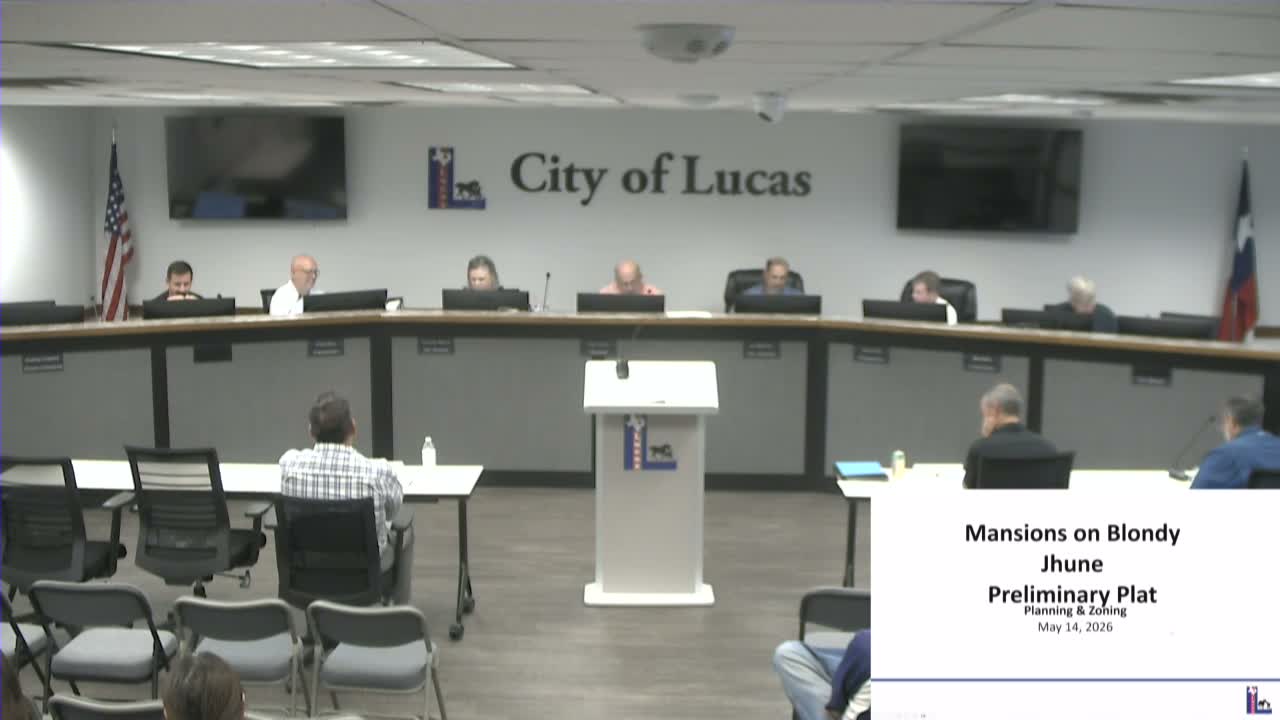
The Planning and Zoning Commission approved a preliminary plat for a 40.64‑acre residential subdivision known in the application as Mansions on Blondie June, voting 5–0 after extended public comment and technical Q&A.
The application, submitted by Corwin Engineering on behalf of Jay Anthony Properties, proposes 16 residential lots (19 lots total including two open‑space blocks) and a split entrance with oversized cul‑de‑sacs and a secondary emergency‑access route. Staff said engineering plans, a tree survey and a flood study have been submitted and reviewed by the city engineer.
Why it matters: Neighbors urged postponement, saying the public record lacked bridge and culvert design sheets, hydrologic and hydraulic studies and detailed construction traffic mitigation plans. Several written comments were read into the record asking the commission to require enforceable conditions before approval to protect drainage, emergency access and neighboring properties.
Residents’ concerns: Written comments read by the chair included requests from nearby residents for a preconstruction pavement evaluation, a traffic and access analysis, a written fire marshal report confirming emergency access adequacy, and clear documentation of bridge/culvert and floodplain work. Chris Adcock, who read comments into the record, requested that technical documents and any CLOMR/LOMR submittals be part of the public record prior to approval.
Staff response and applicant assurances: City staff said a CLOMR (conditional letter of map revision) had been submitted to FEMA two weeks earlier and that CLOMR/LOMR processes typically take about six months. Mr. Hilbert told commissioners that if FEMA requires material changes after review, major design changes would be returned to planning and zoning for re‑consideration. Warren Corwin, the applicant’s engineer, said the project meets city ordinances and that many technical reviews have already been completed. “We’ve gone through that diligently with Joe and his staff, the engineers,” Corwin said.
Emergency access and tree protection: Staff described a 24‑foot paved emergency access designed for 80,000 pounds, a looped water main and oversized cul‑de‑sacs intended to satisfy code for streets longer than 600 feet. Commissioners discussed whether routing emergency access through or adjacent to existing subdivisions was consistent with ordinance language and requested a review of the specific code section.
Vote and next steps: Commissioner S2 moved to approve the preliminary plat; Commissioner S9 seconded. The commission approved the preliminary plat by voice vote, 5–0. Staff said it will post available application documents and explain which technical items remain pending so residents can review them before final plat or construction approvals.
What happens next: The approval clears the preliminary‑plat stage and allows the applicant to proceed to later construction plan reviews, permitting and required FEMA floodplain processes; if FEMA or other reviewing agencies require significant design changes, the application will return to the commission.
The application, submitted by Corwin Engineering on behalf of Jay Anthony Properties, proposes 16 residential lots (19 lots total including two open‑space blocks) and a split entrance with oversized cul‑de‑sacs and a secondary emergency‑access route. Staff said engineering plans, a tree survey and a flood study have been submitted and reviewed by the city engineer.
Why it matters: Neighbors urged postponement, saying the public record lacked bridge and culvert design sheets, hydrologic and hydraulic studies and detailed construction traffic mitigation plans. Several written comments were read into the record asking the commission to require enforceable conditions before approval to protect drainage, emergency access and neighboring properties.
Residents’ concerns: Written comments read by the chair included requests from nearby residents for a preconstruction pavement evaluation, a traffic and access analysis, a written fire marshal report confirming emergency access adequacy, and clear documentation of bridge/culvert and floodplain work. Chris Adcock, who read comments into the record, requested that technical documents and any CLOMR/LOMR submittals be part of the public record prior to approval.
Staff response and applicant assurances: City staff said a CLOMR (conditional letter of map revision) had been submitted to FEMA two weeks earlier and that CLOMR/LOMR processes typically take about six months. Mr. Hilbert told commissioners that if FEMA requires material changes after review, major design changes would be returned to planning and zoning for re‑consideration. Warren Corwin, the applicant’s engineer, said the project meets city ordinances and that many technical reviews have already been completed. “We’ve gone through that diligently with Joe and his staff, the engineers,” Corwin said.
Emergency access and tree protection: Staff described a 24‑foot paved emergency access designed for 80,000 pounds, a looped water main and oversized cul‑de‑sacs intended to satisfy code for streets longer than 600 feet. Commissioners discussed whether routing emergency access through or adjacent to existing subdivisions was consistent with ordinance language and requested a review of the specific code section.
Vote and next steps: Commissioner S2 moved to approve the preliminary plat; Commissioner S9 seconded. The commission approved the preliminary plat by voice vote, 5–0. Staff said it will post available application documents and explain which technical items remain pending so residents can review them before final plat or construction approvals.
What happens next: The approval clears the preliminary‑plat stage and allows the applicant to proceed to later construction plan reviews, permitting and required FEMA floodplain processes; if FEMA or other reviewing agencies require significant design changes, the application will return to the commission.
View the Full Meeting & All Its Details
This article offers just a summary. Unlock complete video, transcripts, and insights as a Founder Member.
✓
Watch full, unedited meeting videos
✓
Search every word spoken in unlimited transcripts
✓
AI summaries & real-time alerts (all government levels)
✓
Permanent access to expanding government content
30-day money-back guarantee
