Senate joint hearing spotlights California'wide creative-economy strategic plan and urges funding to implement it
May 14, 2026 | California State Senate, Senate, Legislative, California
This article was created by AI summarizing key points discussed. AI makes mistakes, so for full details and context, please refer to the video of the full meeting. Please report any errors so we can fix them. Report an error »
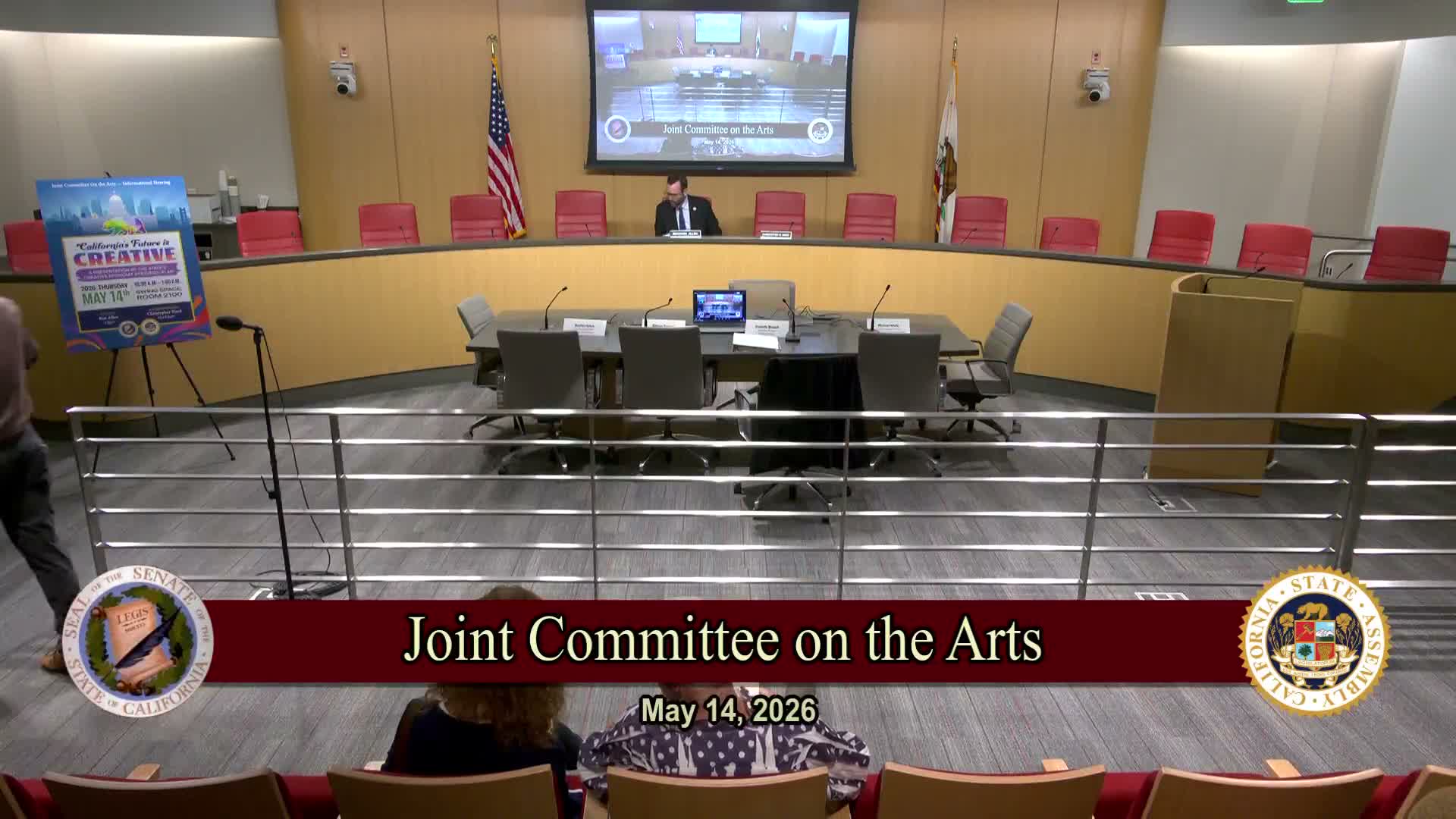
A California State Senate joint committee hearing on the creative economy reviewed the state's first sector‑specific strategic plan and fielded testimony from policy partners, agency officials and arts practitioners about next steps and funding needs.
Sen. Allen convened the informational hearing to introduce "California's Future Is Creative," explaining the plan grew from AB 127 and the Creative Economy Work Group and seeks to stabilize and grow a creative workforce that the chair described as nearly 1,000,000 people with roughly $300 billion in economic impact. "This is what today's all about," the chair said as panelists took the table.
Rachel Hatch, chief impact officer at Institute for the Future, framed the study as foresight rather than prediction and said the team examined how five forces'including accelerated AI adoption and climate disruption'could reshape creative work through 2035. "We began the study with a comparative analysis," Hatch said, and reported that in recent years California lost 2.6% of creative jobs while the U.S. overall grew by 0.3%.
Danielle Bridal of the California Arts Council described the plan's phased approach: framework development, community engagement and implementation/evaluation. Rebecca Ratzkin, the council's equity measures and evaluation manager, said the council held 26 town halls across eight regions with more than 1,100 attendees to road‑test recommendations and collect local input.
Education and workforce officials tied the plan to existing state efforts. A California Department of Education representative noted SB 628 (the Creative Workforce Act of 2021) and recent updates to CTE model curriculum standards that underpin expanded apprenticeships and a digital badging protocol. A California Workforce Development Board official described High Road Training Partnership investments that, he said, produced more than 375 placements and strong placement rates for participants facing barriers to employment.
Panelists and community leaders urged the Legislature to resource implementation. "This plan is not merely a set of recommendations," Julie Baker, CEO of Californians for the Arts, told the committee. "We ask you to commit to sustained public funding" including an ask the panel described as $50 million for the California Arts Council and $40 million for the Performing Arts Equitable Payroll Fund to stabilize nonprofit payrolls and preserve jobs.
Artists and workforce providers also warned that current labor and tax data undercount freelance and 1099 creative work. Riccardo Handy of the Handy Foundation described registered apprenticeships that place students in post‑production and editorial roles and said policy must capture the full cluster of vendors, post‑production houses and Main Street creative businesses that make up the ecosystem.
Panelists emphasized protecting creative labor as technologies like generative AI diffuse through production workflows. Hatch and several practitioners urged training and guardrails for educators and employers so tools augment rather than displace creative jobs. "Some tools you learn how to wield; if the tool is using you, that's where it becomes dangerous," one presenter said.
The hearing concluded with public commenters from across the state describing local programs supported by California Arts Council grants, apprenticeship placements, oral-history projects and calls for artist housing and regional supports. Chair Allen closed the hearing and invited continued legislative engagement on how to define metrics, align agencies and fund implementation.
The committee did not take a formal vote during the informational hearing; proponents requested that the Legislature consider specific budget increases during the final budget negotiations.
Sen. Allen convened the informational hearing to introduce "California's Future Is Creative," explaining the plan grew from AB 127 and the Creative Economy Work Group and seeks to stabilize and grow a creative workforce that the chair described as nearly 1,000,000 people with roughly $300 billion in economic impact. "This is what today's all about," the chair said as panelists took the table.
Rachel Hatch, chief impact officer at Institute for the Future, framed the study as foresight rather than prediction and said the team examined how five forces'including accelerated AI adoption and climate disruption'could reshape creative work through 2035. "We began the study with a comparative analysis," Hatch said, and reported that in recent years California lost 2.6% of creative jobs while the U.S. overall grew by 0.3%.
Danielle Bridal of the California Arts Council described the plan's phased approach: framework development, community engagement and implementation/evaluation. Rebecca Ratzkin, the council's equity measures and evaluation manager, said the council held 26 town halls across eight regions with more than 1,100 attendees to road‑test recommendations and collect local input.
Education and workforce officials tied the plan to existing state efforts. A California Department of Education representative noted SB 628 (the Creative Workforce Act of 2021) and recent updates to CTE model curriculum standards that underpin expanded apprenticeships and a digital badging protocol. A California Workforce Development Board official described High Road Training Partnership investments that, he said, produced more than 375 placements and strong placement rates for participants facing barriers to employment.
Panelists and community leaders urged the Legislature to resource implementation. "This plan is not merely a set of recommendations," Julie Baker, CEO of Californians for the Arts, told the committee. "We ask you to commit to sustained public funding" including an ask the panel described as $50 million for the California Arts Council and $40 million for the Performing Arts Equitable Payroll Fund to stabilize nonprofit payrolls and preserve jobs.
Artists and workforce providers also warned that current labor and tax data undercount freelance and 1099 creative work. Riccardo Handy of the Handy Foundation described registered apprenticeships that place students in post‑production and editorial roles and said policy must capture the full cluster of vendors, post‑production houses and Main Street creative businesses that make up the ecosystem.
Panelists emphasized protecting creative labor as technologies like generative AI diffuse through production workflows. Hatch and several practitioners urged training and guardrails for educators and employers so tools augment rather than displace creative jobs. "Some tools you learn how to wield; if the tool is using you, that's where it becomes dangerous," one presenter said.
The hearing concluded with public commenters from across the state describing local programs supported by California Arts Council grants, apprenticeship placements, oral-history projects and calls for artist housing and regional supports. Chair Allen closed the hearing and invited continued legislative engagement on how to define metrics, align agencies and fund implementation.
The committee did not take a formal vote during the informational hearing; proponents requested that the Legislature consider specific budget increases during the final budget negotiations.
View the Full Meeting & All Its Details
This article offers just a summary. Unlock complete video, transcripts, and insights as a Founder Member.
✓
Watch full, unedited meeting videos
✓
Search every word spoken in unlimited transcripts
✓
AI summaries & real-time alerts (all government levels)
✓
Permanent access to expanding government content
30-day money-back guarantee
