Artists, nonprofit leaders press Legislature for $50M for California Arts Council and expanded performing-arts payroll fund
May 14, 2026 | California State Senate, Senate, Legislative, California
This article was created by AI summarizing key points discussed. AI makes mistakes, so for full details and context, please refer to the video of the full meeting. Please report any errors so we can fix them. Report an error »
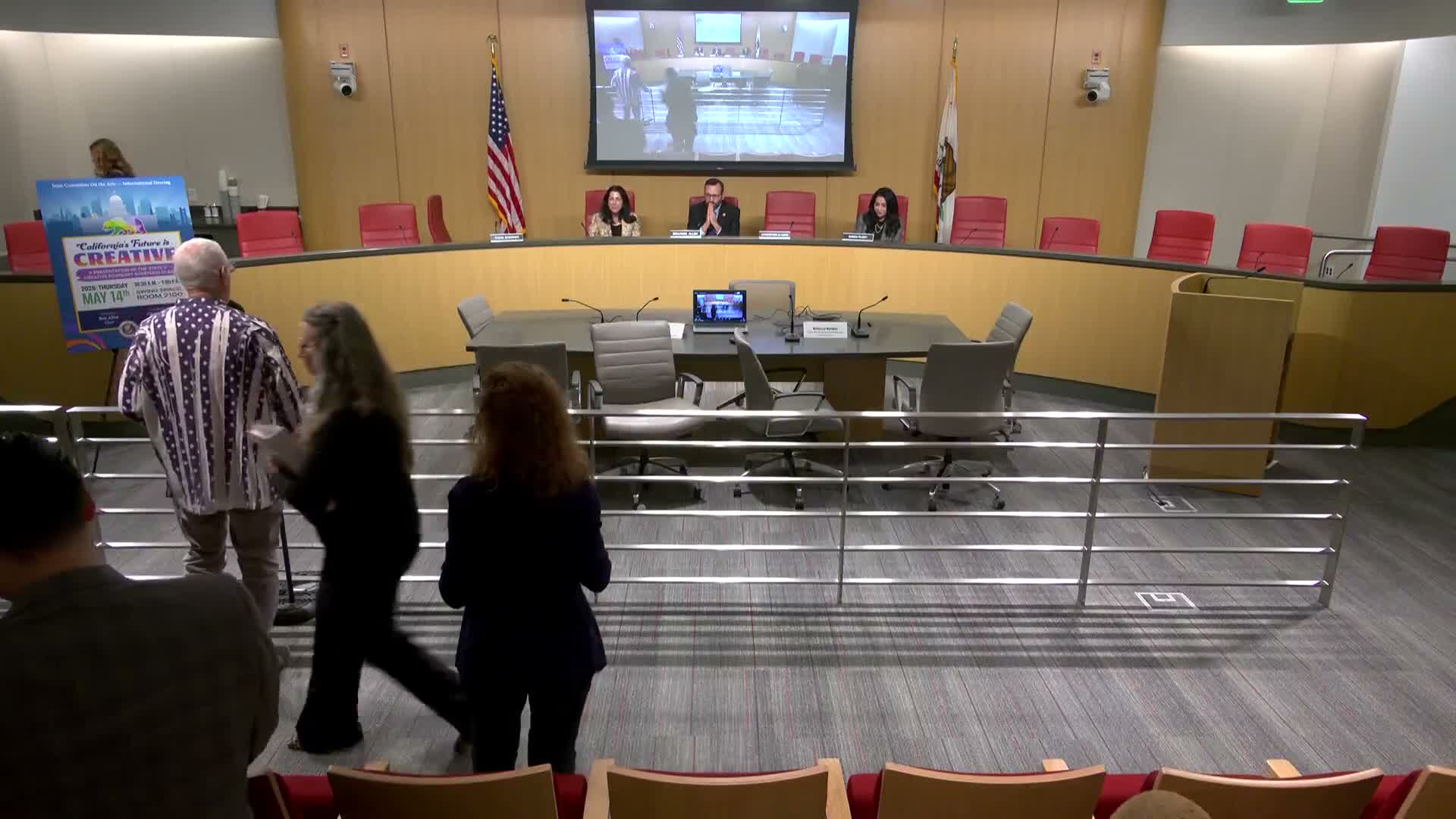
At the close of an informational hearing on California's Creative Economy strategic plan, artists, nonprofit leaders and local arts officials addressed the joint committee to press a single, clear point: fund implementation now.
Julie Baker and several public commenters urged the Legislature to increase the California Arts Council's grant capacity to $50 million and to expand the Performing Arts Equitable Payroll Fund (PAEPF) from current levels to $40 million to stabilize payroll and preserve jobs at small and mid-size performing-arts organizations.
Speakers described measurable local impacts tied to existing state support. Michael Solomon of California Lawyers for the Arts explained a state‑funded program, Designing Creative Futures, that placed formerly incarcerated people in paid arts internships. A program coordinator (Ken) said the original $3 million contract placed 234 people with an 83% completion rate and argued for a $3.5 million follow-on grant to expand placements.
Several small and regional organizations detailed how brief grants made the difference between continuing operations and closing. "The Performing Arts Equitable Payroll Fund is the lifeline we need and deserve," Adam Maggio of a Bay Area theater company told the committee, noting AB 5 compliance and rising payroll costs.
Artists also framed funding as an equity and community-health measure. Janine Maporunga, who used a Creative Core grant to record oral histories of Spanish-speaking immigrant elders, described the work as addressing loneliness and strengthening intergenerational ties. Faith J. McKinney, founder of Black Artist Foundry, said public funding is foundational for Black-led organizations that receive limited philanthropic support.
Public commenters emphasized that funding decisions have immediate consequences: program continuity, paid artist opportunities, workforce pipelines and local cultural economies. Several requested concrete budget lines and urged legislative leadership to act during the current budget window.
The committee did not vote on funding during the hearing; lawmakers said they would carry the testimony into budget deliberations.
Julie Baker and several public commenters urged the Legislature to increase the California Arts Council's grant capacity to $50 million and to expand the Performing Arts Equitable Payroll Fund (PAEPF) from current levels to $40 million to stabilize payroll and preserve jobs at small and mid-size performing-arts organizations.
Speakers described measurable local impacts tied to existing state support. Michael Solomon of California Lawyers for the Arts explained a state‑funded program, Designing Creative Futures, that placed formerly incarcerated people in paid arts internships. A program coordinator (Ken) said the original $3 million contract placed 234 people with an 83% completion rate and argued for a $3.5 million follow-on grant to expand placements.
Several small and regional organizations detailed how brief grants made the difference between continuing operations and closing. "The Performing Arts Equitable Payroll Fund is the lifeline we need and deserve," Adam Maggio of a Bay Area theater company told the committee, noting AB 5 compliance and rising payroll costs.
Artists also framed funding as an equity and community-health measure. Janine Maporunga, who used a Creative Core grant to record oral histories of Spanish-speaking immigrant elders, described the work as addressing loneliness and strengthening intergenerational ties. Faith J. McKinney, founder of Black Artist Foundry, said public funding is foundational for Black-led organizations that receive limited philanthropic support.
Public commenters emphasized that funding decisions have immediate consequences: program continuity, paid artist opportunities, workforce pipelines and local cultural economies. Several requested concrete budget lines and urged legislative leadership to act during the current budget window.
The committee did not vote on funding during the hearing; lawmakers said they would carry the testimony into budget deliberations.
View the Full Meeting & All Its Details
This article offers just a summary. Unlock complete video, transcripts, and insights as a Founder Member.
✓
Watch full, unedited meeting videos
✓
Search every word spoken in unlimited transcripts
✓
AI summaries & real-time alerts (all government levels)
✓
Permanent access to expanding government content
30-day money-back guarantee
