Lawmakers hear strategic plan to shore up California's creative economy; advocates press for $66 million in arts funding
May 14, 2026 | California State Assembly, House, Legislative, California
This article was created by AI summarizing key points discussed. AI makes mistakes, so for full details and context, please refer to the video of the full meeting. Please report any errors so we can fix them. Report an error »
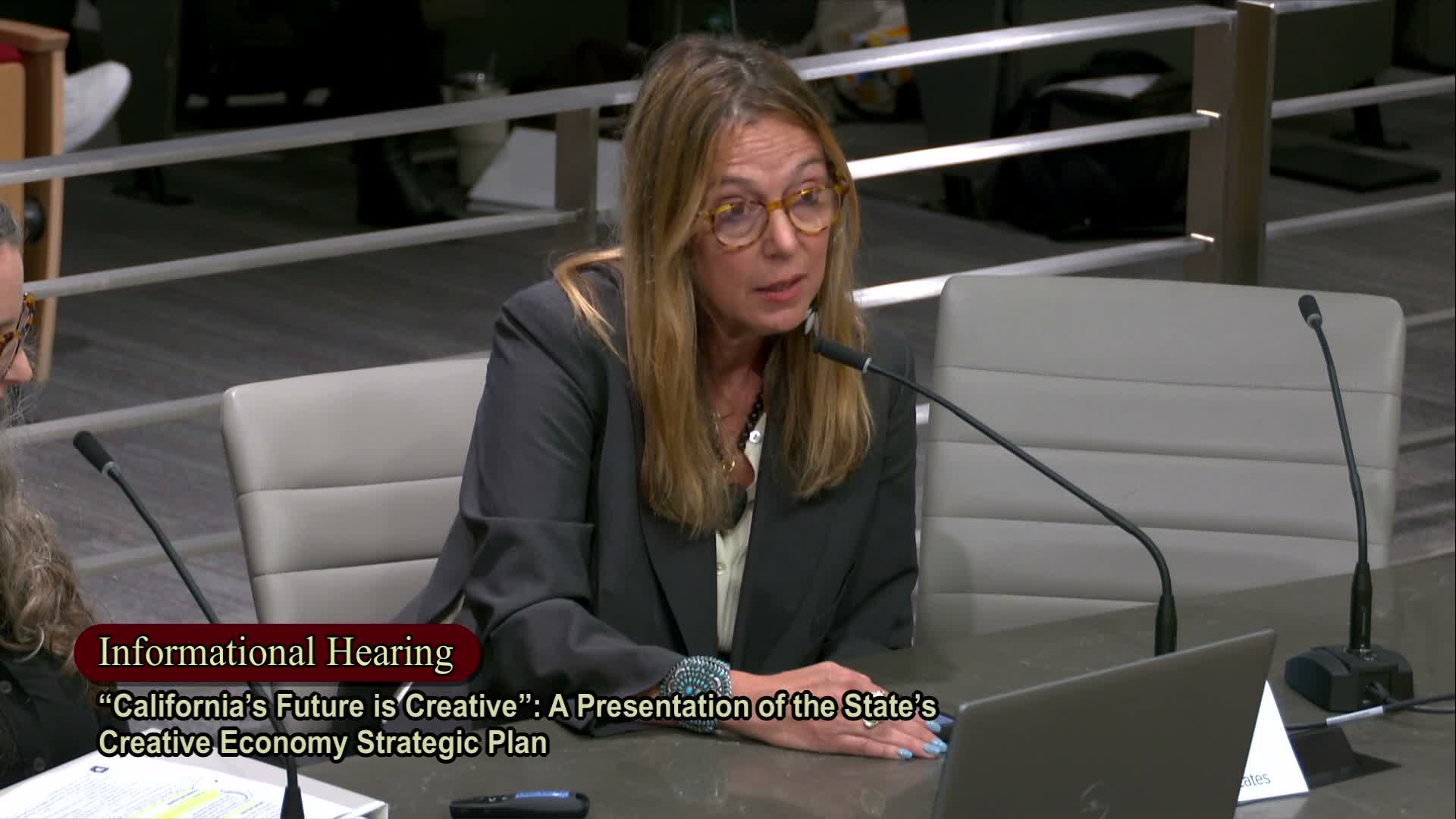
SACRAMENTO — Lawmakers and state arts officials on Friday discussed a new strategic plan aimed at stabilizing California's creative economy and outlined implementation priorities while arts leaders pressed for immediate funding to keep artists and small cultural organizations afloat.
"California's creative economy is not just a cultural engine. It's an economic powerhouse," the chair of the joint committee on the arts said in opening remarks, citing the plan's estimate of nearly 1,000,000 creative jobs and about $300 billion in economic impact. The hearing introduced "California's Future Is Creative," the product of a legislatively established work group and a multi‑phase planning process.
The plan, developed with the Institute for the Future and coordinated by the California Arts Council, identifies six priority action areas including workforce preparation, business stabilization, revenue generation through cultural districts and tourism, cross‑agency incentives (climate and economic development), an equity lens for investments, and building state capacity to implement the recommendations. Rachel Hatch of the Institute for the Future summarized the research and foresight approach, saying it surfaced five long‑term forces — including AI, climate disruption, affordability, concentrated capital, and fragile social fabric — that require coordinated state responses.
Why it matters: Panelists and advocates said the state risks further creative job losses unless it aligns data, funding and workforce pathways. Hatch cited recent labor figures showing a 2.6% decline in California creative employment between 2022 and 2023 while the nation registered modest gains.
Workforce and training programs were a central focus. Education and workforce officials described existing investments and pilots: the California Department of Education updated CTE model curriculum standards for arts, entertainment and design, developed a digital badging protocol, and invested roughly $5 million over five years to support apprenticeship‑aligned pathways in dozens of high schools. The California Workforce Development Board described a High Road Training Partnership investment that included a $3.5 million award to a network (BRIC) and a $1.5 million award to a separate program; officials reported hundreds of placements and high placement rates for participants facing employment barriers.
"Registered apprenticeship can lead to these good, sustainable jobs," said Riccardo Handy of the Handy Foundation, describing apprenticeship placements that have led alumni into studio and post‑production roles. Panelists repeatedly flagged a measurement problem: traditional labor market data, which focuses on W‑2 employment, fails to capture freelancers, 1099 contractors and small vendor firms that are part of the creative ecosystem.
Budget asks and advocacy: Arts advocates used the hearing to press lawmakers for money to implement the plan. Julie Baker, CEO of Californians for the Arts, asked the legislature to increase the California Arts Council's grant capacity to $50 million in its fiftieth anniversary year and to fund a total of $66 million in related asks, including $40 million to expand the Performing Arts Equitable Payroll Fund (PAEPF). "This plan is meant to be actionable, not reflective," Baker said, arguing that modest targeted investments would shore up workforce pipelines and local cultural infrastructure.
Public comments amplified those calls. Dozens of artists and nonprofit leaders described programs that rely on state grants, urged more affordable artist housing, and voiced concern about AI'driven disruption to authorship and creative labor. "It has never been more important to invest in the arts than it is right now," one artist said during public comment, asking legislators to defend creative workers from displacement as technologies advance.
Next steps: The California Arts Council said it has completed a state‑wide listening tour (26 town halls across eight regions with roughly 1,100 attendees) and will reconvene interagency partners to define implementation roles, pilot neighborhood‑level data collection tools, and develop timelines and resource plans for Phase 2 and Phase 3 of the strategy. Lawmakers at the hearing encouraged staff to pursue definitional pilots and cross‑agency data options and to keep the committee apprised of budget negotiations.
What was not decided: The hearing did not mark any formal votes or appropriations; funding decisions will be resolved through the budget process. Several speakers urged the legislature to adopt the plan's implementation funding during the current budget negotiations.
The joint committee adjourned after a public comment period and asked staff to continue coordinating implementation planning with the California Arts Council and partner agencies.
"California's creative economy is not just a cultural engine. It's an economic powerhouse," the chair of the joint committee on the arts said in opening remarks, citing the plan's estimate of nearly 1,000,000 creative jobs and about $300 billion in economic impact. The hearing introduced "California's Future Is Creative," the product of a legislatively established work group and a multi‑phase planning process.
The plan, developed with the Institute for the Future and coordinated by the California Arts Council, identifies six priority action areas including workforce preparation, business stabilization, revenue generation through cultural districts and tourism, cross‑agency incentives (climate and economic development), an equity lens for investments, and building state capacity to implement the recommendations. Rachel Hatch of the Institute for the Future summarized the research and foresight approach, saying it surfaced five long‑term forces — including AI, climate disruption, affordability, concentrated capital, and fragile social fabric — that require coordinated state responses.
Why it matters: Panelists and advocates said the state risks further creative job losses unless it aligns data, funding and workforce pathways. Hatch cited recent labor figures showing a 2.6% decline in California creative employment between 2022 and 2023 while the nation registered modest gains.
Workforce and training programs were a central focus. Education and workforce officials described existing investments and pilots: the California Department of Education updated CTE model curriculum standards for arts, entertainment and design, developed a digital badging protocol, and invested roughly $5 million over five years to support apprenticeship‑aligned pathways in dozens of high schools. The California Workforce Development Board described a High Road Training Partnership investment that included a $3.5 million award to a network (BRIC) and a $1.5 million award to a separate program; officials reported hundreds of placements and high placement rates for participants facing employment barriers.
"Registered apprenticeship can lead to these good, sustainable jobs," said Riccardo Handy of the Handy Foundation, describing apprenticeship placements that have led alumni into studio and post‑production roles. Panelists repeatedly flagged a measurement problem: traditional labor market data, which focuses on W‑2 employment, fails to capture freelancers, 1099 contractors and small vendor firms that are part of the creative ecosystem.
Budget asks and advocacy: Arts advocates used the hearing to press lawmakers for money to implement the plan. Julie Baker, CEO of Californians for the Arts, asked the legislature to increase the California Arts Council's grant capacity to $50 million in its fiftieth anniversary year and to fund a total of $66 million in related asks, including $40 million to expand the Performing Arts Equitable Payroll Fund (PAEPF). "This plan is meant to be actionable, not reflective," Baker said, arguing that modest targeted investments would shore up workforce pipelines and local cultural infrastructure.
Public comments amplified those calls. Dozens of artists and nonprofit leaders described programs that rely on state grants, urged more affordable artist housing, and voiced concern about AI'driven disruption to authorship and creative labor. "It has never been more important to invest in the arts than it is right now," one artist said during public comment, asking legislators to defend creative workers from displacement as technologies advance.
Next steps: The California Arts Council said it has completed a state‑wide listening tour (26 town halls across eight regions with roughly 1,100 attendees) and will reconvene interagency partners to define implementation roles, pilot neighborhood‑level data collection tools, and develop timelines and resource plans for Phase 2 and Phase 3 of the strategy. Lawmakers at the hearing encouraged staff to pursue definitional pilots and cross‑agency data options and to keep the committee apprised of budget negotiations.
What was not decided: The hearing did not mark any formal votes or appropriations; funding decisions will be resolved through the budget process. Several speakers urged the legislature to adopt the plan's implementation funding during the current budget negotiations.
The joint committee adjourned after a public comment period and asked staff to continue coordinating implementation planning with the California Arts Council and partner agencies.
Don't Miss a Word: See the Full Meeting!
Go beyond summaries. Unlock every video, transcript, and key insight with a Founder Membership.
✓
Get instant access to full meeting videos
✓
Search and clip any phrase from complete transcripts
✓
Receive AI-powered summaries & custom alerts
✓
Enjoy lifetime, unrestricted access to government data
30-day money-back guarantee
