Committee briefed on Senate’s one‑year renter credit expansion, estimated $4 million cost
May 14, 2026 | Ways & Means, HOUSE OF REPRESENTATIVES, Committees, Legislative , Vermont
This article was created by AI summarizing key points discussed. AI makes mistakes, so for full details and context, please refer to the video of the full meeting. Please report any errors so we can fix them. Report an error »
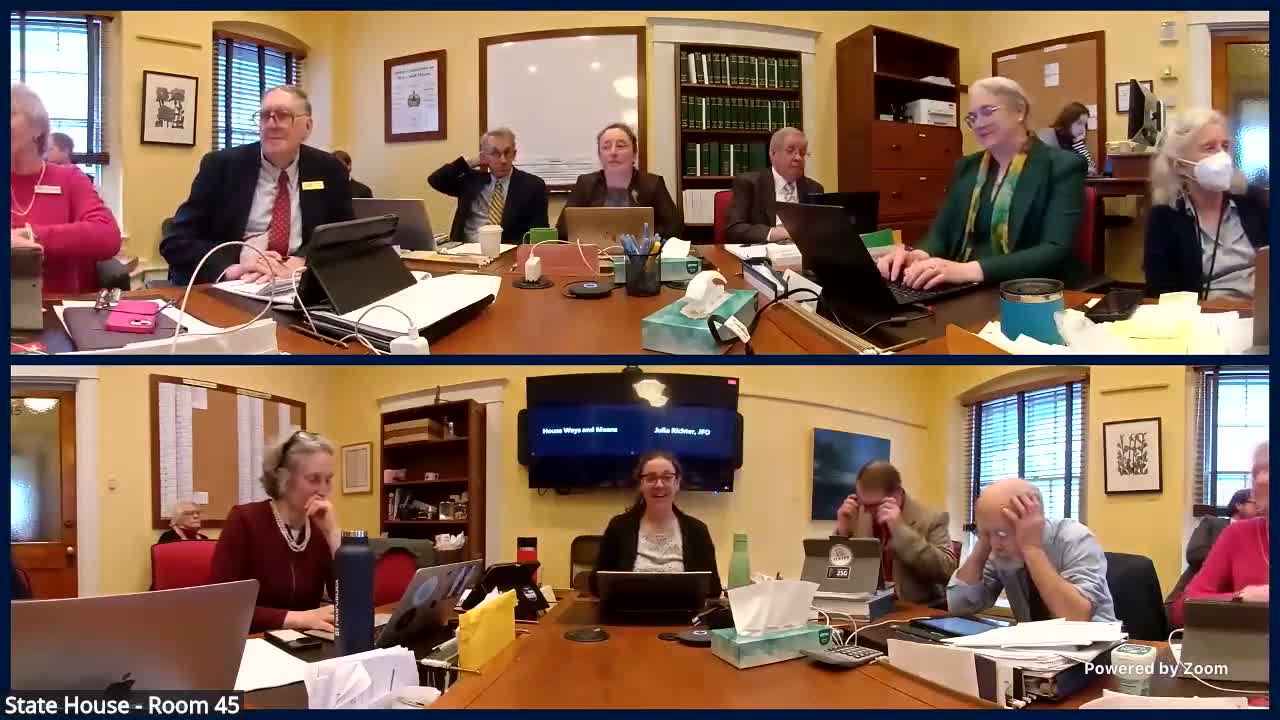
The Ways & Means committee received a briefing on a Senate amendment to H.949 that would temporarily expand the state renter credit for one claim year by raising the credit rate from 10% of HUD fair market rent to 12.5% and increasing the statutory cap from $2,500 to $3,250.
John, of the Office of Legislative Council, walked lawmakers through the amendment and the statutory language, saying, “this is a 1 year expansion of the renter credit” and explaining that the proposal both increases the percentage used to compute the credit and lifts the statutory cap. He described how eligibility is defined in statute (domiciled in the state for the taxable year, not claimed as a dependent, and renting at least six calendar months) and how statewide income bands determine whether a claimant receives the full benchmarked credit or a proportionally reduced amount.
Patrick, the presenter, summarized why the program changed from a contract‑rent rebate to a benchmarked renter credit: using HUD fair market rents (broken out by county and bedroom size) reduces claimant paperwork and updates automatically with HUD’s survey data. As Patrick put it, moving to a benchmarked amount “reduces the amount of documentation” claimants must provide and lets the department calculate payments rather than requiring claimants to do the math.
Julie Reykdera of the Joint Fiscal Office presented the fiscal outlook: she said the one‑year expansion is estimated to cost about $4,000,000 and that the yield bill and budget materials reflect that change. “The expansion of the renter credit costs an estimated 4,000,000, which is accounted for in the budget,” she told the committee, noting the result is a $4 million reduction in the one‑time pool available to buy down property taxes and a roughly 0.2 percentage‑point difference in the modeled average property‑tax bill change under the Senate construct.
Committee members asked technical and fairness questions. One member raised a fairness concern that increasing the credit rate and cap might affect owners differently than renters; Chair responded that senators who proposed the change sought to balance some general‑fund money for property‑tax buy‑downs with direct renter assistance. Members also questioned county and household‑size differences in income thresholds; presenters said Chittenden County is the only county where several household sizes currently hit the $2,500 cap, which affects who benefits from raising the cap.
Officials emphasized that the Senate change is a one‑year expansion for the coming claim year only; absent further action the credit rate and cap would revert to 10% and $2,500 after that year. Julie Reykdera and staff warned that moving other eligibility thresholds (for example, increasing a $47,000 threshold to $50,000) would add costs — preliminary JFO modeling put that specific change in the $300,000–$500,000 range, but noted costs are not linear and rise as thresholds move further.
The committee did not take formal votes during the briefing. Staff said the Senate and House budget and yield constructs already account for the Senate amendment’s $4 million cost, and members were advised that a conference committee would need to reconcile updated budget data if the bodies wish to preserve a uniform outcome.
The meeting ended with procedural scheduling notes about upcoming conference committees and floor activity.
John, of the Office of Legislative Council, walked lawmakers through the amendment and the statutory language, saying, “this is a 1 year expansion of the renter credit” and explaining that the proposal both increases the percentage used to compute the credit and lifts the statutory cap. He described how eligibility is defined in statute (domiciled in the state for the taxable year, not claimed as a dependent, and renting at least six calendar months) and how statewide income bands determine whether a claimant receives the full benchmarked credit or a proportionally reduced amount.
Patrick, the presenter, summarized why the program changed from a contract‑rent rebate to a benchmarked renter credit: using HUD fair market rents (broken out by county and bedroom size) reduces claimant paperwork and updates automatically with HUD’s survey data. As Patrick put it, moving to a benchmarked amount “reduces the amount of documentation” claimants must provide and lets the department calculate payments rather than requiring claimants to do the math.
Julie Reykdera of the Joint Fiscal Office presented the fiscal outlook: she said the one‑year expansion is estimated to cost about $4,000,000 and that the yield bill and budget materials reflect that change. “The expansion of the renter credit costs an estimated 4,000,000, which is accounted for in the budget,” she told the committee, noting the result is a $4 million reduction in the one‑time pool available to buy down property taxes and a roughly 0.2 percentage‑point difference in the modeled average property‑tax bill change under the Senate construct.
Committee members asked technical and fairness questions. One member raised a fairness concern that increasing the credit rate and cap might affect owners differently than renters; Chair responded that senators who proposed the change sought to balance some general‑fund money for property‑tax buy‑downs with direct renter assistance. Members also questioned county and household‑size differences in income thresholds; presenters said Chittenden County is the only county where several household sizes currently hit the $2,500 cap, which affects who benefits from raising the cap.
Officials emphasized that the Senate change is a one‑year expansion for the coming claim year only; absent further action the credit rate and cap would revert to 10% and $2,500 after that year. Julie Reykdera and staff warned that moving other eligibility thresholds (for example, increasing a $47,000 threshold to $50,000) would add costs — preliminary JFO modeling put that specific change in the $300,000–$500,000 range, but noted costs are not linear and rise as thresholds move further.
The committee did not take formal votes during the briefing. Staff said the Senate and House budget and yield constructs already account for the Senate amendment’s $4 million cost, and members were advised that a conference committee would need to reconcile updated budget data if the bodies wish to preserve a uniform outcome.
The meeting ended with procedural scheduling notes about upcoming conference committees and floor activity.
View the Full Meeting & All Its Details
This article offers just a summary. Unlock complete video, transcripts, and insights as a Founder Member.
✓
Watch full, unedited meeting videos
✓
Search every word spoken in unlimited transcripts
✓
AI summaries & real-time alerts (all government levels)
✓
Permanent access to expanding government content
30-day money-back guarantee
